

79
Steam Gasification and Reforming Technologies
The study proposed a method in which external firing is combined with the potential
high efficiency of combined cycles through co-utilization of natural gas with biomass. Biomass is burned to provide heat for partial reforming of the natural gas
feed. In this way, biomass energy is converted into chemical energy contained in the
produced syngas. Waste heats from reformer and biomass combustor are recovered
through a waste heat recovery system. This way, biomass can replace up to 5% of the
energy in the natural gas feed. It also shows that in the case of combined cycles, this
alternate path allows for external firing of biomass without an important drop in
cycle efficiency.
4.5.2.7 Carbon and Carbon Monoxide
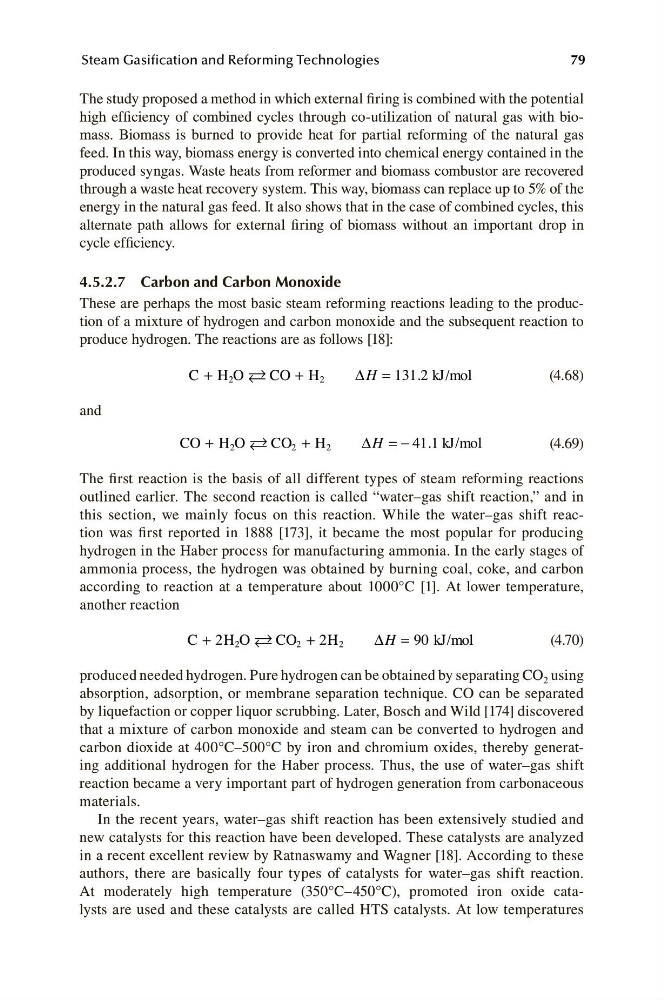
These are perhaps the most basic steam reforming reactions leading to the production of a mixture of hydrogen and carbon monoxide and the subsequent reaction to
produce hydrogen. The reactions are as follows [18]:
C H
+
+
2 O
C
O H 2
∆H = 131.2 kJ/mol
(4.68)
and
CO +
+
H O
2
CO 2
2
H
∆H = − 41.1 kJ/mol
(4.69)
The first reaction is the basis of all different types of steam reforming reactions
outlined earlier. The second reaction is called “water–gas shift reaction,” and in
this section, we mainly focus on this reaction. While the water–gas shift reaction was first reported in 1888 [173], it became the most popular for producing
hydrogen in the Haber process for manufacturing ammonia. In the early stages of
ammonia process, the hydrogen was obtained by burning coal, coke, and carbon
according to reaction at a temperature about 1000°C [1]. At lower temperature,
another reaction
C
H
+
+
2
2
2 O
C
O
H
2
2
∆H = 90 kJ/mol
(4.70)
produced needed hydrogen. Pure hydrogen can be obtained by separating CO 2 using
absorption, adsorption, or membrane separation technique. CO can be separated
by liquefaction or copper liquor scrubbing. Later, Bosch and Wild [174] discovered
that a mixture of carbon monoxide and steam can be converted to hydrogen and
carbon dioxide at 400°C–500°C by iron and chromium oxides, thereby generating additional hydrogen for the Haber process. Thus, the use of water–gas shift
reaction became a very important part of hydrogen generation from carbonaceous
materials.
In the recent years, water–gas shift reaction has been extensively studied and
new catalysts for this reaction have been developed. These catalysts are analyzed
in a recent excellent review by Ratnaswamy and Wagner [18]. According to these
authors, there are basically four types of catalysts for water–gas shift reaction.
At moderately high temperature (350°C–450°C), promoted iron oxide catalysts are used and these catalysts are called HTS catalysts. At low temperatures
Steam Gasification and Reforming Technologies
The study proposed a method in which external firing is combined with the potential
high efficiency of combined cycles through co-utilization of natural gas with biomass. Biomass is burned to provide heat for partial reforming of the natural gas
feed. In this way, biomass energy is converted into chemical energy contained in the
produced syngas. Waste heats from reformer and biomass combustor are recovered
through a waste heat recovery system. This way, biomass can replace up to 5% of the
energy in the natural gas feed. It also shows that in the case of combined cycles, this
alternate path allows for external firing of biomass without an important drop in
cycle efficiency.
4.5.2.7 Carbon and Carbon Monoxide
These are perhaps the most basic steam reforming reactions leading to the production of a mixture of hydrogen and carbon monoxide and the subsequent reaction to
produce hydrogen. The reactions are as follows [18]:
C H
+
+
2 O
C
O H 2
∆H = 131.2 kJ/mol
(4.68)
and
CO +
+
H O
2
CO 2
2
H
∆H = − 41.1 kJ/mol
(4.69)
The first reaction is the basis of all different types of steam reforming reactions
outlined earlier. The second reaction is called “water–gas shift reaction,” and in
this section, we mainly focus on this reaction. While the water–gas shift reaction was first reported in 1888 [173], it became the most popular for producing
hydrogen in the Haber process for manufacturing ammonia. In the early stages of
ammonia process, the hydrogen was obtained by burning coal, coke, and carbon
according to reaction at a temperature about 1000°C [1]. At lower temperature,
another reaction
C
H
+
+
2
2
2 O
C
O
H
2
2
∆H = 90 kJ/mol
(4.70)
produced needed hydrogen. Pure hydrogen can be obtained by separating CO 2 using
absorption, adsorption, or membrane separation technique. CO can be separated
by liquefaction or copper liquor scrubbing. Later, Bosch and Wild [174] discovered
that a mixture of carbon monoxide and steam can be converted to hydrogen and
carbon dioxide at 400°C–500°C by iron and chromium oxides, thereby generating additional hydrogen for the Haber process. Thus, the use of water–gas shift
reaction became a very important part of hydrogen generation from carbonaceous
materials.
In the recent years, water–gas shift reaction has been extensively studied and
new catalysts for this reaction have been developed. These catalysts are analyzed
in a recent excellent review by Ratnaswamy and Wagner [18]. According to these
authors, there are basically four types of catalysts for water–gas shift reaction.
At moderately high temperature (350°C–450°C), promoted iron oxide catalysts are used and these catalysts are called HTS catalysts. At low temperatures