

82
5 Macroscopic Limits
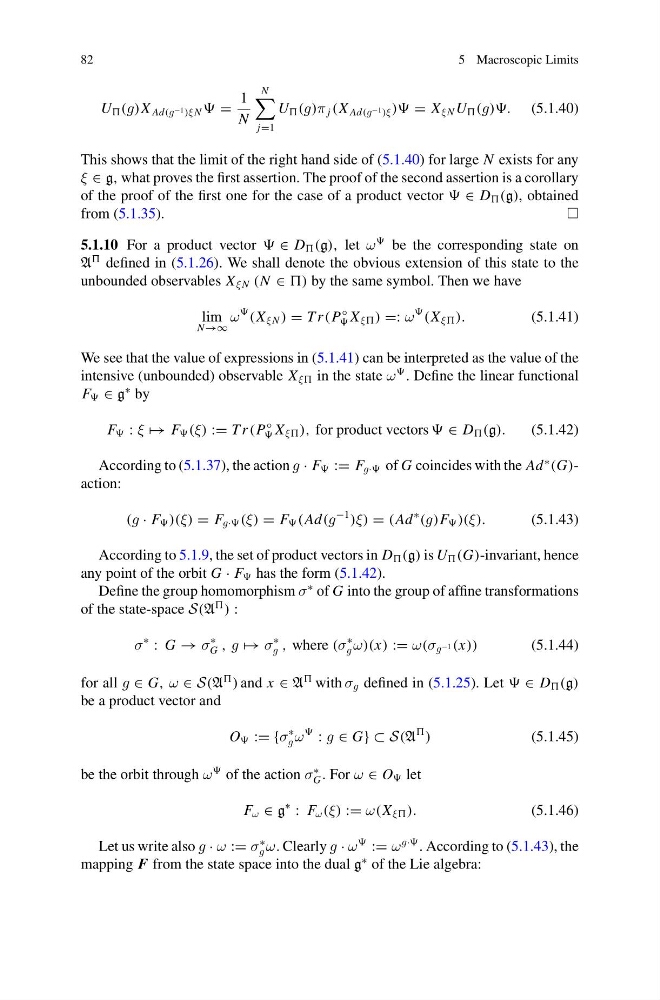
U (g)X Ad(g −1 )ξ N =
1
N
N
j=1
U (g)π j (X Ad(g −1 )ξ )) = X ξ N U (g)). (5.1.40)
This shows that the limit of the right hand side of (5.1.40) for large N exists for any
ξ ∈ g, what proves the first assertion. The proof of the second assertion is a corollary
of the proof of the first one for the case of a product vector ∈ D (g), obtained
from (5.1.35).
5.1.10 For a product vector ∈ D (g), let ω
be the corresponding state on
A
defined in (5.1.26). We shall denote the obvious extension of this state to the
unbounded observables X ξ N (N ∈ ) by the same symbol. Then we have
lim
N →∞
ω
(X ξ N ) = T r(P
◦
X ξ ) =: ω
(X ξ ).
(5.1.41)
We see that the value of expressions in (5.1.41) can be interpreted as the value of the
intensive (unbounded) observable X ξ in the state ω
. Define the linear functional
F ∈ g
∗ by
F : ξ → F (ξ) := T r(P
◦
X ξ ), for product vectors ∈ D (g).
(5.1.42)
According to (5.1.37), the action g · F := F g· of G coincides with the Ad
∗
(G)action:
(g · F )(ξ) = F g· (ξ) = F (Ad(g
−1
)ξ) = (Ad
∗
(g)F )(ξ).
(5.1.43)
According to 5.1.9, the set of product vectors in D (g) is U (G)-invariant, hence
any point of the orbit G · F has the form (5.1.42).
Define the group homomorphism σ
∗ of G into the group of affine transformations
of the state-space S(A
) :
σ
∗
: G → σ
∗
G , g → σ
∗
g , where (σ
∗
g ω)(x) := ω(σ g −1 (x))
(5.1.44)
for all g ∈ G, ω ∈ S(A
) and x ∈ A
with σ g defined in (5.1.25). Let ∈ D (g)
be a product vector and
O := {σ
∗
g ω
: g ∈ G} ⊂ S(A
)
(5.1.45)
be the orbit through ω
of the action σ
∗
G . For ω ∈ O let
F ω ∈ g
∗
: F ω (ξ) := ω(X ξ ).
(5.1.46)
Let us write also g · ω := σ
∗
g ω. Clearly g · ω
:= ω
g· . According to (5.1.43), the
mapping F from the state space into the dual g
∗ of the Lie algebra:
5 Macroscopic Limits
U (g)X Ad(g −1 )ξ N =
1
N
N
j=1
U (g)π j (X Ad(g −1 )ξ )) = X ξ N U (g)). (5.1.40)
This shows that the limit of the right hand side of (5.1.40) for large N exists for any
ξ ∈ g, what proves the first assertion. The proof of the second assertion is a corollary
of the proof of the first one for the case of a product vector ∈ D (g), obtained
from (5.1.35).
5.1.10 For a product vector ∈ D (g), let ω
be the corresponding state on
A
defined in (5.1.26). We shall denote the obvious extension of this state to the
unbounded observables X ξ N (N ∈ ) by the same symbol. Then we have
lim
N →∞
ω
(X ξ N ) = T r(P
◦
X ξ ) =: ω
(X ξ ).
(5.1.41)
We see that the value of expressions in (5.1.41) can be interpreted as the value of the
intensive (unbounded) observable X ξ in the state ω
. Define the linear functional
F ∈ g
∗ by
F : ξ → F (ξ) := T r(P
◦
X ξ ), for product vectors ∈ D (g).
(5.1.42)
According to (5.1.37), the action g · F := F g· of G coincides with the Ad
∗
(G)action:
(g · F )(ξ) = F g· (ξ) = F (Ad(g
−1
)ξ) = (Ad
∗
(g)F )(ξ).
(5.1.43)
According to 5.1.9, the set of product vectors in D (g) is U (G)-invariant, hence
any point of the orbit G · F has the form (5.1.42).
Define the group homomorphism σ
∗ of G into the group of affine transformations
of the state-space S(A
) :
σ
∗
: G → σ
∗
G , g → σ
∗
g , where (σ
∗
g ω)(x) := ω(σ g −1 (x))
(5.1.44)
for all g ∈ G, ω ∈ S(A
) and x ∈ A
with σ g defined in (5.1.25). Let ∈ D (g)
be a product vector and
O := {σ
∗
g ω
: g ∈ G} ⊂ S(A
)
(5.1.45)
be the orbit through ω
of the action σ
∗
G . For ω ∈ O let
F ω ∈ g
∗
: F ω (ξ) := ω(X ξ ).
(5.1.46)
Let us write also g · ω := σ
∗
g ω. Clearly g · ω
:= ω
g· . According to (5.1.43), the
mapping F from the state space into the dual g
∗ of the Lie algebra: