

80
5 Macroscopic Limits
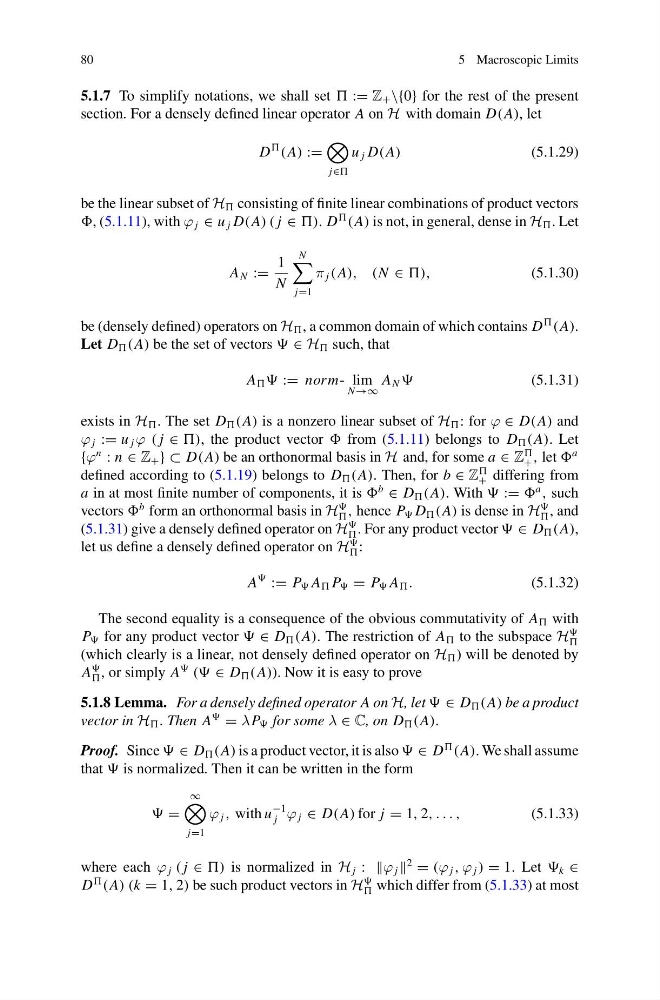
5.1.7 To simplify notations, we shall set := Z + \{0} for the rest of the present
section. For a densely defined linear operator A on H with domain D(A), let
D
(A) :=
j∈
u j D(A)
(5.1.29)
be the linear subset of H consisting of finite linear combinations of product vectors
, (5.1.11), with ϕ j ∈ u j D(A) ( j ∈ ). D
(A) is not, in general, dense in H . Let
A N :=
1
N
N
j=1
π j (A), (N ∈ ),
(5.1.30)
be (densely defined) operators on H , a common domain of which contains D
(A).
Let D (A) be the set of vectors ∈ H such, that
A := norm- lim
N →∞
A N
(5.1.31)
exists in H . The set D (A) is a nonzero linear subset of H : for ϕ ∈ D(A) and
ϕ j := u j ϕ ( j ∈ ), the product vector from (5.1.11) belongs to D (A). Let
{ϕ
n
: n ∈ Z + } ⊂ D(A) be an orthonormal basis in H and, for some a ∈ Z
+ , let
a
defined according to (5.1.19) belongs to D (A). Then, for b ∈ Z
+ differing from
a in at most finite number of components, it is
b
∈ D (A). With :=
a
, such
vectors
b form an orthonormal basis in H
, hence P D (A) is dense in H
, and
(5.1.31) give a densely defined operator on H
. For any product vector ∈ D (A),
let us define a densely defined operator on H
:
A
:= P A P = P A .
(5.1.32)
The second equality is a consequence of the obvious commutativity of A with
P for any product vector ∈ D (A). The restriction of A to the subspace H
(which clearly is a linear, not densely defined operator on H ) will be denoted by
A
, or simply A
( ∈ D (A)). Now it is easy to prove
5.1.8 Lemma. For a densely defined operator A on H, let ∈ D (A) be a product
vector in H . Then A
= λP for some λ ∈ C, on D (A).
Proof. Since ∈ D (A) is a product vector, it is also ∈ D
(A). We shall assume
that is normalized. Then it can be written in the form
=
∞
j=1
ϕ j , with u
−1
j ϕ j ∈ D(A) for j = 1, 2, . . . ,
(5.1.33)
where each ϕ j ( j ∈ ) is normalized in H j : :ϕ j
2
= (ϕ j , ϕ j ) = 1. Let k ∈
D
(A) (k = 1, 2) be such product vectors in H
which differ from (5.1.33) at most
5 Macroscopic Limits
5.1.7 To simplify notations, we shall set := Z + \{0} for the rest of the present
section. For a densely defined linear operator A on H with domain D(A), let
D
(A) :=
j∈
u j D(A)
(5.1.29)
be the linear subset of H consisting of finite linear combinations of product vectors
, (5.1.11), with ϕ j ∈ u j D(A) ( j ∈ ). D
(A) is not, in general, dense in H . Let
A N :=
1
N
N
j=1
π j (A), (N ∈ ),
(5.1.30)
be (densely defined) operators on H , a common domain of which contains D
(A).
Let D (A) be the set of vectors ∈ H such, that
A := norm- lim
N →∞
A N
(5.1.31)
exists in H . The set D (A) is a nonzero linear subset of H : for ϕ ∈ D(A) and
ϕ j := u j ϕ ( j ∈ ), the product vector from (5.1.11) belongs to D (A). Let
{ϕ
n
: n ∈ Z + } ⊂ D(A) be an orthonormal basis in H and, for some a ∈ Z
+ , let
a
defined according to (5.1.19) belongs to D (A). Then, for b ∈ Z
+ differing from
a in at most finite number of components, it is
b
∈ D (A). With :=
a
, such
vectors
b form an orthonormal basis in H
, hence P D (A) is dense in H
, and
(5.1.31) give a densely defined operator on H
. For any product vector ∈ D (A),
let us define a densely defined operator on H
:
A
:= P A P = P A .
(5.1.32)
The second equality is a consequence of the obvious commutativity of A with
P for any product vector ∈ D (A). The restriction of A to the subspace H
(which clearly is a linear, not densely defined operator on H ) will be denoted by
A
, or simply A
( ∈ D (A)). Now it is easy to prove
5.1.8 Lemma. For a densely defined operator A on H, let ∈ D (A) be a product
vector in H . Then A
= λP for some λ ∈ C, on D (A).
Proof. Since ∈ D (A) is a product vector, it is also ∈ D
(A). We shall assume
that is normalized. Then it can be written in the form
=
∞
j=1
ϕ j , with u
−1
j ϕ j ∈ D(A) for j = 1, 2, . . . ,
(5.1.33)
where each ϕ j ( j ∈ ) is normalized in H j : :ϕ j
2
= (ϕ j , ϕ j ) = 1. Let k ∈
D
(A) (k = 1, 2) be such product vectors in H
which differ from (5.1.33) at most