

48
3 Classical Mechanical Projections of QM
and also the corresponding notation for multiple commutators for operators. Then
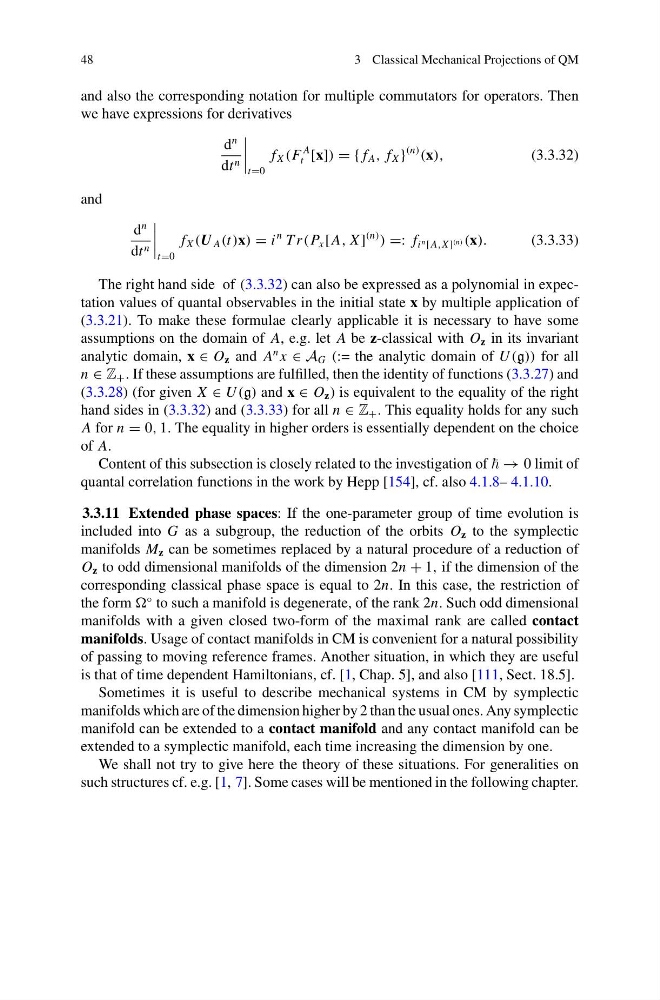
we have expressions for derivatives
d
n
dt n
t=0
f X (F
A
t [x]) = { f A , f X }
(n)
(x),
(3.3.32)
and
d
n
dt n
t=0
f X (U A (t)x) = i
n T r(P x [A, X ]
(n)
) =: f i n [A,X ] (n) (x).
(3.3.33)
The right hand side of (3.3.32) can also be expressed as a polynomial in expectation values of quantal observables in the initial state x by multiple application of
(3.3.21). To make these formulae clearly applicable it is necessary to have some
assumptions on the domain of A, e.g. let A be z-classical with O z in its invariant
analytic domain, x ∈ O z and A
n x ∈ A G (:= the analytic domain of U (g)) for all
n ∈ Z + . If these assumptions are fulfilled, then the identity of functions (3.3.27) and
(3.3.28) (for given X ∈ U (g) and x ∈ O z ) is equivalent to the equality of the right
hand sides in (3.3.32) and (3.3.33) for all n ∈ Z + . This equality holds for any such
A for n = 0, 1. The equality in higher orders is essentially dependent on the choice
of A.
Content of this subsection is closely related to the investigation of → 0 limit of
quantal correlation functions in the work by Hepp [154], cf. also 4.1.8– 4.1.10.
3.3.11 Extended phase spaces: If the one-parameter group of time evolution is
included into G as a subgroup, the reduction of the orbits O z to the symplectic
manifolds M z can be sometimes replaced by a natural procedure of a reduction of
O z to odd dimensional manifolds of the dimension 2n + 1, if the dimension of the
corresponding classical phase space is equal to 2n. In this case, the restriction of
the form
◦ to such a manifold is degenerate, of the rank 2n. Such odd dimensional
manifolds with a given closed two-form of the maximal rank are called contact
manifolds. Usage of contact manifolds in CM is convenient for a natural possibility
of passing to moving reference frames. Another situation, in which they are useful
is that of time dependent Hamiltonians, cf. [1, Chap. 5], and also [111, Sect. 18.5].
Sometimes it is useful to describe mechanical systems in CM by symplectic
manifolds which are of the dimension higher by 2 than the usual ones. Any symplectic
manifold can be extended to a contact manifold and any contact manifold can be
extended to a symplectic manifold, each time increasing the dimension by one.
We shall not try to give here the theory of these situations. For generalities on
such structures cf. e.g. [1, 7]. Some cases will be mentioned in the following chapter.
3 Classical Mechanical Projections of QM
and also the corresponding notation for multiple commutators for operators. Then
we have expressions for derivatives
d
n
dt n
t=0
f X (F
A
t [x]) = { f A , f X }
(n)
(x),
(3.3.32)
and
d
n
dt n
t=0
f X (U A (t)x) = i
n T r(P x [A, X ]
(n)
) =: f i n [A,X ] (n) (x).
(3.3.33)
The right hand side of (3.3.32) can also be expressed as a polynomial in expectation values of quantal observables in the initial state x by multiple application of
(3.3.21). To make these formulae clearly applicable it is necessary to have some
assumptions on the domain of A, e.g. let A be z-classical with O z in its invariant
analytic domain, x ∈ O z and A
n x ∈ A G (:= the analytic domain of U (g)) for all
n ∈ Z + . If these assumptions are fulfilled, then the identity of functions (3.3.27) and
(3.3.28) (for given X ∈ U (g) and x ∈ O z ) is equivalent to the equality of the right
hand sides in (3.3.32) and (3.3.33) for all n ∈ Z + . This equality holds for any such
A for n = 0, 1. The equality in higher orders is essentially dependent on the choice
of A.
Content of this subsection is closely related to the investigation of → 0 limit of
quantal correlation functions in the work by Hepp [154], cf. also 4.1.8– 4.1.10.
3.3.11 Extended phase spaces: If the one-parameter group of time evolution is
included into G as a subgroup, the reduction of the orbits O z to the symplectic
manifolds M z can be sometimes replaced by a natural procedure of a reduction of
O z to odd dimensional manifolds of the dimension 2n + 1, if the dimension of the
corresponding classical phase space is equal to 2n. In this case, the restriction of
the form
◦ to such a manifold is degenerate, of the rank 2n. Such odd dimensional
manifolds with a given closed two-form of the maximal rank are called contact
manifolds. Usage of contact manifolds in CM is convenient for a natural possibility
of passing to moving reference frames. Another situation, in which they are useful
is that of time dependent Hamiltonians, cf. [1, Chap. 5], and also [111, Sect. 18.5].
Sometimes it is useful to describe mechanical systems in CM by symplectic
manifolds which are of the dimension higher by 2 than the usual ones. Any symplectic
manifold can be extended to a contact manifold and any contact manifold can be
extended to a symplectic manifold, each time increasing the dimension by one.
We shall not try to give here the theory of these situations. For generalities on
such structures cf. e.g. [1, 7]. Some cases will be mentioned in the following chapter.