

44
3 Classical Mechanical Projections of QM
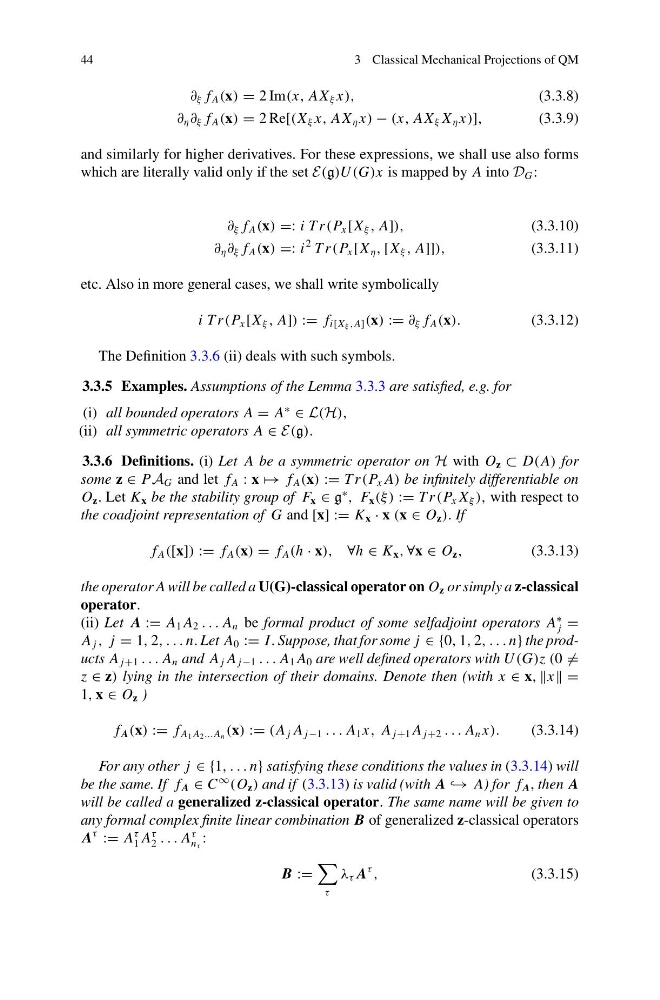
∂ ξ f A (x) = 2 Im(x, AX ξ x),
(3.3.8)
∂ η ∂ ξ f A (x) = 2 Re[(X ξ x, AX η x) − (x, AX ξ X η x)],
(3.3.9)
and similarly for higher derivatives. For these expressions, we shall use also forms
which are literally valid only if the set E(g)U (G)x is mapped by A into D G :
∂ ξ f A (x) =: i T r(P x [X ξ , A]),
(3.3.10)
∂ η ∂ ξ f A (x) =: i
2 T r(P x [X η , [X ξ , A]]),
(3.3.11)
etc. Also in more general cases, we shall write symbolically
i T r(P x [X ξ , A]) := f i[X ξ ,A] (x) := ∂ ξ f A (x).
(3.3.12)
The Definition 3.3.6 (ii) deals with such symbols.
3.3.5 Examples. Assumptions of the Lemma 3.3.3 are satisfied, e.g. for
(i) all bounded operators A = A
∗
∈ L(H),
(ii) all symmetric operators A ∈ E(g).
3.3.6 Definitions. (i) Let A be a symmetric operator on H with O z ⊂ D(A) for
some z ∈ PA G and let f A : x → f A (x) := T r(P x A) be infinitely differentiable on
O z . Let K x be the stability group of F x ∈ g
∗
, F x (ξ ) := T r(P x X ξ ), with respect to
the coadjoint representation of G and [x] := K x · x (x ∈ O z ). If
f A ([x]) := f A (x) = f A (h · x), ∀h ∈ K x , ∀x ∈ O z ,
(3.3.13)
the operator A will be called a U(G)-classical operator on O z or simply a z-classical
operator.
(ii) Let A := A 1 A 2 . . . A n be formal product of some selfadjoint operators A
∗
j =
A j , j = 1, 2, . . . n. Let A 0 := I. Suppose, that for some j ∈ {0, 1, 2, . . . n} the products A j+1 . . . A n and A j A j−1 . . . A 1 A 0 are well defined operators with U (G)z (0 =
z ∈ z) lying in the intersection of their domains. Denote then (with x ∈ x, x =
1, x ∈ O z )
f A (x) := f A 1 A 2 ...A n (x) := (A j A j−1 . . . A 1 x, A j+1 A j+2 . . . A n x).
(3.3.14)
For any other j ∈ {1, . . . n} satisfying these conditions the values in (3.3.14) will
be the same. If f A ∈ C
∞
(O z ) and if (3.3.13) is valid (with A → A) for f A , then A
will be called a generalized z-classical operator. The same name will be given to
any formal complex finite linear combination B of generalized z-classical operators
A
τ
:= A
τ
1 A
τ
2 . . . A
τ
n τ
:
B :=
τ
λ τ A
τ
,
(3.3.15)
3 Classical Mechanical Projections of QM
∂ ξ f A (x) = 2 Im(x, AX ξ x),
(3.3.8)
∂ η ∂ ξ f A (x) = 2 Re[(X ξ x, AX η x) − (x, AX ξ X η x)],
(3.3.9)
and similarly for higher derivatives. For these expressions, we shall use also forms
which are literally valid only if the set E(g)U (G)x is mapped by A into D G :
∂ ξ f A (x) =: i T r(P x [X ξ , A]),
(3.3.10)
∂ η ∂ ξ f A (x) =: i
2 T r(P x [X η , [X ξ , A]]),
(3.3.11)
etc. Also in more general cases, we shall write symbolically
i T r(P x [X ξ , A]) := f i[X ξ ,A] (x) := ∂ ξ f A (x).
(3.3.12)
The Definition 3.3.6 (ii) deals with such symbols.
3.3.5 Examples. Assumptions of the Lemma 3.3.3 are satisfied, e.g. for
(i) all bounded operators A = A
∗
∈ L(H),
(ii) all symmetric operators A ∈ E(g).
3.3.6 Definitions. (i) Let A be a symmetric operator on H with O z ⊂ D(A) for
some z ∈ PA G and let f A : x → f A (x) := T r(P x A) be infinitely differentiable on
O z . Let K x be the stability group of F x ∈ g
∗
, F x (ξ ) := T r(P x X ξ ), with respect to
the coadjoint representation of G and [x] := K x · x (x ∈ O z ). If
f A ([x]) := f A (x) = f A (h · x), ∀h ∈ K x , ∀x ∈ O z ,
(3.3.13)
the operator A will be called a U(G)-classical operator on O z or simply a z-classical
operator.
(ii) Let A := A 1 A 2 . . . A n be formal product of some selfadjoint operators A
∗
j =
A j , j = 1, 2, . . . n. Let A 0 := I. Suppose, that for some j ∈ {0, 1, 2, . . . n} the products A j+1 . . . A n and A j A j−1 . . . A 1 A 0 are well defined operators with U (G)z (0 =
z ∈ z) lying in the intersection of their domains. Denote then (with x ∈ x, x =
1, x ∈ O z )
f A (x) := f A 1 A 2 ...A n (x) := (A j A j−1 . . . A 1 x, A j+1 A j+2 . . . A n x).
(3.3.14)
For any other j ∈ {1, . . . n} satisfying these conditions the values in (3.3.14) will
be the same. If f A ∈ C
∞
(O z ) and if (3.3.13) is valid (with A → A) for f A , then A
will be called a generalized z-classical operator. The same name will be given to
any formal complex finite linear combination B of generalized z-classical operators
A
τ
:= A
τ
1 A
τ
2 . . . A
τ
n τ
:
B :=
τ
λ τ A
τ
,
(3.3.15)