

38
3 Classical Mechanical Projections of QM
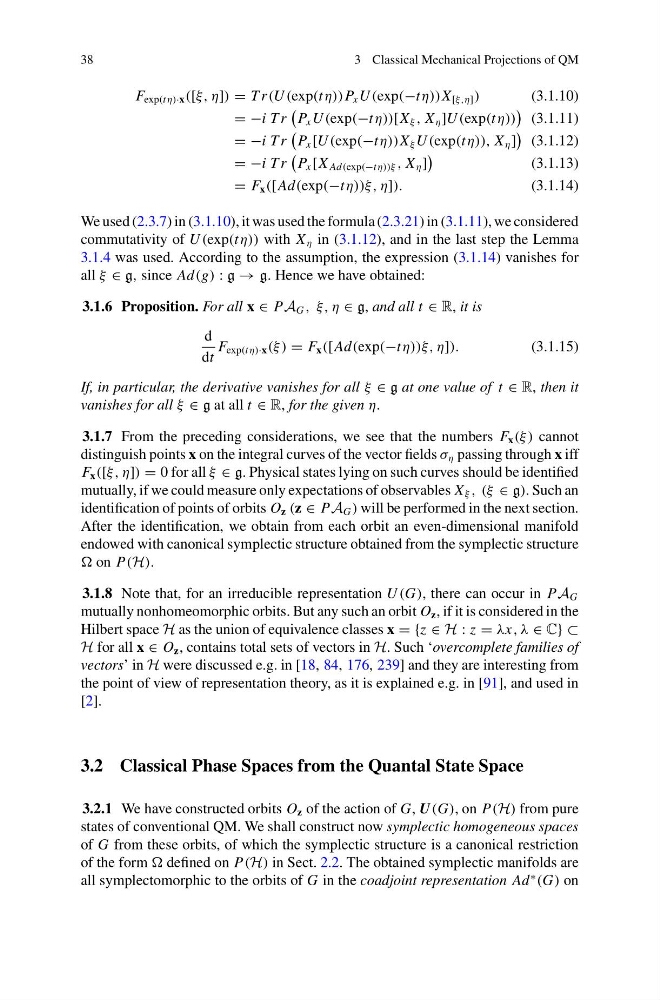
F exp(tη)·x ([ξ, η]) = T r(U (exp(tη))P x U (exp(−tη))X [ξ,η] )
(3.1.10)
= −i T r
P x U (exp(−tη))[X ξ , X η ]U (exp(tη))
(3.1.11)
= −i T r
P x [U (exp(−tη))X ξ U (exp(tη)), X η ]
(3.1.12)
= −i T r
P x [X Ad(exp(−tη))ξ , X η ]
(3.1.13)
= F x ([Ad(exp(−tη))ξ, η]).
(3.1.14)
We used (2.3.7) in (3.1.10), it was used the formula (2.3.21) in (3.1.11), we considered
commutativity of U (exp(tη)) with X η in (3.1.12), and in the last step the Lemma
3.1.4 was used. According to the assumption, the expression (3.1.14) vanishes for
all ξ ∈ g, since Ad(g) : g → g. Hence we have obtained:
3.1.6 Proposition. For all x ∈ PA G , ξ, η ∈ g, and all t ∈ R, it is
d
dt
F exp(tη)·x (ξ ) = F x ([Ad(exp(−tη))ξ, η]).
(3.1.15)
If, in particular, the derivative vanishes for all ξ ∈ g at one value of t ∈ R, then it
vanishes for all ξ ∈ g at all t ∈ R, for the given η.
3.1.7 From the preceding considerations, we see that the numbers F x (ξ ) cannot
distinguish points x on the integral curves of the vector fields σ η passing through x iff
F x ([ξ, η]) = 0 for all ξ ∈ g. Physical states lying on such curves should be identified
mutually, if we could measure only expectations of observables X ξ , (ξ ∈ g). Such an
identification of points of orbits O z (z ∈ PA G ) will be performed in the next section.
After the identification, we obtain from each orbit an even-dimensional manifold
endowed with canonical symplectic structure obtained from the symplectic structure
on P(H).
3.1.8 Note that, for an irreducible representation U (G), there can occur in PA G
mutually nonhomeomorphic orbits. But any such an orbit O z , if it is considered in the
Hilbert space H as the union of equivalence classes x = {z ∈ H : z = λx, λ ∈ C} ⊂
H for all x ∈ O z , contains total sets of vectors in H. Such ‘overcomplete families of
vectors’ in H were discussed e.g. in [18, 84, 176, 239] and they are interesting from
the point of view of representation theory, as it is explained e.g. in [91], and used in
[2].
3.2 Classical Phase Spaces from the Quantal State Space
3.2.1 We have constructed orbits O z of the action of G, U(G), on P(H) from pure
states of conventional QM. We shall construct now symplectic homogeneous spaces
of G from these orbits, of which the symplectic structure is a canonical restriction
of the form defined on P(H) in Sect. 2.2. The obtained symplectic manifolds are
all symplectomorphic to the orbits of G in the coadjoint representation Ad
∗
(G) on
3 Classical Mechanical Projections of QM
F exp(tη)·x ([ξ, η]) = T r(U (exp(tη))P x U (exp(−tη))X [ξ,η] )
(3.1.10)
= −i T r
P x U (exp(−tη))[X ξ , X η ]U (exp(tη))
(3.1.11)
= −i T r
P x [U (exp(−tη))X ξ U (exp(tη)), X η ]
(3.1.12)
= −i T r
P x [X Ad(exp(−tη))ξ , X η ]
(3.1.13)
= F x ([Ad(exp(−tη))ξ, η]).
(3.1.14)
We used (2.3.7) in (3.1.10), it was used the formula (2.3.21) in (3.1.11), we considered
commutativity of U (exp(tη)) with X η in (3.1.12), and in the last step the Lemma
3.1.4 was used. According to the assumption, the expression (3.1.14) vanishes for
all ξ ∈ g, since Ad(g) : g → g. Hence we have obtained:
3.1.6 Proposition. For all x ∈ PA G , ξ, η ∈ g, and all t ∈ R, it is
d
dt
F exp(tη)·x (ξ ) = F x ([Ad(exp(−tη))ξ, η]).
(3.1.15)
If, in particular, the derivative vanishes for all ξ ∈ g at one value of t ∈ R, then it
vanishes for all ξ ∈ g at all t ∈ R, for the given η.
3.1.7 From the preceding considerations, we see that the numbers F x (ξ ) cannot
distinguish points x on the integral curves of the vector fields σ η passing through x iff
F x ([ξ, η]) = 0 for all ξ ∈ g. Physical states lying on such curves should be identified
mutually, if we could measure only expectations of observables X ξ , (ξ ∈ g). Such an
identification of points of orbits O z (z ∈ PA G ) will be performed in the next section.
After the identification, we obtain from each orbit an even-dimensional manifold
endowed with canonical symplectic structure obtained from the symplectic structure
on P(H).
3.1.8 Note that, for an irreducible representation U (G), there can occur in PA G
mutually nonhomeomorphic orbits. But any such an orbit O z , if it is considered in the
Hilbert space H as the union of equivalence classes x = {z ∈ H : z = λx, λ ∈ C} ⊂
H for all x ∈ O z , contains total sets of vectors in H. Such ‘overcomplete families of
vectors’ in H were discussed e.g. in [18, 84, 176, 239] and they are interesting from
the point of view of representation theory, as it is explained e.g. in [91], and used in
[2].
3.2 Classical Phase Spaces from the Quantal State Space
3.2.1 We have constructed orbits O z of the action of G, U(G), on P(H) from pure
states of conventional QM. We shall construct now symplectic homogeneous spaces
of G from these orbits, of which the symplectic structure is a canonical restriction
of the form defined on P(H) in Sect. 2.2. The obtained symplectic manifolds are
all symplectomorphic to the orbits of G in the coadjoint representation Ad
∗
(G) on