

26
2 Geometry of the State Space of Quantum Mechanics
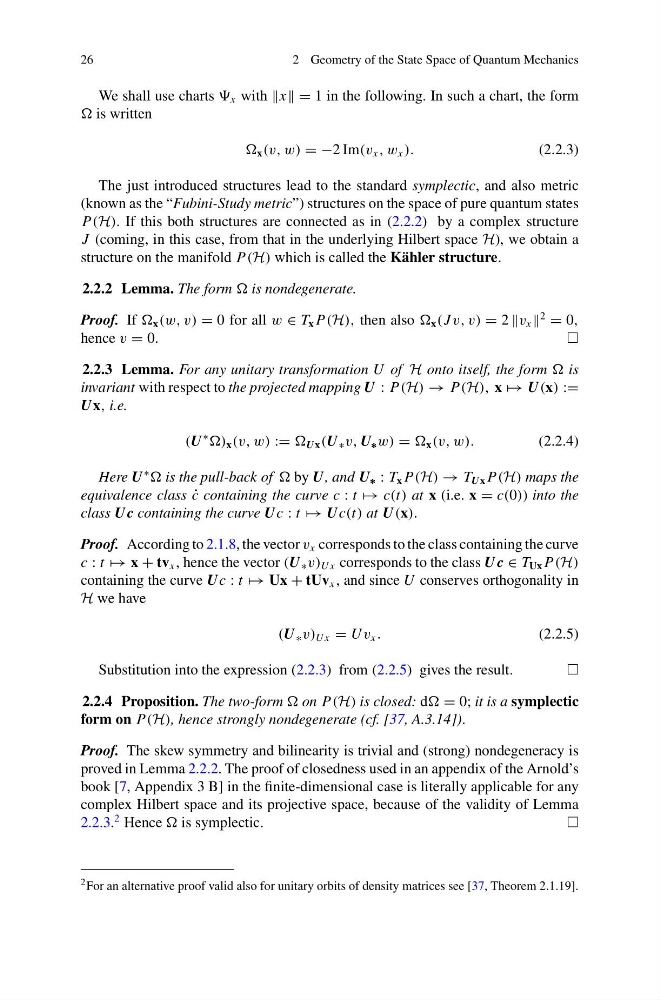
We shall use charts x with x = 1 in the following. In such a chart, the form
is written
x (v, w) = −2 Im(v x , w x ).
(2.2.3)
The just introduced structures lead to the standard symplectic, and also metric
(known as the “Fubini-Study metric”) structures on the space of pure quantum states
P(H). If this both structures are connected as in (2.2.2) by a complex structure
J (coming, in this case, from that in the underlying Hilbert space H), we obtain a
structure on the manifold P(H) which is called the Kähler structure.
2.2.2 Lemma. The form is nondegenerate.
Proof. If x (w, v) = 0 for all w ∈ T x P(H), then also x (J v, v) = 2 v x
2
= 0,
hence v = 0.
2.2.3 Lemma. For any unitary transformation U of H onto itself, the form is
invariant with respect to the projected mapping U : P(H) → P(H), x → U(x) :=
Ux, i.e.
(U
∗
) x (v, w) := Ux (U ∗ v, U ∗ w) = x (v, w).
(2.2.4)
Here U
∗
is the pull-back of by U, and U ∗ : T x P(H) → T Ux P(H) maps the
equivalence class ˙
c containing the curve c : t → c(t) at x (i.e. x = c(0)) into the
class U c containing the curve Uc : t → Uc(t) at U(x).
Proof. According to 2.1.8, the vector v x corresponds to the class containing the curve
c : t → x + tv x , hence the vector (U ∗ v) U x corresponds to the class U c ∈ T Ux P(H)
containing the curve Uc : t → Ux + tUv x , and since U conserves orthogonality in
H we have
(U ∗ v) U x = U v x .
(2.2.5)
Substitution into the expression (2.2.3) from (2.2.5) gives the result.
2.2.4 Proposition. The two-form on P(H) is closed: d = 0; it is a symplectic
form on P(H), hence strongly nondegenerate (cf. [37, A.3.14]).
Proof. The skew symmetry and bilinearity is trivial and (strong) nondegeneracy is
proved in Lemma 2.2.2. The proof of closedness used in an appendix of the Arnold’s
book [7, Appendix 3 B] in the finite-dimensional case is literally applicable for any
complex Hilbert space and its projective space, because of the validity of Lemma
2.2.3.
2 Hence is symplectic.
2 For an alternative proof valid also for unitary orbits of density matrices see [37, Theorem 2.1.19].
2 Geometry of the State Space of Quantum Mechanics
We shall use charts x with x = 1 in the following. In such a chart, the form
is written
x (v, w) = −2 Im(v x , w x ).
(2.2.3)
The just introduced structures lead to the standard symplectic, and also metric
(known as the “Fubini-Study metric”) structures on the space of pure quantum states
P(H). If this both structures are connected as in (2.2.2) by a complex structure
J (coming, in this case, from that in the underlying Hilbert space H), we obtain a
structure on the manifold P(H) which is called the Kähler structure.
2.2.2 Lemma. The form is nondegenerate.
Proof. If x (w, v) = 0 for all w ∈ T x P(H), then also x (J v, v) = 2 v x
2
= 0,
hence v = 0.
2.2.3 Lemma. For any unitary transformation U of H onto itself, the form is
invariant with respect to the projected mapping U : P(H) → P(H), x → U(x) :=
Ux, i.e.
(U
∗
) x (v, w) := Ux (U ∗ v, U ∗ w) = x (v, w).
(2.2.4)
Here U
∗
is the pull-back of by U, and U ∗ : T x P(H) → T Ux P(H) maps the
equivalence class ˙
c containing the curve c : t → c(t) at x (i.e. x = c(0)) into the
class U c containing the curve Uc : t → Uc(t) at U(x).
Proof. According to 2.1.8, the vector v x corresponds to the class containing the curve
c : t → x + tv x , hence the vector (U ∗ v) U x corresponds to the class U c ∈ T Ux P(H)
containing the curve Uc : t → Ux + tUv x , and since U conserves orthogonality in
H we have
(U ∗ v) U x = U v x .
(2.2.5)
Substitution into the expression (2.2.3) from (2.2.5) gives the result.
2.2.4 Proposition. The two-form on P(H) is closed: d = 0; it is a symplectic
form on P(H), hence strongly nondegenerate (cf. [37, A.3.14]).
Proof. The skew symmetry and bilinearity is trivial and (strong) nondegeneracy is
proved in Lemma 2.2.2. The proof of closedness used in an appendix of the Arnold’s
book [7, Appendix 3 B] in the finite-dimensional case is literally applicable for any
complex Hilbert space and its projective space, because of the validity of Lemma
2.2.3.
2 Hence is symplectic.
2 For an alternative proof valid also for unitary orbits of density matrices see [37, Theorem 2.1.19].