

22
2 Geometry of the State Space of Quantum Mechanics
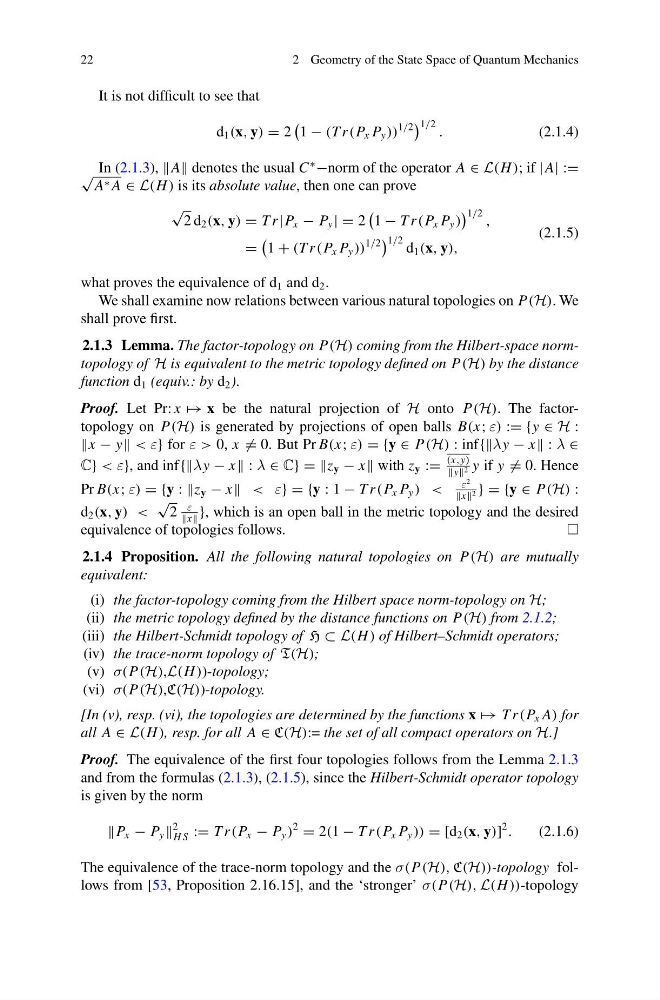
It is not difficult to see that
d 1 (x, y) = 2
1 − (T r(P x P y ))
1/2
1/2 .
(2.1.4)
In (2.1.3), A denotes the usual C
∗
−norm of the operator A ∈ L(H ); if |A| :=
√
A ∗ A ∈ L(H ) is its absolute value, then one can prove
√
2 d 2 (x, y) = T r|P x − P y | = 2
1 − T r(P x P y )
1/2 ,
=
1 + (T r(P x P y ))
1/2
1/2 d 1 (x, y),
(2.1.5)
what proves the equivalence of d 1 and d 2 .
We shall examine now relations between various natural topologies on P(H). We
shall prove first.
2.1.3 Lemma. The factor-topology on P(H) coming from the Hilbert-space normtopology of H is equivalent to the metric topology defined on P(H) by the distance
function d 1 (equiv.: by d 2 ).
Proof. Let Pr: x → x be the natural projection of H onto P(H). The factortopology on P(H) is generated by projections of open balls B(x; ε) := {y ∈ H :
x − y < ε} for ε > 0, x = 0. But Pr B(x; ε) = {y ∈ P(H) : inf{{λy − x : λ ∈
C} < ε}, and inf{{λy − x : λ ∈ C} = =z y − x with z y :=
(x,y)
y 2 y if y = 0. Hence
Pr B(x; ε) = {y : :z y − x < ε} = {y : 1 − T r(P x P y ) <
ε
2
x 2 } = {y ∈ P(H) :
d 2 (x, y) <
√
2
ε
x
}, which is an open ball in the metric topology and the desired
equivalence of topologies follows.
2.1.4 Proposition. All the following natural topologies on P(H) are mutually
equivalent:
(i) the factor-topology coming from the Hilbert space norm-topology on H;
(ii) the metric topology defined by the distance functions on P(H) from 2.1.2;
(iii) the Hilbert-Schmidt topology of H ⊂ L(H ) of Hilbert–Schmidt operators;
(iv) the trace-norm topology of T(H);
(v) σ(P(H),L(H ))-topology;
(vi) σ(P(H),C(H))-topology.
[In (v), resp. (vi), the topologies are determined by the functions x → T r(P x A) for
all A ∈ L(H ), resp. for all A ∈ C(H):= the set of all compact operators on H.]
Proof. The equivalence of the first four topologies follows from the Lemma 2.1.3
and from the formulas (2.1.3), (2.1.5), since the Hilbert-Schmidt operator topology
is given by the norm
P x − P y
2
H S := T r(P x − P y )
2
= 2(1 − T r(P x P y )) = [d 2 (x, y)]
2
.
(2.1.6)
The equivalence of the trace-norm topology and the σ(P(H), C(H))-topology follows from [53, Proposition 2.16.15], and the ‘stronger’ σ(P(H), L(H ))-topology
2 Geometry of the State Space of Quantum Mechanics
It is not difficult to see that
d 1 (x, y) = 2
1 − (T r(P x P y ))
1/2
1/2 .
(2.1.4)
In (2.1.3), A denotes the usual C
∗
−norm of the operator A ∈ L(H ); if |A| :=
√
A ∗ A ∈ L(H ) is its absolute value, then one can prove
√
2 d 2 (x, y) = T r|P x − P y | = 2
1 − T r(P x P y )
1/2 ,
=
1 + (T r(P x P y ))
1/2
1/2 d 1 (x, y),
(2.1.5)
what proves the equivalence of d 1 and d 2 .
We shall examine now relations between various natural topologies on P(H). We
shall prove first.
2.1.3 Lemma. The factor-topology on P(H) coming from the Hilbert-space normtopology of H is equivalent to the metric topology defined on P(H) by the distance
function d 1 (equiv.: by d 2 ).
Proof. Let Pr: x → x be the natural projection of H onto P(H). The factortopology on P(H) is generated by projections of open balls B(x; ε) := {y ∈ H :
x − y < ε} for ε > 0, x = 0. But Pr B(x; ε) = {y ∈ P(H) : inf{{λy − x : λ ∈
C} < ε}, and inf{{λy − x : λ ∈ C} = =z y − x with z y :=
(x,y)
y 2 y if y = 0. Hence
Pr B(x; ε) = {y : :z y − x < ε} = {y : 1 − T r(P x P y ) <
ε
2
x 2 } = {y ∈ P(H) :
d 2 (x, y) <
√
2
ε
x
}, which is an open ball in the metric topology and the desired
equivalence of topologies follows.
2.1.4 Proposition. All the following natural topologies on P(H) are mutually
equivalent:
(i) the factor-topology coming from the Hilbert space norm-topology on H;
(ii) the metric topology defined by the distance functions on P(H) from 2.1.2;
(iii) the Hilbert-Schmidt topology of H ⊂ L(H ) of Hilbert–Schmidt operators;
(iv) the trace-norm topology of T(H);
(v) σ(P(H),L(H ))-topology;
(vi) σ(P(H),C(H))-topology.
[In (v), resp. (vi), the topologies are determined by the functions x → T r(P x A) for
all A ∈ L(H ), resp. for all A ∈ C(H):= the set of all compact operators on H.]
Proof. The equivalence of the first four topologies follows from the Lemma 2.1.3
and from the formulas (2.1.3), (2.1.5), since the Hilbert-Schmidt operator topology
is given by the norm
P x − P y
2
H S := T r(P x − P y )
2
= 2(1 − T r(P x P y )) = [d 2 (x, y)]
2
.
(2.1.6)
The equivalence of the trace-norm topology and the σ(P(H), C(H))-topology follows from [53, Proposition 2.16.15], and the ‘stronger’ σ(P(H), L(H ))-topology