

18
1 Introduction
A: ω ∈ ES(A) ⇔ {ω =
1
2
ω 1 +
1
2
ω 2 (ω 1,2 ∈ S(A)) ⇒ ω 1 = ω 2 = ω}. Although the
decomposition of a general ω ∈ S(A) into its extremal components (∈ ES(A)) is not
unique if A is noncommutative, there are other physically relevant convex compact
subsets of S(A) (Choquet simplexes) allowing unique extremal decompositions of
their elements into extremal components of these simplexes, cf. [73, 218] for basic
mathematics, or also [53, Ch.4], [235, Ch.4], [274, Ch.3] for broader contexts.
1.4.4 The expectation value of a bounded observable x = x
∗
∈ A in the state ω ∈
S(A) (in accordance with comments in 1.2.4) is expressed by the value ω(x) of
the functional ω on the element x. For calculations of probability distributions
of values of x = x
∗
∈ A in the states ω ∈ S(A) it is used, however, the spectral
decomposition of x. If A is a general C
∗ -algebra, its selfadjoint elements need not
have their spectral resolutions in A. The spectral resolutions in A exist, however,
if A is a W
∗ -algebra, [274]: x = x
∗
∈ A ⇒ x =
R λ E x (d λ), E x (B)
∗
= E x (B) =
E x (B)
2
∈ A, B ⊂ R Borel, . . . , hence E x is the projector valued spectral measure
in the W
∗ -algebra A. Any C
∗ -algebra is naturally embedded into a W
∗ -algebra -
the bidual A
∗∗ of A, and any state ω ∈ S(A) can be uniquely extended to a state
(equally denoted) ω ∈ S ∗ (A
∗∗
). For any state ω ∈ S(A), we can construct by the
GNS-algorithm corresponding cyclic representation π ω of A in a Hilbert space H ω
with a cyclic vector, ω (i.e. the norm-closure π ω (A)) ω = H ω ), cf. [53, 223, 274],
or also [37, Textbook], characterized (up to the unitary equivalence) by
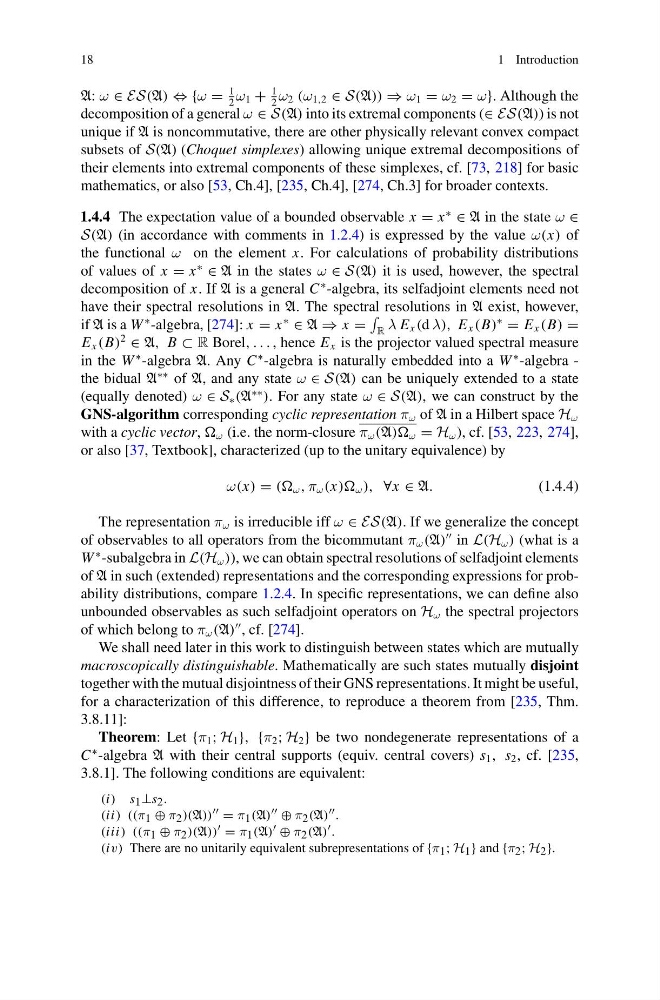
ω(x) = (( ω , π ω (x)) ω ), ∀x ∈ A.
(1.4.4)
The representation π ω is irreducible iff ω ∈ ES(A). If we generalize the concept
of observables to all operators from the bicommutant π ω (A)
in L(H ω ) (what is a
W
∗ -subalgebra in L(H ω )), we can obtain spectral resolutions of selfadjoint elements
of A in such (extended) representations and the corresponding expressions for probability distributions, compare 1.2.4. In specific representations, we can define also
unbounded observables as such selfadjoint operators on H ω the spectral projectors
of which belong to π ω (A)
, cf. [274].
We shall need later in this work to distinguish between states which are mutually
macroscopically distinguishable. Mathematically are such states mutually disjoint
together with the mutual disjointness of their GNS representations. It might be useful,
for a characterization of this difference, to reproduce a theorem from [235, Thm.
3.8.11]:
Theorem: Let {π 1 ; H 1 }, {π 2 ; H 2 } be two nondegenerate representations of a
C
∗ -algebra A with their central supports (equiv. central covers) s 1 , s 2 , cf. [235,
3.8.1]. The following conditions are equivalent:
(i) s 1 ⊥s 2 .
(ii) ((π 1 ⊕ π 2 )(A)) = π 1 (A) ⊕ π 2 (A) .
(iii) ((π 1 ⊕ π 2 )(A)) = π 1 (A) ⊕ π 2 (A) .
(iv) There are no unitarily equivalent subrepresentations of {π 1 ; H 1 } and {π 2 ; H 2 }.
1 Introduction
A: ω ∈ ES(A) ⇔ {ω =
1
2
ω 1 +
1
2
ω 2 (ω 1,2 ∈ S(A)) ⇒ ω 1 = ω 2 = ω}. Although the
decomposition of a general ω ∈ S(A) into its extremal components (∈ ES(A)) is not
unique if A is noncommutative, there are other physically relevant convex compact
subsets of S(A) (Choquet simplexes) allowing unique extremal decompositions of
their elements into extremal components of these simplexes, cf. [73, 218] for basic
mathematics, or also [53, Ch.4], [235, Ch.4], [274, Ch.3] for broader contexts.
1.4.4 The expectation value of a bounded observable x = x
∗
∈ A in the state ω ∈
S(A) (in accordance with comments in 1.2.4) is expressed by the value ω(x) of
the functional ω on the element x. For calculations of probability distributions
of values of x = x
∗
∈ A in the states ω ∈ S(A) it is used, however, the spectral
decomposition of x. If A is a general C
∗ -algebra, its selfadjoint elements need not
have their spectral resolutions in A. The spectral resolutions in A exist, however,
if A is a W
∗ -algebra, [274]: x = x
∗
∈ A ⇒ x =
R λ E x (d λ), E x (B)
∗
= E x (B) =
E x (B)
2
∈ A, B ⊂ R Borel, . . . , hence E x is the projector valued spectral measure
in the W
∗ -algebra A. Any C
∗ -algebra is naturally embedded into a W
∗ -algebra -
the bidual A
∗∗ of A, and any state ω ∈ S(A) can be uniquely extended to a state
(equally denoted) ω ∈ S ∗ (A
∗∗
). For any state ω ∈ S(A), we can construct by the
GNS-algorithm corresponding cyclic representation π ω of A in a Hilbert space H ω
with a cyclic vector, ω (i.e. the norm-closure π ω (A)) ω = H ω ), cf. [53, 223, 274],
or also [37, Textbook], characterized (up to the unitary equivalence) by
ω(x) = (( ω , π ω (x)) ω ), ∀x ∈ A.
(1.4.4)
The representation π ω is irreducible iff ω ∈ ES(A). If we generalize the concept
of observables to all operators from the bicommutant π ω (A)
in L(H ω ) (what is a
W
∗ -subalgebra in L(H ω )), we can obtain spectral resolutions of selfadjoint elements
of A in such (extended) representations and the corresponding expressions for probability distributions, compare 1.2.4. In specific representations, we can define also
unbounded observables as such selfadjoint operators on H ω the spectral projectors
of which belong to π ω (A)
, cf. [274].
We shall need later in this work to distinguish between states which are mutually
macroscopically distinguishable. Mathematically are such states mutually disjoint
together with the mutual disjointness of their GNS representations. It might be useful,
for a characterization of this difference, to reproduce a theorem from [235, Thm.
3.8.11]:
Theorem: Let {π 1 ; H 1 }, {π 2 ; H 2 } be two nondegenerate representations of a
C
∗ -algebra A with their central supports (equiv. central covers) s 1 , s 2 , cf. [235,
3.8.1]. The following conditions are equivalent:
(i) s 1 ⊥s 2 .
(ii) ((π 1 ⊕ π 2 )(A)) = π 1 (A) ⊕ π 2 (A) .
(iii) ((π 1 ⊕ π 2 )(A)) = π 1 (A) ⊕ π 2 (A) .
(iv) There are no unitarily equivalent subrepresentations of {π 1 ; H 1 } and {π 2 ; H 2 }.