

1.3 Classical Hamiltonian Mechanics
13
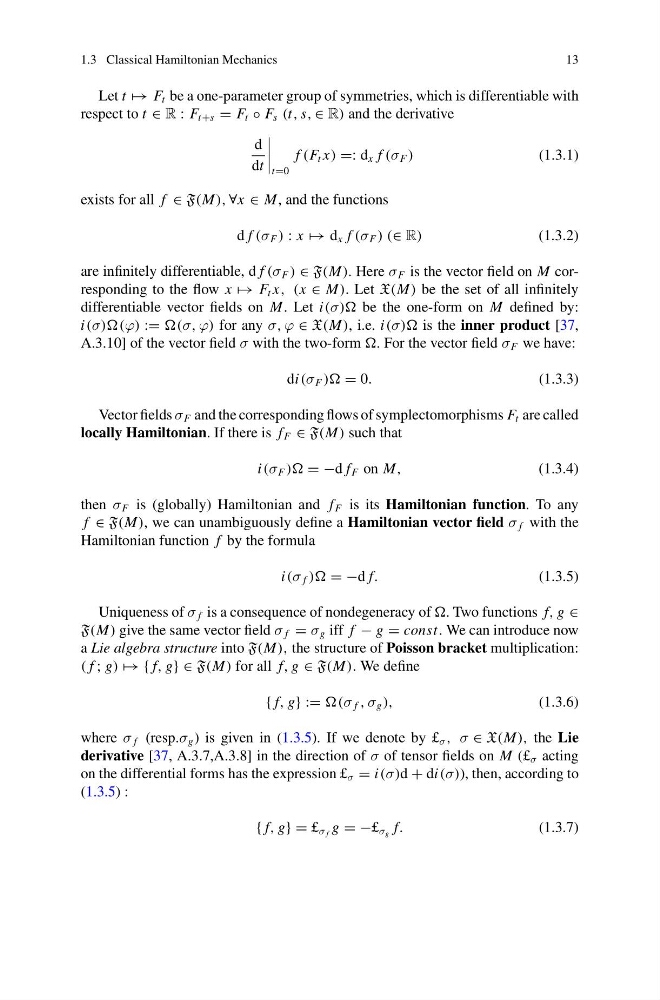
Let t → F t be a one-parameter group of symmetries, which is differentiable with
respect to t ∈ R : F t+s = F t ◦ F s (t, s, ∈ R) and the derivative
d
dt
t=0
f (F t x) =: d x f (σ F )
(1.3.1)
exists for all f ∈ F(M), ∀x ∈ M, and the functions
d f (σ F ) : x → d x f (σ F ) (∈ R)
(1.3.2)
are infinitely differentiable, d f (σ F ) ∈ F(M). Here σ F is the vector field on M corresponding to the flow x → F t x, (x ∈ M). Let X(M) be the set of all infinitely
differentiable vector fields on M. Let i(σ)) be the one-form on M defined by:
i(σ))(ϕ) := (σ, ϕ) for any σ, ϕ ∈ X(M), i.e. i(σ)) is the inner product [37,
A.3.10] of the vector field σ with the two-form . For the vector field σ F we have:
di(σ F )) = 0.
(1.3.3)
Vector fields σ F and the corresponding flows of symplectomorphisms F t are called
locally Hamiltonian. If there is f F ∈ F(M) such that
i(σ F )) = −d f F on M,
(1.3.4)
then σ F is (globally) Hamiltonian and f F is its Hamiltonian function. To any
f ∈ F(M), we can unambiguously define a Hamiltonian vector field σ f with the
Hamiltonian function f by the formula
i(σ f )) = −d f.
(1.3.5)
Uniqueness of σ f is a consequence of nondegeneracy of . Two functions f, g ∈
F(M) give the same vector field σ f = σ g iff f − g = const. We can introduce now
a Lie algebra structure into F(M), the structure of Poisson bracket multiplication:
( f ; g) → { f, g} ∈ F(M) for all f, g ∈ F(M). We define
{ f, g} := (σ f , σ g ),
(1.3.6)
where σ f (resp.σ g ) is given in (1.3.5). If we denote by £ σ , σ ∈ X(M), the Lie
derivative [37, A.3.7,A.3.8] in the direction of σ of tensor fields on M (£ σ acting
on the differential forms has the expression £ σ = i(σ)d + di(σ)), then, according to
(1.3.5) :
{ f, g} = £ σ f g = −£ σ g f.
(1.3.7)
13
Let t → F t be a one-parameter group of symmetries, which is differentiable with
respect to t ∈ R : F t+s = F t ◦ F s (t, s, ∈ R) and the derivative
d
dt
t=0
f (F t x) =: d x f (σ F )
(1.3.1)
exists for all f ∈ F(M), ∀x ∈ M, and the functions
d f (σ F ) : x → d x f (σ F ) (∈ R)
(1.3.2)
are infinitely differentiable, d f (σ F ) ∈ F(M). Here σ F is the vector field on M corresponding to the flow x → F t x, (x ∈ M). Let X(M) be the set of all infinitely
differentiable vector fields on M. Let i(σ)) be the one-form on M defined by:
i(σ))(ϕ) := (σ, ϕ) for any σ, ϕ ∈ X(M), i.e. i(σ)) is the inner product [37,
A.3.10] of the vector field σ with the two-form . For the vector field σ F we have:
di(σ F )) = 0.
(1.3.3)
Vector fields σ F and the corresponding flows of symplectomorphisms F t are called
locally Hamiltonian. If there is f F ∈ F(M) such that
i(σ F )) = −d f F on M,
(1.3.4)
then σ F is (globally) Hamiltonian and f F is its Hamiltonian function. To any
f ∈ F(M), we can unambiguously define a Hamiltonian vector field σ f with the
Hamiltonian function f by the formula
i(σ f )) = −d f.
(1.3.5)
Uniqueness of σ f is a consequence of nondegeneracy of . Two functions f, g ∈
F(M) give the same vector field σ f = σ g iff f − g = const. We can introduce now
a Lie algebra structure into F(M), the structure of Poisson bracket multiplication:
( f ; g) → { f, g} ∈ F(M) for all f, g ∈ F(M). We define
{ f, g} := (σ f , σ g ),
(1.3.6)
where σ f (resp.σ g ) is given in (1.3.5). If we denote by £ σ , σ ∈ X(M), the Lie
derivative [37, A.3.7,A.3.8] in the direction of σ of tensor fields on M (£ σ acting
on the differential forms has the expression £ σ = i(σ)d + di(σ)), then, according to
(1.3.5) :
{ f, g} = £ σ f g = −£ σ g f.
(1.3.7)