

7.6 Radiating Finite Spin Chain
207
ε 0 > 2 + ab
2
+ 2v
2
∞
ab 2
ρ μ (λ)
λ − ab 2 dλ,
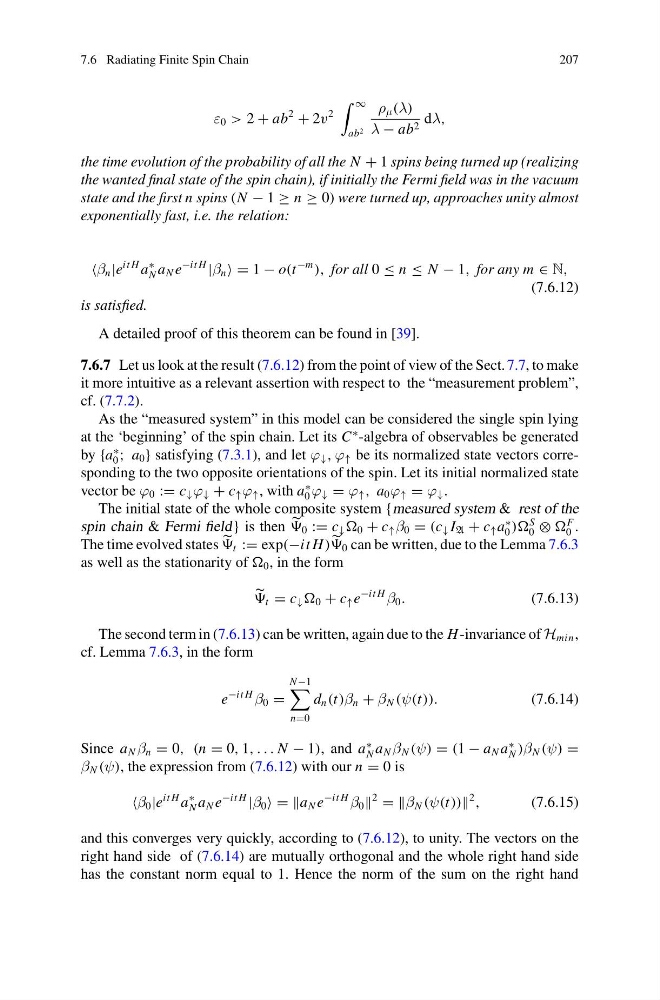
the time evolution of the probability of all the N + 1 spins being turned up (realizing
the wanted final state of the spin chain), if initially the Fermi field was in the vacuum
state and the first n spins (N − 1 ≥ n ≥ 0) were turned up, approaches unity almost
exponentially fast, i.e. the relation:
β n |e
it H a
∗
N a N e
−it H
|β n = 1 − o(t
−m
), for all 0 ≤ n ≤ N − 1, for any m ∈ N,
(7.6.12)
is satisfied.
A detailed proof of this theorem can be found in [39].
7.6.7 Let us look at the result (7.6.12) from the point of view of the Sect. 7.7, to make
it more intuitive as a relevant assertion with respect to the “measurement problem”,
cf. (7.7.2).
As the “measured system” in this model can be considered the single spin lying
at the ‘beginning’ of the spin chain. Let its C
∗ -algebra of observables be generated
by {a
∗
0 ; a 0 } satisfying (7.3.1), and let ϕ ↓ , ϕ ↑ be its normalized state vectors corresponding to the two opposite orientations of the spin. Let its initial normalized state
vector be ϕ 0 := c ↓ ϕ ↓ + c ↑ ϕ ↑ , with a
∗
0 ϕ ↓ = ϕ ↑ , a 0 ϕ ↑ = ϕ ↓ .
The initial state of the whole composite system {measured system & rest of the
spin chain & Fermi field} is then
0 := c ↓ 0 + c ↑ β 0 = (c ↓ I A + c ↑ a
∗
0 ))
S
0 ⊗
F
0 .
The time evolved states
t := exp(−it H)
0 can be written, due to the Lemma 7.6.3
as well as the stationarity of 0 , in the form
t = c ↓ 0 + c ↑ e
−it H
β 0 .
(7.6.13)
The second term in (7.6.13) can be written, again due to the H -invariance of H min ,
cf. Lemma 7.6.3, in the form
e
−it H
β 0 =
N −1
n=0
d n (t)β n + β N (ψ(t)).
(7.6.14)
Since a N β n = 0, (n = 0, 1, . . . N − 1), and a
∗
N a N β N (ψ) = (1 − a N a
∗
N )β N (ψ) =
β N (ψ), the expression from (7.6.12) with our n = 0 is
β 0 |e
it H a
∗
N a N e
−it H
|β 0 = =a N e
−it H
β 0
2
= =β N (ψ(t))
2
,
(7.6.15)
and this converges very quickly, according to (7.6.12), to unity. The vectors on the
right hand side of (7.6.14) are mutually orthogonal and the whole right hand side
has the constant norm equal to 1. Hence the norm of the sum on the right hand
207
ε 0 > 2 + ab
2
+ 2v
2
∞
ab 2
ρ μ (λ)
λ − ab 2 dλ,
the time evolution of the probability of all the N + 1 spins being turned up (realizing
the wanted final state of the spin chain), if initially the Fermi field was in the vacuum
state and the first n spins (N − 1 ≥ n ≥ 0) were turned up, approaches unity almost
exponentially fast, i.e. the relation:
β n |e
it H a
∗
N a N e
−it H
|β n = 1 − o(t
−m
), for all 0 ≤ n ≤ N − 1, for any m ∈ N,
(7.6.12)
is satisfied.
A detailed proof of this theorem can be found in [39].
7.6.7 Let us look at the result (7.6.12) from the point of view of the Sect. 7.7, to make
it more intuitive as a relevant assertion with respect to the “measurement problem”,
cf. (7.7.2).
As the “measured system” in this model can be considered the single spin lying
at the ‘beginning’ of the spin chain. Let its C
∗ -algebra of observables be generated
by {a
∗
0 ; a 0 } satisfying (7.3.1), and let ϕ ↓ , ϕ ↑ be its normalized state vectors corresponding to the two opposite orientations of the spin. Let its initial normalized state
vector be ϕ 0 := c ↓ ϕ ↓ + c ↑ ϕ ↑ , with a
∗
0 ϕ ↓ = ϕ ↑ , a 0 ϕ ↑ = ϕ ↓ .
The initial state of the whole composite system {measured system & rest of the
spin chain & Fermi field} is then
0 := c ↓ 0 + c ↑ β 0 = (c ↓ I A + c ↑ a
∗
0 ))
S
0 ⊗
F
0 .
The time evolved states
t := exp(−it H)
0 can be written, due to the Lemma 7.6.3
as well as the stationarity of 0 , in the form
t = c ↓ 0 + c ↑ e
−it H
β 0 .
(7.6.13)
The second term in (7.6.13) can be written, again due to the H -invariance of H min ,
cf. Lemma 7.6.3, in the form
e
−it H
β 0 =
N −1
n=0
d n (t)β n + β N (ψ(t)).
(7.6.14)
Since a N β n = 0, (n = 0, 1, . . . N − 1), and a
∗
N a N β N (ψ) = (1 − a N a
∗
N )β N (ψ) =
β N (ψ), the expression from (7.6.12) with our n = 0 is
β 0 |e
it H a
∗
N a N e
−it H
|β 0 = =a N e
−it H
β 0
2
= =β N (ψ(t))
2
,
(7.6.15)
and this converges very quickly, according to (7.6.12), to unity. The vectors on the
right hand side of (7.6.14) are mutually orthogonal and the whole right hand side
has the constant norm equal to 1. Hence the norm of the sum on the right hand