

7.4 Particle Detection—A “Nonideal” Measurement
191
ω := w
∗ - lim
t→∞
ω
A&B
t
= (w ω
A
↑ + (1 − w) ω
A
↓ ) ⊗ ω
B
0 , with w := γ
2
(F + , F + ∗ f ).
(7.4.54)
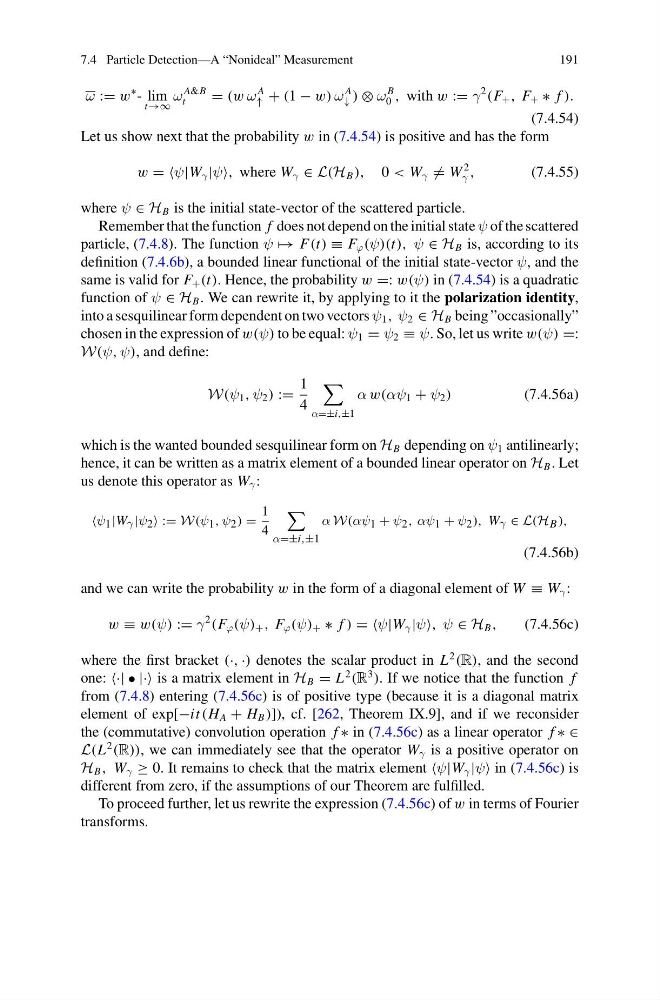
Let us show next that the probability w in (7.4.54) is positive and has the form
w = =ψ|W γ |ψ, where W γ ∈ L(H B ), 0 < W γ = W
2
γ ,
(7.4.55)
where ψ ∈ H B is the initial state-vector of the scattered particle.
Remember that the function f does not depend on the initial state ψ of the scattered
particle, (7.4.8). The function ψ → F(t) ≡ F ϕ (ψ)(t), ψ ∈ H B is, according to its
definition (7.4.6b), a bounded linear functional of the initial state-vector ψ, and the
same is valid for F + (t). Hence, the probability w =: w(ψ) in (7.4.54) is a quadratic
function of ψ ∈ H B . We can rewrite it, by applying to it the polarization identity,
into a sesquilinear form dependent on two vectors ψ 1 , ψ 2 ∈ H B being ”occasionally”
chosen in the expression of w(ψ) to be equal: ψ 1 = ψ 2 ≡ ψ. So, let us write w(ψ) =:
W(ψ, ψ), and define:
W(ψ 1 , ψ 2 ) :=
1
4
α=±i,±1
α w(αψ 1 + ψ 2 )
(7.4.56a)
which is the wanted bounded sesquilinear form on H B depending on ψ 1 antilinearly;
hence, it can be written as a matrix element of a bounded linear operator on H B . Let
us denote this operator as W γ :
ψ 1 |W γ |ψ 2 := W(ψ 1 , ψ 2 ) =
1
4
α=±i,±1
α W(αψ 1 + ψ 2 , αψ 1 + ψ 2 ), W γ ∈ L(H B ),
(7.4.56b)
and we can write the probability w in the form of a diagonal element of W ≡ W γ :
w ≡ w(ψ) := γ
2
(F ϕ (ψ) + , F ϕ (ψ) + ∗ f ) = =ψ|W γ |ψ, ψ ∈ H B ,
(7.4.56c)
where the first bracket (·, ·) denotes the scalar product in L
2
(R), and the second
one: • |·· is a matrix element in H B = L
2
(R
3
). If we notice that the function f
from (7.4.8) entering (7.4.56c) is of positive type (because it is a diagonal matrix
element of exp[−it (H A + H B )]), cf. [262, Theorem IX.9], and if we reconsider
the (commutative) convolution operation f ∗ in (7.4.56c) as a linear operator f ∗ ∈
L(L
2
(R)), we can immediately see that the operator W γ is a positive operator on
H B , W γ ≥ 0. It remains to check that the matrix element ψ|W γ |ψ in (7.4.56c) is
different from zero, if the assumptions of our Theorem are fulfilled.
To proceed further, let us rewrite the expression (7.4.56c) of w in terms of Fourier
transforms.
191
ω := w
∗ - lim
t→∞
ω
A&B
t
= (w ω
A
↑ + (1 − w) ω
A
↓ ) ⊗ ω
B
0 , with w := γ
2
(F + , F + ∗ f ).
(7.4.54)
Let us show next that the probability w in (7.4.54) is positive and has the form
w = =ψ|W γ |ψ, where W γ ∈ L(H B ), 0 < W γ = W
2
γ ,
(7.4.55)
where ψ ∈ H B is the initial state-vector of the scattered particle.
Remember that the function f does not depend on the initial state ψ of the scattered
particle, (7.4.8). The function ψ → F(t) ≡ F ϕ (ψ)(t), ψ ∈ H B is, according to its
definition (7.4.6b), a bounded linear functional of the initial state-vector ψ, and the
same is valid for F + (t). Hence, the probability w =: w(ψ) in (7.4.54) is a quadratic
function of ψ ∈ H B . We can rewrite it, by applying to it the polarization identity,
into a sesquilinear form dependent on two vectors ψ 1 , ψ 2 ∈ H B being ”occasionally”
chosen in the expression of w(ψ) to be equal: ψ 1 = ψ 2 ≡ ψ. So, let us write w(ψ) =:
W(ψ, ψ), and define:
W(ψ 1 , ψ 2 ) :=
1
4
α=±i,±1
α w(αψ 1 + ψ 2 )
(7.4.56a)
which is the wanted bounded sesquilinear form on H B depending on ψ 1 antilinearly;
hence, it can be written as a matrix element of a bounded linear operator on H B . Let
us denote this operator as W γ :
ψ 1 |W γ |ψ 2 := W(ψ 1 , ψ 2 ) =
1
4
α=±i,±1
α W(αψ 1 + ψ 2 , αψ 1 + ψ 2 ), W γ ∈ L(H B ),
(7.4.56b)
and we can write the probability w in the form of a diagonal element of W ≡ W γ :
w ≡ w(ψ) := γ
2
(F ϕ (ψ) + , F ϕ (ψ) + ∗ f ) = =ψ|W γ |ψ, ψ ∈ H B ,
(7.4.56c)
where the first bracket (·, ·) denotes the scalar product in L
2
(R), and the second
one: • |·· is a matrix element in H B = L
2
(R
3
). If we notice that the function f
from (7.4.8) entering (7.4.56c) is of positive type (because it is a diagonal matrix
element of exp[−it (H A + H B )]), cf. [262, Theorem IX.9], and if we reconsider
the (commutative) convolution operation f ∗ in (7.4.56c) as a linear operator f ∗ ∈
L(L
2
(R)), we can immediately see that the operator W γ is a positive operator on
H B , W γ ≥ 0. It remains to check that the matrix element ψ|W γ |ψ in (7.4.56c) is
different from zero, if the assumptions of our Theorem are fulfilled.
To proceed further, let us rewrite the expression (7.4.56c) of w in terms of Fourier
transforms.