

180
7 Some Models of “Quantum Measurement”
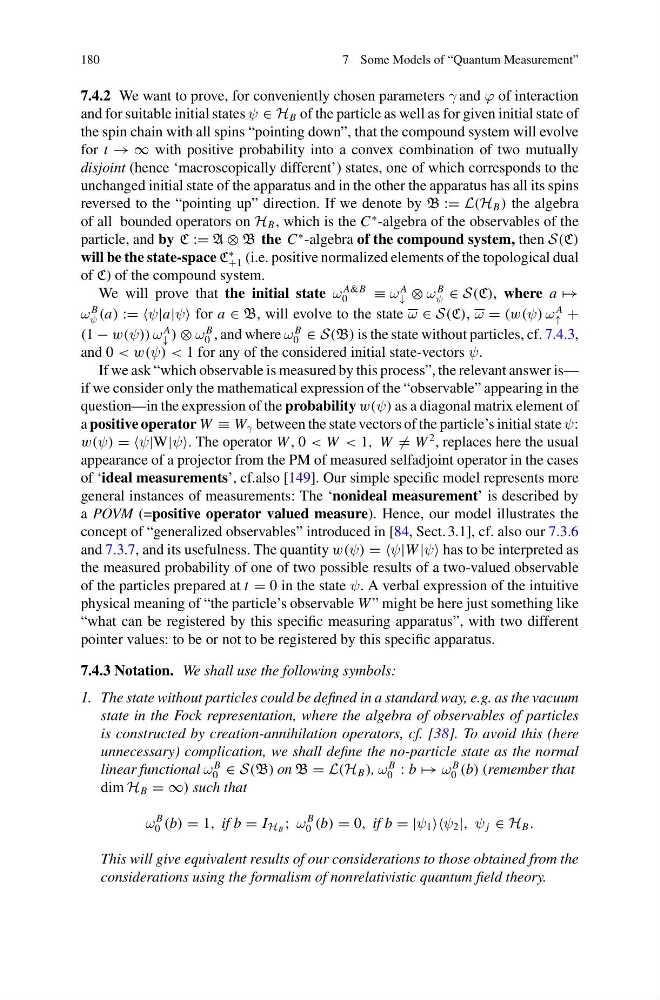
7.4.2 We want to prove, for conveniently chosen parameters γ and ϕ of interaction
and for suitable initial states ψ ∈ H B of the particle as well as for given initial state of
the spin chain with all spins “pointing down”, that the compound system will evolve
for t → ∞ with positive probability into a convex combination of two mutually
disjoint (hence ‘macroscopically different’) states, one of which corresponds to the
unchanged initial state of the apparatus and in the other the apparatus has all its spins
reversed to the “pointing up” direction. If we denote by B := L(H B ) the algebra
of all bounded operators on H B , which is the C
∗ -algebra of the observables of the
particle, and by C := A ⊗ B the C
∗ -algebra of the compound system, then S(C)
will be the state-space C
∗
+1 (i.e. positive normalized elements of the topological dual
of C) of the compound system.
We will prove that the initial state ω
A&B
0
≡ ω
A
↓ ⊗ ω
B
ψ ∈ S(C), where a →
ω
B
ψ (a) := =ψ|a|ψ for a ∈ B, will evolve to the state ω ∈ S(C), ω = (w(ψ) ω
A
↑ +
(1 − w(ψ)) ω
A
↓ ) ⊗ ω
B
0 , and where ω
B
0 ∈ S(B) is the state without particles, cf. 7.4.3,
and 0 < w(ψ) < 1 for any of the considered initial state-vectors ψ.
If we ask “which observable is measured by this process”, the relevant answer is—
if we consider only the mathematical expression of the “observable” appearing in the
question—in the expression of the probability w(ψ) as a diagonal matrix element of
a positive operator W ≡ W γ between the state vectors of the particle’s initial state ψ:
w(ψ) = =ψ|W|ψ. The operator W , 0 < W < 1, W = W
2 , replaces here the usual
appearance of a projector from the PM of measured selfadjoint operator in the cases
of ‘ideal measurements’, cf.also [149]. Our simple specific model represents more
general instances of measurements: The ‘nonideal measurement’ is described by
a POVM (=positive operator valued measure). Hence, our model illustrates the
concept of “generalized observables” introduced in [84, Sect. 3.1], cf. also our 7.3.6
and 7.3.7, and its usefulness. The quantity w(ψ) = =ψ|W |ψ has to be interpreted as
the measured probability of one of two possible results of a two-valued observable
of the particles prepared at t = 0 in the state ψ. A verbal expression of the intuitive
physical meaning of “the particle’s observable W ” might be here just something like
“what can be registered by this specific measuring apparatus”, with two different
pointer values: to be or not to be registered by this specific apparatus.
7.4.3 Notation. We shall use the following symbols:
1. The state without particles could be defined in a standard way, e.g. as the vacuum
state in the Fock representation, where the algebra of observables of particles
is constructed by creation-annihilation operators, cf. [38]. To avoid this (here
unnecessary) complication, we shall define the no-particle state as the normal
linear functional ω
B
0 ∈ S(B) on B = L(H B ), ω
B
0 : b → ω
B
0 (b) (remember that
dim H B = ∞) such that
ω
B
0 (b) = 1, if b = I H B ; ω
B
0 (b) = 0, if b = |ψ 1 ψ 2 |, ψ j ∈ H B .
This will give equivalent results of our considerations to those obtained from the
considerations using the formalism of nonrelativistic quantum field theory.
7 Some Models of “Quantum Measurement”
7.4.2 We want to prove, for conveniently chosen parameters γ and ϕ of interaction
and for suitable initial states ψ ∈ H B of the particle as well as for given initial state of
the spin chain with all spins “pointing down”, that the compound system will evolve
for t → ∞ with positive probability into a convex combination of two mutually
disjoint (hence ‘macroscopically different’) states, one of which corresponds to the
unchanged initial state of the apparatus and in the other the apparatus has all its spins
reversed to the “pointing up” direction. If we denote by B := L(H B ) the algebra
of all bounded operators on H B , which is the C
∗ -algebra of the observables of the
particle, and by C := A ⊗ B the C
∗ -algebra of the compound system, then S(C)
will be the state-space C
∗
+1 (i.e. positive normalized elements of the topological dual
of C) of the compound system.
We will prove that the initial state ω
A&B
0
≡ ω
A
↓ ⊗ ω
B
ψ ∈ S(C), where a →
ω
B
ψ (a) := =ψ|a|ψ for a ∈ B, will evolve to the state ω ∈ S(C), ω = (w(ψ) ω
A
↑ +
(1 − w(ψ)) ω
A
↓ ) ⊗ ω
B
0 , and where ω
B
0 ∈ S(B) is the state without particles, cf. 7.4.3,
and 0 < w(ψ) < 1 for any of the considered initial state-vectors ψ.
If we ask “which observable is measured by this process”, the relevant answer is—
if we consider only the mathematical expression of the “observable” appearing in the
question—in the expression of the probability w(ψ) as a diagonal matrix element of
a positive operator W ≡ W γ between the state vectors of the particle’s initial state ψ:
w(ψ) = =ψ|W|ψ. The operator W , 0 < W < 1, W = W
2 , replaces here the usual
appearance of a projector from the PM of measured selfadjoint operator in the cases
of ‘ideal measurements’, cf.also [149]. Our simple specific model represents more
general instances of measurements: The ‘nonideal measurement’ is described by
a POVM (=positive operator valued measure). Hence, our model illustrates the
concept of “generalized observables” introduced in [84, Sect. 3.1], cf. also our 7.3.6
and 7.3.7, and its usefulness. The quantity w(ψ) = =ψ|W |ψ has to be interpreted as
the measured probability of one of two possible results of a two-valued observable
of the particles prepared at t = 0 in the state ψ. A verbal expression of the intuitive
physical meaning of “the particle’s observable W ” might be here just something like
“what can be registered by this specific measuring apparatus”, with two different
pointer values: to be or not to be registered by this specific apparatus.
7.4.3 Notation. We shall use the following symbols:
1. The state without particles could be defined in a standard way, e.g. as the vacuum
state in the Fock representation, where the algebra of observables of particles
is constructed by creation-annihilation operators, cf. [38]. To avoid this (here
unnecessary) complication, we shall define the no-particle state as the normal
linear functional ω
B
0 ∈ S(B) on B = L(H B ), ω
B
0 : b → ω
B
0 (b) (remember that
dim H B = ∞) such that
ω
B
0 (b) = 1, if b = I H B ; ω
B
0 (b) = 0, if b = |ψ 1 ψ 2 |, ψ j ∈ H B .
This will give equivalent results of our considerations to those obtained from the
considerations using the formalism of nonrelativistic quantum field theory.