

7.3 Quantum Domino
173
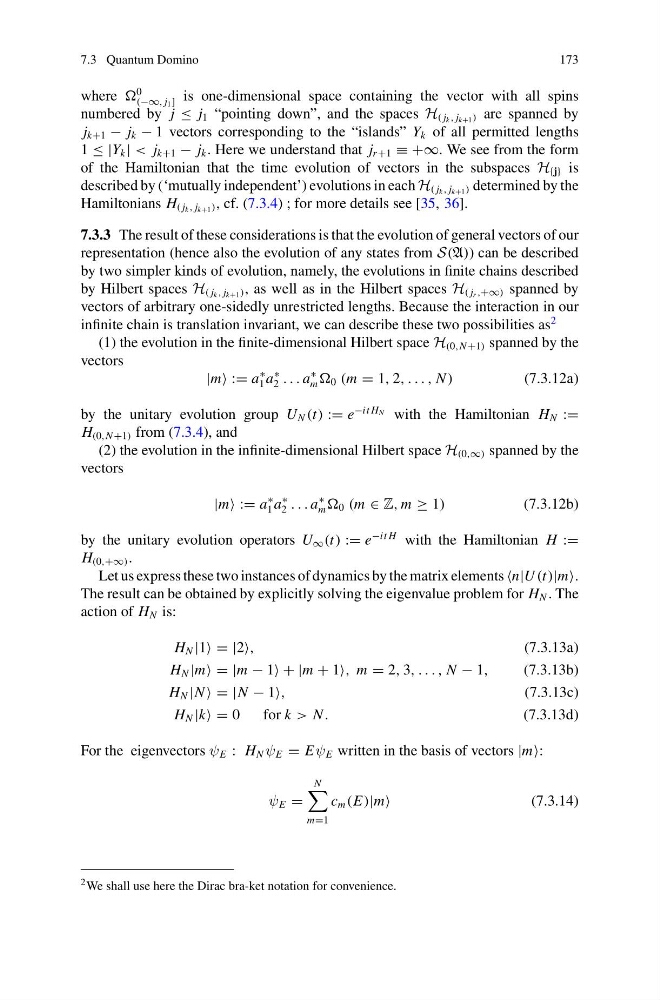
where
0
(−∞, j 1 ] is one-dimensional space containing the vector with all spins
numbered by j ≤ j 1 “pointing down”, and the spaces H ( j k , j k+1 ) are spanned by
j k+1 − j k − 1 vectors corresponding to the “islands” Y k of all permitted lengths
1 ≤ |Y k | < j k+1 − j k . Here we understand that j r +1 ≡ +∞. We see from the form
of the Hamiltonian that the time evolution of vectors in the subspaces H {j} is
described by (‘mutually independent’) evolutions in each H ( j k , j k+1 ) determined by the
Hamiltonians H ( j k , j k+1 ) , cf. (7.3.4) ; for more details see [35, 36].
7.3.3 The result of these considerations is that the evolution of general vectors of our
representation (hence also the evolution of any states from S(A)) can be described
by two simpler kinds of evolution, namely, the evolutions in finite chains described
by Hilbert spaces H ( j k , j k+1 ) , as well as in the Hilbert spaces H ( j r ,+∞) spanned by
vectors of arbitrary one-sidedly unrestricted lengths. Because the interaction in our
infinite chain is translation invariant, we can describe these two possibilities as
2
(1) the evolution in the finite-dimensional Hilbert space H (0,N +1) spanned by the
vectors
|m := a
∗
1 a
∗
2 . . . a
∗
m 0 (m = 1, 2, . . . , N )
(7.3.12a)
by the unitary evolution group U N (t) := e
−it H N with the Hamiltonian H N :=
H (0,N +1) from (7.3.4), and
(2) the evolution in the infinite-dimensional Hilbert space H (0,∞) spanned by the
vectors
|m := a
∗
1 a
∗
2 . . . a
∗
m 0 (m ∈ Z, m ≥ 1)
(7.3.12b)
by the unitary evolution operators U ∞ (t) := e
−it H with the Hamiltonian H :=
H (0,+∞) .
Let us express these two instances of dynamics by the matrix elements n|U (t)|m.
The result can be obtained by explicitly solving the eigenvalue problem for H N . The
action of H N is:
H N |1 = |2,
(7.3.13a)
H N |m = |m − 1 + |m + 1, m = 2, 3, . . . , N − 1,
(7.3.13b)
H N |N = |N − 1,
(7.3.13c)
H N |k = 0
fork > N .
(7.3.13d)
For the eigenvectors ψ E : H N ψ E = Eψ E written in the basis of vectors |m:
ψ E =
N
m=1
c m (E)|m
(7.3.14)
2 We shall use here the Dirac bra-ket notation for convenience.
173
where
0
(−∞, j 1 ] is one-dimensional space containing the vector with all spins
numbered by j ≤ j 1 “pointing down”, and the spaces H ( j k , j k+1 ) are spanned by
j k+1 − j k − 1 vectors corresponding to the “islands” Y k of all permitted lengths
1 ≤ |Y k | < j k+1 − j k . Here we understand that j r +1 ≡ +∞. We see from the form
of the Hamiltonian that the time evolution of vectors in the subspaces H {j} is
described by (‘mutually independent’) evolutions in each H ( j k , j k+1 ) determined by the
Hamiltonians H ( j k , j k+1 ) , cf. (7.3.4) ; for more details see [35, 36].
7.3.3 The result of these considerations is that the evolution of general vectors of our
representation (hence also the evolution of any states from S(A)) can be described
by two simpler kinds of evolution, namely, the evolutions in finite chains described
by Hilbert spaces H ( j k , j k+1 ) , as well as in the Hilbert spaces H ( j r ,+∞) spanned by
vectors of arbitrary one-sidedly unrestricted lengths. Because the interaction in our
infinite chain is translation invariant, we can describe these two possibilities as
2
(1) the evolution in the finite-dimensional Hilbert space H (0,N +1) spanned by the
vectors
|m := a
∗
1 a
∗
2 . . . a
∗
m 0 (m = 1, 2, . . . , N )
(7.3.12a)
by the unitary evolution group U N (t) := e
−it H N with the Hamiltonian H N :=
H (0,N +1) from (7.3.4), and
(2) the evolution in the infinite-dimensional Hilbert space H (0,∞) spanned by the
vectors
|m := a
∗
1 a
∗
2 . . . a
∗
m 0 (m ∈ Z, m ≥ 1)
(7.3.12b)
by the unitary evolution operators U ∞ (t) := e
−it H with the Hamiltonian H :=
H (0,+∞) .
Let us express these two instances of dynamics by the matrix elements n|U (t)|m.
The result can be obtained by explicitly solving the eigenvalue problem for H N . The
action of H N is:
H N |1 = |2,
(7.3.13a)
H N |m = |m − 1 + |m + 1, m = 2, 3, . . . , N − 1,
(7.3.13b)
H N |N = |N − 1,
(7.3.13c)
H N |k = 0
fork > N .
(7.3.13d)
For the eigenvectors ψ E : H N ψ E = Eψ E written in the basis of vectors |m:
ψ E =
N
m=1
c m (E)|m
(7.3.14)
2 We shall use here the Dirac bra-ket notation for convenience.