

6.4 Equilibrium States
157
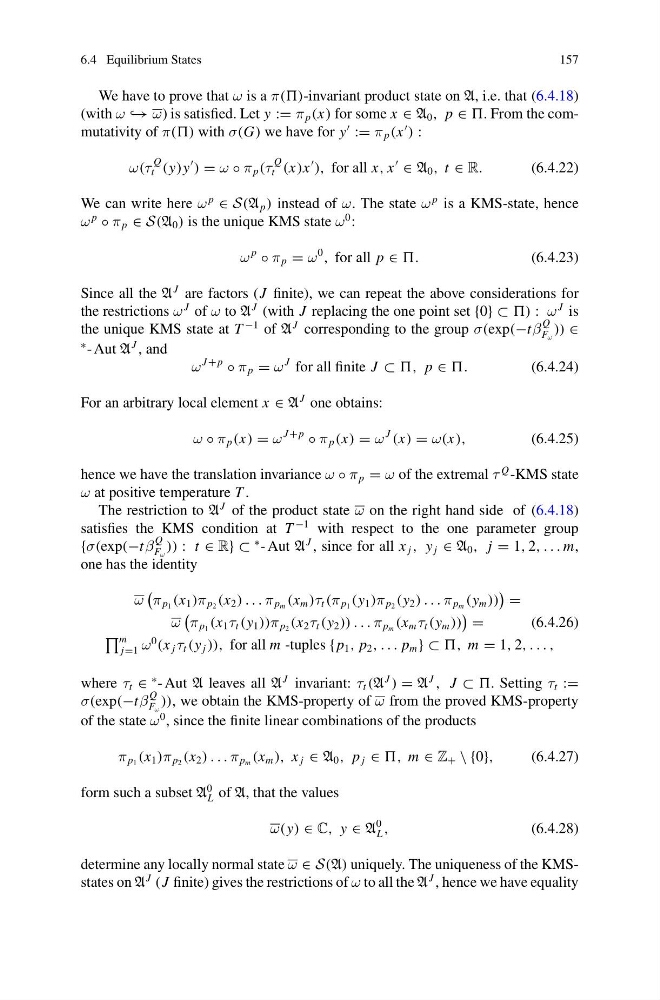
We have to prove that ω is a π(()-invariant product state on A, i.e. that (6.4.18)
(with ω → ω) is satisfied. Let y := π p (x) for some x ∈ A 0 , p ∈ . From the commutativity of π(() with σ(G) we have for y
:= π p (x
) :
ω(τ
Q
t (y)y
) = ω ◦ π p (τ
Q
t (x)x
), for all x, x
∈ A 0 , t ∈ R.
(6.4.22)
We can write here ω
p
∈ S(A p ) instead of ω. The state ω
p is a KMS-state, hence
ω
p
◦ π p ∈ S(A 0 ) is the unique KMS state ω
0 :
ω
p
◦ π p = ω
0
, for all p ∈ .
(6.4.23)
Since all the A
J are factors (J finite), we can repeat the above considerations for
the restrictions ω
J of ω to A
J (with J replacing the one point set {0} ⊂ ) : ω
J is
the unique KMS state at T
−1 of A
J corresponding to the group σ(exp(−tβ
Q
F ω
)) ∈
∗ - Aut A
J , and
ω
J + p
◦ π p = ω
J for all finite J ⊂ , p ∈ .
(6.4.24)
For an arbitrary local element x ∈ A
J one obtains:
ω ◦ π p (x) = ω
J + p
◦ π p (x) = ω
J
(x) = ω(x),
(6.4.25)
hence we have the translation invariance ω ◦ π p = ω of the extremal τ
Q -KMS state
ω at positive temperature T .
The restriction to A
J of the product state ω on the right hand side of (6.4.18)
satisfies the KMS condition at T
−1 with respect to the one parameter group
{σ(exp(−tβ
Q
F ω
)) : t ∈ R} ⊂
∗ - Aut A
J , since for all x j , y j ∈ A 0 , j = 1, 2, . . . m,
one has the identity
ω
π p 1 (x 1 )π p 2 (x 2 ) . . . π p m (x m )τ t (π p 1 (y 1 )π p 2 (y 2 ) . . . π p m (y m ))
=
ω
π p 1 (x 1 τ t (y 1 ))π p 2 (x 2 τ t (y 2 )) . . . π p m (x m τ t (y m ))
=
(6.4.26)
m
j=1 ω
0
(x j τ t (y j )), for all m -tuples { p 1 , p 2 , . . . p m } ⊂ , m = 1, 2, . . . ,
where τ t ∈
∗ - Aut A leaves all A
J invariant: τ t (A
J
) = A
J
, J ⊂ . Setting τ t :=
σ(exp(−tβ
Q
F ω
)), we obtain the KMS-property of ω from the proved KMS-property
of the state ω
0 , since the finite linear combinations of the products
π p 1 (x 1 )π p 2 (x 2 ) . . . π p m (x m ), x j ∈ A 0 , p j ∈ , m ∈ Z + \ {0},
(6.4.27)
form such a subset A
0
L of A, that the values
ω(y) ∈ C, y ∈ A
0
L ,
(6.4.28)
determine any locally normal state ω ∈ S(A) uniquely. The uniqueness of the KMSstates on A
J (J finite) gives the restrictions of ω to all the A
J , hence we have equality
157
We have to prove that ω is a π(()-invariant product state on A, i.e. that (6.4.18)
(with ω → ω) is satisfied. Let y := π p (x) for some x ∈ A 0 , p ∈ . From the commutativity of π(() with σ(G) we have for y
:= π p (x
) :
ω(τ
Q
t (y)y
) = ω ◦ π p (τ
Q
t (x)x
), for all x, x
∈ A 0 , t ∈ R.
(6.4.22)
We can write here ω
p
∈ S(A p ) instead of ω. The state ω
p is a KMS-state, hence
ω
p
◦ π p ∈ S(A 0 ) is the unique KMS state ω
0 :
ω
p
◦ π p = ω
0
, for all p ∈ .
(6.4.23)
Since all the A
J are factors (J finite), we can repeat the above considerations for
the restrictions ω
J of ω to A
J (with J replacing the one point set {0} ⊂ ) : ω
J is
the unique KMS state at T
−1 of A
J corresponding to the group σ(exp(−tβ
Q
F ω
)) ∈
∗ - Aut A
J , and
ω
J + p
◦ π p = ω
J for all finite J ⊂ , p ∈ .
(6.4.24)
For an arbitrary local element x ∈ A
J one obtains:
ω ◦ π p (x) = ω
J + p
◦ π p (x) = ω
J
(x) = ω(x),
(6.4.25)
hence we have the translation invariance ω ◦ π p = ω of the extremal τ
Q -KMS state
ω at positive temperature T .
The restriction to A
J of the product state ω on the right hand side of (6.4.18)
satisfies the KMS condition at T
−1 with respect to the one parameter group
{σ(exp(−tβ
Q
F ω
)) : t ∈ R} ⊂
∗ - Aut A
J , since for all x j , y j ∈ A 0 , j = 1, 2, . . . m,
one has the identity
ω
π p 1 (x 1 )π p 2 (x 2 ) . . . π p m (x m )τ t (π p 1 (y 1 )π p 2 (y 2 ) . . . π p m (y m ))
=
ω
π p 1 (x 1 τ t (y 1 ))π p 2 (x 2 τ t (y 2 )) . . . π p m (x m τ t (y m ))
=
(6.4.26)
m
j=1 ω
0
(x j τ t (y j )), for all m -tuples { p 1 , p 2 , . . . p m } ⊂ , m = 1, 2, . . . ,
where τ t ∈
∗ - Aut A leaves all A
J invariant: τ t (A
J
) = A
J
, J ⊂ . Setting τ t :=
σ(exp(−tβ
Q
F ω
)), we obtain the KMS-property of ω from the proved KMS-property
of the state ω
0 , since the finite linear combinations of the products
π p 1 (x 1 )π p 2 (x 2 ) . . . π p m (x m ), x j ∈ A 0 , p j ∈ , m ∈ Z + \ {0},
(6.4.27)
form such a subset A
0
L of A, that the values
ω(y) ∈ C, y ∈ A
0
L ,
(6.4.28)
determine any locally normal state ω ∈ S(A) uniquely. The uniqueness of the KMSstates on A
J (J finite) gives the restrictions of ω to all the A
J , hence we have equality