

154
6 Dynamics of Quantum Mechanical Macroscopic Systems
the considered system at the temperature T = β
−1 . This interpretation is especially
intuitive in cases of quasilocal algebras C when the extremal KMS (hence factor)
states have short range correlations (cf. e.g. [193])—the necessary property of the
states representing pure phases of a spatially extended system [271, 6.5]. We shall
investigate general properties of the extremal (τ
Q
, β)-KMS states of the systems
(C; τ
Q
) and (C; τ
Q
; π(()) representing the generalized mean-field theories.
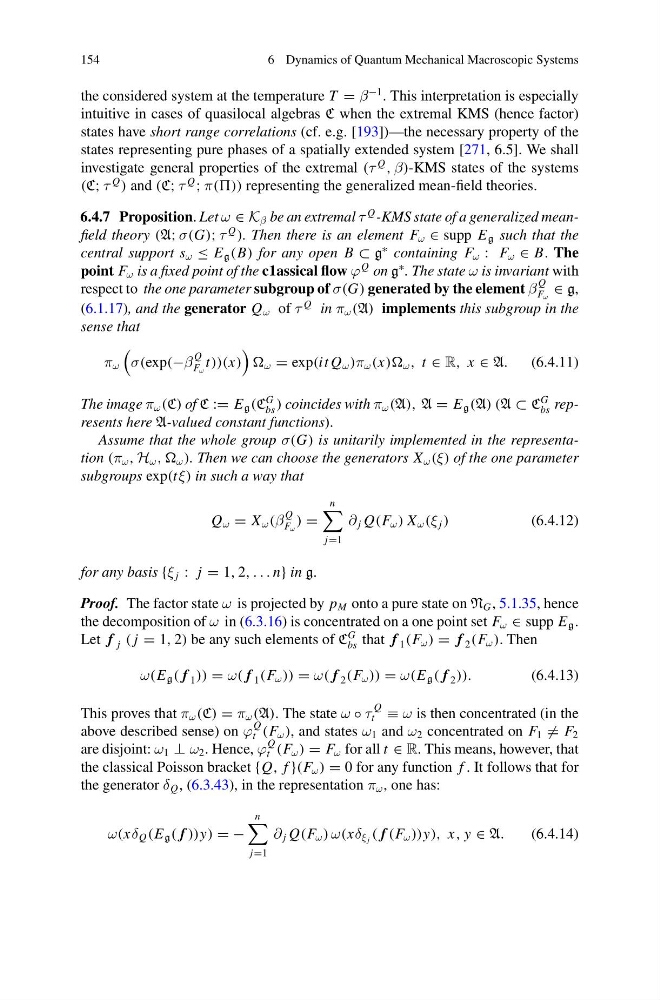
6.4.7 Proposition. Let ω ∈ K β be an extremal τ
Q -KMS state of a generalized meanfield theory (A; σ(G); τ
Q
). Then there is an element F ω ∈ supp E g such that the
central support s ω ≤ E g (B) for any open B ⊂ g
∗ containing F ω : F ω ∈ B. The
point F ω is a fixed point of the c1assical flow ϕ
Q on g
∗ . The state ω is invariant with
respect to the one parameter subgroup of σ(G) generated by the element β
Q
F ω
∈ g,
(6.1.17), and the generator Q ω of τ
Q in π ω (A) implements this subgroup in the
sense that
π ω
σ(exp(−β
Q
F ω
t))(x)
ω = exp(it Q ω )π ω (x)) ω , t ∈ R, x ∈ A.
(6.4.11)
The image π ω (C) of C := E g (C
G
bs ) coincides with π ω (A), A = E g (A) (A ⊂ C
G
bs represents here A-valued constant functions).
Assume that the whole group σ(G) is unitarily implemented in the representation (π ω , H ω , , ω ). Then we can choose the generators X ω (ξ) of the one parameter
subgroups exp(tξ) in such a way that
Q ω = X ω (β
Q
F ω
) =
n
j=1
∂ j Q(F ω ) X ω (ξ j )
(6.4.12)
for any basis {ξ j : j = 1, 2, . . . n} in g.
Proof. The factor state ω is projected by p M onto a pure state on N G , 5.1.35, hence
the decomposition of ω in (6.3.16) is concentrated on a one point set F ω ∈ supp E g .
Let f j ( j = 1, 2) be any such elements of C
G
bs that f 1 (F ω ) = f 2 (F ω ). Then
ω(E g ( f 1 )) = ω( f 1 (F ω )) = ω( f 2 (F ω )) = ω(E g ( f 2 )).
(6.4.13)
This proves that π ω (C) = π ω (A). The state ω ◦ τ
Q
t ≡ ω is then concentrated (in the
above described sense) on ϕ
Q
t (F ω ), and states ω 1 and ω 2 concentrated on F 1 = F 2
are disjoint: ω 1 ⊥ ω 2 . Hence, ϕ
Q
t (F ω ) = F ω for all t ∈ R. This means, however, that
the classical Poisson bracket {Q, f }(F ω ) = 0 for any function f . It follows that for
the generator δ Q , (6.3.43), in the representation π ω , one has:
ω(xδ Q (E g ( f ))y) = −
n
j=1
∂ j Q(F ω ) ω(xδ ξ j ( f (F ω ))y), x, y ∈ A.
(6.4.14)
6 Dynamics of Quantum Mechanical Macroscopic Systems
the considered system at the temperature T = β
−1 . This interpretation is especially
intuitive in cases of quasilocal algebras C when the extremal KMS (hence factor)
states have short range correlations (cf. e.g. [193])—the necessary property of the
states representing pure phases of a spatially extended system [271, 6.5]. We shall
investigate general properties of the extremal (τ
Q
, β)-KMS states of the systems
(C; τ
Q
) and (C; τ
Q
; π(()) representing the generalized mean-field theories.
6.4.7 Proposition. Let ω ∈ K β be an extremal τ
Q -KMS state of a generalized meanfield theory (A; σ(G); τ
Q
). Then there is an element F ω ∈ supp E g such that the
central support s ω ≤ E g (B) for any open B ⊂ g
∗ containing F ω : F ω ∈ B. The
point F ω is a fixed point of the c1assical flow ϕ
Q on g
∗ . The state ω is invariant with
respect to the one parameter subgroup of σ(G) generated by the element β
Q
F ω
∈ g,
(6.1.17), and the generator Q ω of τ
Q in π ω (A) implements this subgroup in the
sense that
π ω
σ(exp(−β
Q
F ω
t))(x)
ω = exp(it Q ω )π ω (x)) ω , t ∈ R, x ∈ A.
(6.4.11)
The image π ω (C) of C := E g (C
G
bs ) coincides with π ω (A), A = E g (A) (A ⊂ C
G
bs represents here A-valued constant functions).
Assume that the whole group σ(G) is unitarily implemented in the representation (π ω , H ω , , ω ). Then we can choose the generators X ω (ξ) of the one parameter
subgroups exp(tξ) in such a way that
Q ω = X ω (β
Q
F ω
) =
n
j=1
∂ j Q(F ω ) X ω (ξ j )
(6.4.12)
for any basis {ξ j : j = 1, 2, . . . n} in g.
Proof. The factor state ω is projected by p M onto a pure state on N G , 5.1.35, hence
the decomposition of ω in (6.3.16) is concentrated on a one point set F ω ∈ supp E g .
Let f j ( j = 1, 2) be any such elements of C
G
bs that f 1 (F ω ) = f 2 (F ω ). Then
ω(E g ( f 1 )) = ω( f 1 (F ω )) = ω( f 2 (F ω )) = ω(E g ( f 2 )).
(6.4.13)
This proves that π ω (C) = π ω (A). The state ω ◦ τ
Q
t ≡ ω is then concentrated (in the
above described sense) on ϕ
Q
t (F ω ), and states ω 1 and ω 2 concentrated on F 1 = F 2
are disjoint: ω 1 ⊥ ω 2 . Hence, ϕ
Q
t (F ω ) = F ω for all t ∈ R. This means, however, that
the classical Poisson bracket {Q, f }(F ω ) = 0 for any function f . It follows that for
the generator δ Q , (6.3.43), in the representation π ω , one has:
ω(xδ Q (E g ( f ))y) = −
n
j=1
∂ j Q(F ω ) ω(xδ ξ j ( f (F ω ))y), x, y ∈ A.
(6.4.14)