

6.3 Time Evolution in Generalized Mean-Field Theories
147
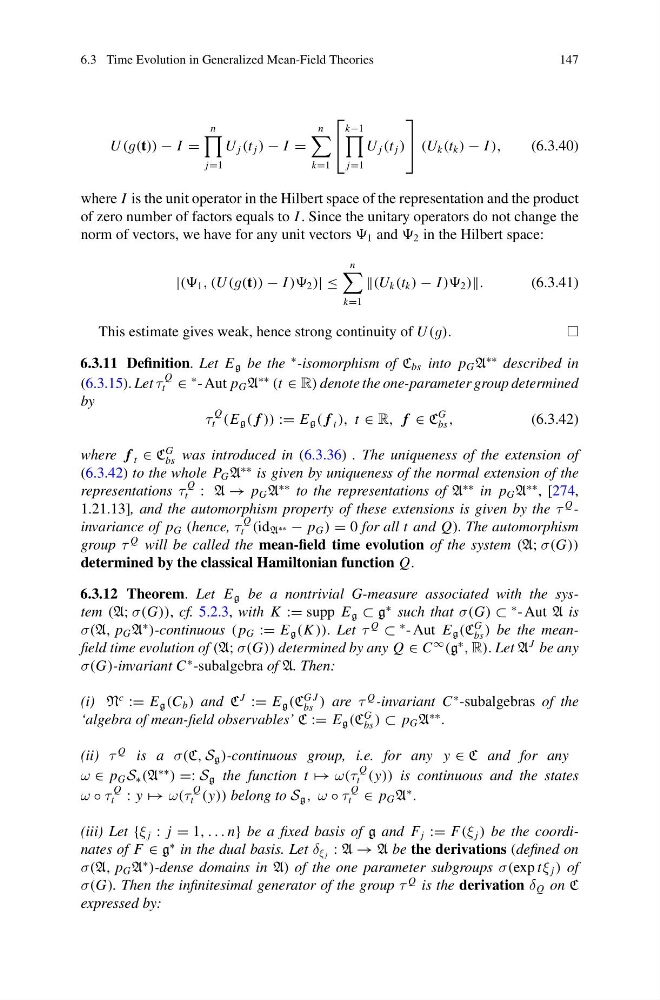
U (g(t)) − I =
n
j=1
U j (t j ) − I =
n
k=1
⎡
⎣
k−1
j=1
U j (t j )
⎤
⎦ (U k (t k ) − I ),
(6.3.40)
where I is the unit operator in the Hilbert space of the representation and the product
of zero number of factors equals to I . Since the unitary operators do not change the
norm of vectors, we have for any unit vectors 1 and 2 in the Hilbert space:
|(( 1 , (U (g(t)) − I )) 2 )| ≤
n
k=1
(U k (t k ) − I )) 2 ).
(6.3.41)
This estimate gives weak, hence strong continuity of U (g).
6.3.11 Definition. Let E g be the
∗ -isomorphism of C bs into p G A
∗∗ described in
(6.3.15). Let τ
Q
t ∈
∗ - Aut p G A
∗∗
(t ∈ R) denote the one-parameter group determined
by
τ
Q
t (E g ( f )) := E g ( f t ), t ∈ R, f ∈ C
G
bs ,
(6.3.42)
where f t ∈ C
G
bs was introduced in (6.3.36) . The uniqueness of the extension of
(6.3.42) to the whole P G A
∗∗ is given by uniqueness of the normal extension of the
representations τ
Q
t : A → p G A
∗∗ to the representations of A
∗∗ in p G A
∗∗ , [274,
1.21.13], and the automorphism property of these extensions is given by the τ
Q -
invariance of p G (hence, τ
Q
t (id A ∗∗ − p G ) = 0 for all t and Q). The automorphism
group τ
Q will be called the mean-field time evolution of the system (A; σ(G))
determined by the classical Hamiltonian function Q.
6.3.12 Theorem. Let E g be a nontrivial G-measure associated with the system (A; σ(G)), cf. 5.2.3, with K := supp E g ⊂ g
∗ such that σ(G) ⊂
∗ - Aut A is
σ(A, p G A
∗
)-continuous ( p G := E g (K )). Let τ
Q
⊂
∗ - Aut E g (C
G
bs ) be the meanfield time evolution of (A; σ(G)) determined by any Q ∈ C
∞
(g
∗
, R). Let A
J be any
σ(G)-invariant C
∗ -subalgebra of A. Then:
(i) N
c
:= E g (C b ) and C
J
:= E g (C
G J
bs ) are τ
Q -invariant C
∗ -subalgebras of the
‘algebra of mean-field observables’ C := E g (C
G
bs ) ⊂ p G A
∗∗ .
(ii) τ
Q is a σ(C, S g )-continuous group, i.e. for any y ∈ C and for any
ω ∈ p G S ∗ (A
∗∗
) =: S g the function t → ω(τ
Q
t (y)) is continuous and the states
ω ◦ τ
Q
t : y → ω(τ
Q
t (y)) belong to S g , ω ◦ τ
Q
t ∈ p G A
∗ .
(iii) Let {ξ j : j = 1, . . . n} be a fixed basis of g and F j := F(ξ j ) be the coordinates of F ∈ g
∗ in the dual basis. Let δ ξ j : A → A be the derivations (defined on
σ(A, p G A
∗
)-dense domains in A) of the one parameter subgroups σ(exp tξ j ) of
σ(G). Then the infinitesimal generator of the group τ
Q is the derivation δ Q on C
expressed by:
147
U (g(t)) − I =
n
j=1
U j (t j ) − I =
n
k=1
⎡
⎣
k−1
j=1
U j (t j )
⎤
⎦ (U k (t k ) − I ),
(6.3.40)
where I is the unit operator in the Hilbert space of the representation and the product
of zero number of factors equals to I . Since the unitary operators do not change the
norm of vectors, we have for any unit vectors 1 and 2 in the Hilbert space:
|(( 1 , (U (g(t)) − I )) 2 )| ≤
n
k=1
(U k (t k ) − I )) 2 ).
(6.3.41)
This estimate gives weak, hence strong continuity of U (g).
6.3.11 Definition. Let E g be the
∗ -isomorphism of C bs into p G A
∗∗ described in
(6.3.15). Let τ
Q
t ∈
∗ - Aut p G A
∗∗
(t ∈ R) denote the one-parameter group determined
by
τ
Q
t (E g ( f )) := E g ( f t ), t ∈ R, f ∈ C
G
bs ,
(6.3.42)
where f t ∈ C
G
bs was introduced in (6.3.36) . The uniqueness of the extension of
(6.3.42) to the whole P G A
∗∗ is given by uniqueness of the normal extension of the
representations τ
Q
t : A → p G A
∗∗ to the representations of A
∗∗ in p G A
∗∗ , [274,
1.21.13], and the automorphism property of these extensions is given by the τ
Q -
invariance of p G (hence, τ
Q
t (id A ∗∗ − p G ) = 0 for all t and Q). The automorphism
group τ
Q will be called the mean-field time evolution of the system (A; σ(G))
determined by the classical Hamiltonian function Q.
6.3.12 Theorem. Let E g be a nontrivial G-measure associated with the system (A; σ(G)), cf. 5.2.3, with K := supp E g ⊂ g
∗ such that σ(G) ⊂
∗ - Aut A is
σ(A, p G A
∗
)-continuous ( p G := E g (K )). Let τ
Q
⊂
∗ - Aut E g (C
G
bs ) be the meanfield time evolution of (A; σ(G)) determined by any Q ∈ C
∞
(g
∗
, R). Let A
J be any
σ(G)-invariant C
∗ -subalgebra of A. Then:
(i) N
c
:= E g (C b ) and C
J
:= E g (C
G J
bs ) are τ
Q -invariant C
∗ -subalgebras of the
‘algebra of mean-field observables’ C := E g (C
G
bs ) ⊂ p G A
∗∗ .
(ii) τ
Q is a σ(C, S g )-continuous group, i.e. for any y ∈ C and for any
ω ∈ p G S ∗ (A
∗∗
) =: S g the function t → ω(τ
Q
t (y)) is continuous and the states
ω ◦ τ
Q
t : y → ω(τ
Q
t (y)) belong to S g , ω ◦ τ
Q
t ∈ p G A
∗ .
(iii) Let {ξ j : j = 1, . . . n} be a fixed basis of g and F j := F(ξ j ) be the coordinates of F ∈ g
∗ in the dual basis. Let δ ξ j : A → A be the derivations (defined on
σ(A, p G A
∗
)-dense domains in A) of the one parameter subgroups σ(exp tξ j ) of
σ(G). Then the infinitesimal generator of the group τ
Q is the derivation δ Q on C
expressed by: