

144
6 Dynamics of Quantum Mechanical Macroscopic Systems
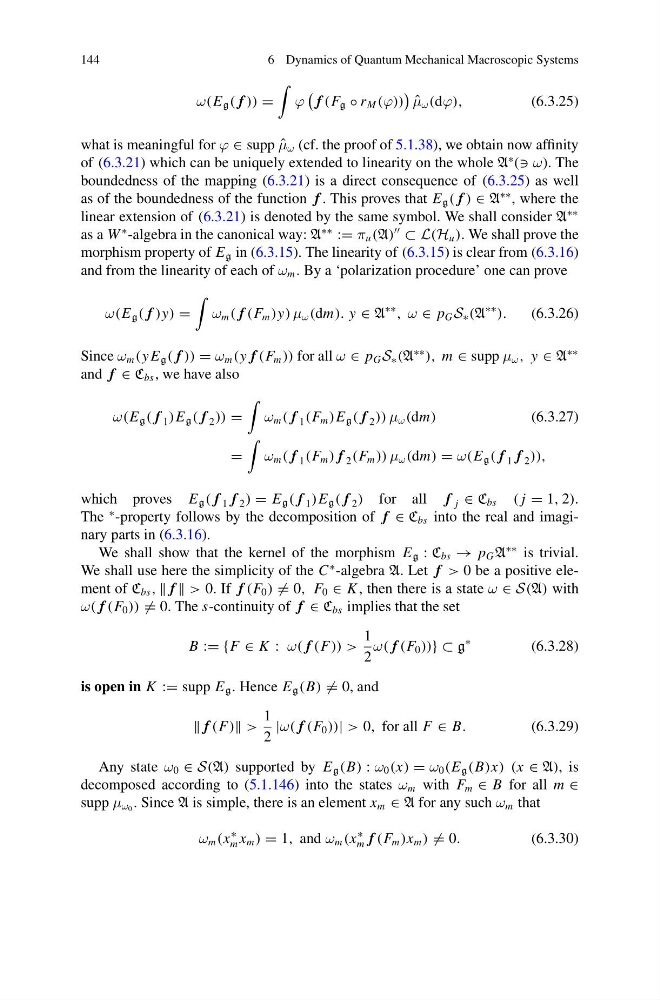
ω(E g ( f )) =
ϕ
f (F g ◦ r M (ϕ))
ˆ
μ ω (dϕ),
(6.3.25)
what is meaningful for ϕ ∈ supp ˆ
μ ω (cf. the proof of 5.1.38), we obtain now affinity
of (6.3.21) which can be uniquely extended to linearity on the whole A
∗ ( ω). The
boundedness of the mapping (6.3.21) is a direct consequence of (6.3.25) as well
as of the boundedness of the function f . This proves that E g ( f ) ∈ A
∗∗ , where the
linear extension of (6.3.21) is denoted by the same symbol. We shall consider A
∗∗
as a W
∗ -algebra in the canonical way: A
∗∗
:= π u (A)
⊂ L(H u ). We shall prove the
morphism property of E g in (6.3.15). The linearity of (6.3.15) is clear from (6.3.16)
and from the linearity of each of ω m . By a ‘polarization procedure’ one can prove
ω(E g ( f )y) =
ω m ( f (F m )y) μ ω (dm). y ∈ A
∗∗
, ω ∈ p G S ∗ (A
∗∗
).
(6.3.26)
Since ω m (y E g ( f )) = ω m (y f (F m )) for all ω ∈ p G S ∗ (A
∗∗
), m ∈ supp μ ω , y ∈ A
∗∗
and f ∈ C bs , we have also
ω(E g ( f 1 )E g ( f 2 )) =
ω m ( f 1 (F m )E g ( f 2 )) μ ω (dm)
(6.3.27)
=
ω m ( f 1 (F m ) f 2 (F m )) μ ω (dm) = ω(E g ( f 1 f 2 )),
which proves E g ( f 1 f 2 ) = E g ( f 1 )E g ( f 2 ) for all f j ∈ C bs ( j = 1, 2).
The
∗ -property follows by the decomposition of f ∈ C bs into the real and imaginary parts in (6.3.16).
We shall show that the kernel of the morphism E g : C bs → p G A
∗∗ is trivial.
We shall use here the simplicity of the C
∗ -algebra A. Let f > 0 be a positive element of C bs , f > 0. If f (F 0 ) = 0, F 0 ∈ K , then there is a state ω ∈ S(A) with
ω( f (F 0 )) = 0. The s-continuity of f ∈ C bs implies that the set
B := {F ∈ K : ω( f (F)) >
1
2
ω( f (F 0 ))} ⊂ g
∗
(6.3.28)
is open in K := supp E g . Hence E g (B) = 0, and
f (F) >
1
2
|ω( f (F 0 ))| > 0, for all F ∈ B.
(6.3.29)
Any state ω 0 ∈ S(A) supported by E g (B) : ω 0 (x) = ω 0 (E g (B)x) (x ∈ A), is
decomposed according to (5.1.146) into the states ω m with F m ∈ B for all m ∈
supp μ ω 0 . Since A is simple, there is an element x m ∈ A for any such ω m that
ω m (x
∗
m x m ) = 1, and ω m (x
∗
m f (F m )x m ) = 0.
(6.3.30)
6 Dynamics of Quantum Mechanical Macroscopic Systems
ω(E g ( f )) =
ϕ
f (F g ◦ r M (ϕ))
ˆ
μ ω (dϕ),
(6.3.25)
what is meaningful for ϕ ∈ supp ˆ
μ ω (cf. the proof of 5.1.38), we obtain now affinity
of (6.3.21) which can be uniquely extended to linearity on the whole A
∗ ( ω). The
boundedness of the mapping (6.3.21) is a direct consequence of (6.3.25) as well
as of the boundedness of the function f . This proves that E g ( f ) ∈ A
∗∗ , where the
linear extension of (6.3.21) is denoted by the same symbol. We shall consider A
∗∗
as a W
∗ -algebra in the canonical way: A
∗∗
:= π u (A)
⊂ L(H u ). We shall prove the
morphism property of E g in (6.3.15). The linearity of (6.3.15) is clear from (6.3.16)
and from the linearity of each of ω m . By a ‘polarization procedure’ one can prove
ω(E g ( f )y) =
ω m ( f (F m )y) μ ω (dm). y ∈ A
∗∗
, ω ∈ p G S ∗ (A
∗∗
).
(6.3.26)
Since ω m (y E g ( f )) = ω m (y f (F m )) for all ω ∈ p G S ∗ (A
∗∗
), m ∈ supp μ ω , y ∈ A
∗∗
and f ∈ C bs , we have also
ω(E g ( f 1 )E g ( f 2 )) =
ω m ( f 1 (F m )E g ( f 2 )) μ ω (dm)
(6.3.27)
=
ω m ( f 1 (F m ) f 2 (F m )) μ ω (dm) = ω(E g ( f 1 f 2 )),
which proves E g ( f 1 f 2 ) = E g ( f 1 )E g ( f 2 ) for all f j ∈ C bs ( j = 1, 2).
The
∗ -property follows by the decomposition of f ∈ C bs into the real and imaginary parts in (6.3.16).
We shall show that the kernel of the morphism E g : C bs → p G A
∗∗ is trivial.
We shall use here the simplicity of the C
∗ -algebra A. Let f > 0 be a positive element of C bs , f > 0. If f (F 0 ) = 0, F 0 ∈ K , then there is a state ω ∈ S(A) with
ω( f (F 0 )) = 0. The s-continuity of f ∈ C bs implies that the set
B := {F ∈ K : ω( f (F)) >
1
2
ω( f (F 0 ))} ⊂ g
∗
(6.3.28)
is open in K := supp E g . Hence E g (B) = 0, and
f (F) >
1
2
|ω( f (F 0 ))| > 0, for all F ∈ B.
(6.3.29)
Any state ω 0 ∈ S(A) supported by E g (B) : ω 0 (x) = ω 0 (E g (B)x) (x ∈ A), is
decomposed according to (5.1.146) into the states ω m with F m ∈ B for all m ∈
supp μ ω 0 . Since A is simple, there is an element x m ∈ A for any such ω m that
ω m (x
∗
m x m ) = 1, and ω m (x
∗
m f (F m )x m ) = 0.
(6.3.30)