

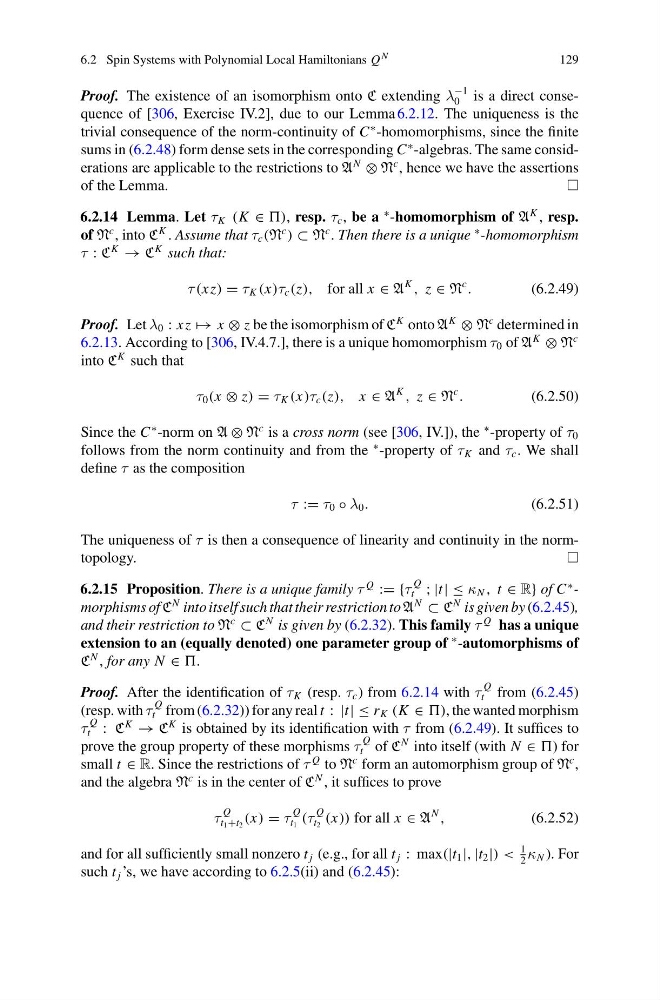
6.2 Spin Systems with Polynomial Local Hamiltonians Q N
129
Proof. The existence of an isomorphism onto C extending λ
−1
0 is a direct consequence of [306, Exercise IV.2], due to our Lemma 6.2.12. The uniqueness is the
trivial consequence of the norm-continuity of C
∗ -homomorphisms, since the finite
sums in (6.2.48) form dense sets in the corresponding C
∗ -algebras. The same considerations are applicable to the restrictions to A
N
⊗ N
c , hence we have the assertions
of the Lemma.
6.2.14 Lemma. Let τ K (K ∈ ), resp. τ c , be a
∗ -homomorphism of A
K , resp.
of N
c , into C
K . Assume that τ c (N
c
) ⊂ N
c . Then there is a unique
∗ -homomorphism
τ : C
K
→ C
K such that:
τ (xz) = τ K (x)τ c (z), for all x ∈ A
K
, z ∈ N
c
.
(6.2.49)
Proof. Let λ 0 : xz → x ⊗ z be the isomorphism of C
K onto A
K
⊗ N
c determined in
6.2.13. According to [306, IV.4.7.], there is a unique homomorphism τ 0 of A
K
⊗ N
c
into C
K such that
τ 0 (x ⊗ z) = τ K (x)τ c (z), x ∈ A
K
, z ∈ N
c
.
(6.2.50)
Since the C
∗ -norm on A ⊗ N
c is a cross norm (see [306, IV.]), the
∗ -property of τ 0
follows from the norm continuity and from the
∗ -property of τ K and τ c . We shall
define τ as the composition
τ := τ 0 ◦ λ 0 .
(6.2.51)
The uniqueness of τ is then a consequence of linearity and continuity in the normtopology.
6.2.15 Proposition. There is a unique family τ
Q
:= {τ
Q
t ; |t| ≤ κ N , t ∈ R} of C
∗ -
morphisms of C
N into itself such that their restriction to A
N
⊂ C
N is given by (6.2.45),
and their restriction to N
c
⊂ C
N is given by (6.2.32). This family τ
Q has a unique
extension to an (equally denoted) one parameter group of
∗ -automorphisms of
C
N , for any N ∈ .
Proof. After the identification of τ K (resp. τ c ) from 6.2.14 with τ
Q
t from (6.2.45)
(resp. with τ
Q
t from (6.2.32)) for any real t : |t| ≤ r K (K ∈ ), the wanted morphism
τ
Q
t : C
K
→ C
K is obtained by its identification with τ from (6.2.49). It suffices to
prove the group property of these morphisms τ
Q
t of C
N into itself (with N ∈ ) for
small t ∈ R. Since the restrictions of τ
Q to N
c form an automorphism group of N
c ,
and the algebra N
c is in the center of C
N , it suffices to prove
τ
Q
t 1 +t 2 (x) = τ
Q
t 1 (τ
Q
t 2 (x)) for all x ∈ A
N
,
(6.2.52)
and for all sufficiently small nonzero t j (e.g., for all t j : max(|t 1 |, |t 2 |) <
1
2
κ N ). For
such t j ’s, we have according to 6.2.5(ii) and (6.2.45):
129
Proof. The existence of an isomorphism onto C extending λ
−1
0 is a direct consequence of [306, Exercise IV.2], due to our Lemma 6.2.12. The uniqueness is the
trivial consequence of the norm-continuity of C
∗ -homomorphisms, since the finite
sums in (6.2.48) form dense sets in the corresponding C
∗ -algebras. The same considerations are applicable to the restrictions to A
N
⊗ N
c , hence we have the assertions
of the Lemma.
6.2.14 Lemma. Let τ K (K ∈ ), resp. τ c , be a
∗ -homomorphism of A
K , resp.
of N
c , into C
K . Assume that τ c (N
c
) ⊂ N
c . Then there is a unique
∗ -homomorphism
τ : C
K
→ C
K such that:
τ (xz) = τ K (x)τ c (z), for all x ∈ A
K
, z ∈ N
c
.
(6.2.49)
Proof. Let λ 0 : xz → x ⊗ z be the isomorphism of C
K onto A
K
⊗ N
c determined in
6.2.13. According to [306, IV.4.7.], there is a unique homomorphism τ 0 of A
K
⊗ N
c
into C
K such that
τ 0 (x ⊗ z) = τ K (x)τ c (z), x ∈ A
K
, z ∈ N
c
.
(6.2.50)
Since the C
∗ -norm on A ⊗ N
c is a cross norm (see [306, IV.]), the
∗ -property of τ 0
follows from the norm continuity and from the
∗ -property of τ K and τ c . We shall
define τ as the composition
τ := τ 0 ◦ λ 0 .
(6.2.51)
The uniqueness of τ is then a consequence of linearity and continuity in the normtopology.
6.2.15 Proposition. There is a unique family τ
Q
:= {τ
Q
t ; |t| ≤ κ N , t ∈ R} of C
∗ -
morphisms of C
N into itself such that their restriction to A
N
⊂ C
N is given by (6.2.45),
and their restriction to N
c
⊂ C
N is given by (6.2.32). This family τ
Q has a unique
extension to an (equally denoted) one parameter group of
∗ -automorphisms of
C
N , for any N ∈ .
Proof. After the identification of τ K (resp. τ c ) from 6.2.14 with τ
Q
t from (6.2.45)
(resp. with τ
Q
t from (6.2.32)) for any real t : |t| ≤ r K (K ∈ ), the wanted morphism
τ
Q
t : C
K
→ C
K is obtained by its identification with τ from (6.2.49). It suffices to
prove the group property of these morphisms τ
Q
t of C
N into itself (with N ∈ ) for
small t ∈ R. Since the restrictions of τ
Q to N
c form an automorphism group of N
c ,
and the algebra N
c is in the center of C
N , it suffices to prove
τ
Q
t 1 +t 2 (x) = τ
Q
t 1 (τ
Q
t 2 (x)) for all x ∈ A
N
,
(6.2.52)
and for all sufficiently small nonzero t j (e.g., for all t j : max(|t 1 |, |t 2 |) <
1
2
κ N ). For
such t j ’s, we have according to 6.2.5(ii) and (6.2.45):