

124
6 Dynamics of Quantum Mechanical Macroscopic Systems
∗ -homomorphisms of the minimal
∗ -algebra in A containing B
N
0 into s G A
∗∗ . The
obvious norm-boundedness of these homomorphisms gives by continuity the wanted
(equally denoted) extensions τ
Q
t .
Note: The values τ
Q
t (x) can be calculated according to the formula (6.2.18) for all
x ∈ B
N . This is a consequence of the norm-continuity of C
∗ -homomorphisms, and
it is easily verified by an elementary calculation.
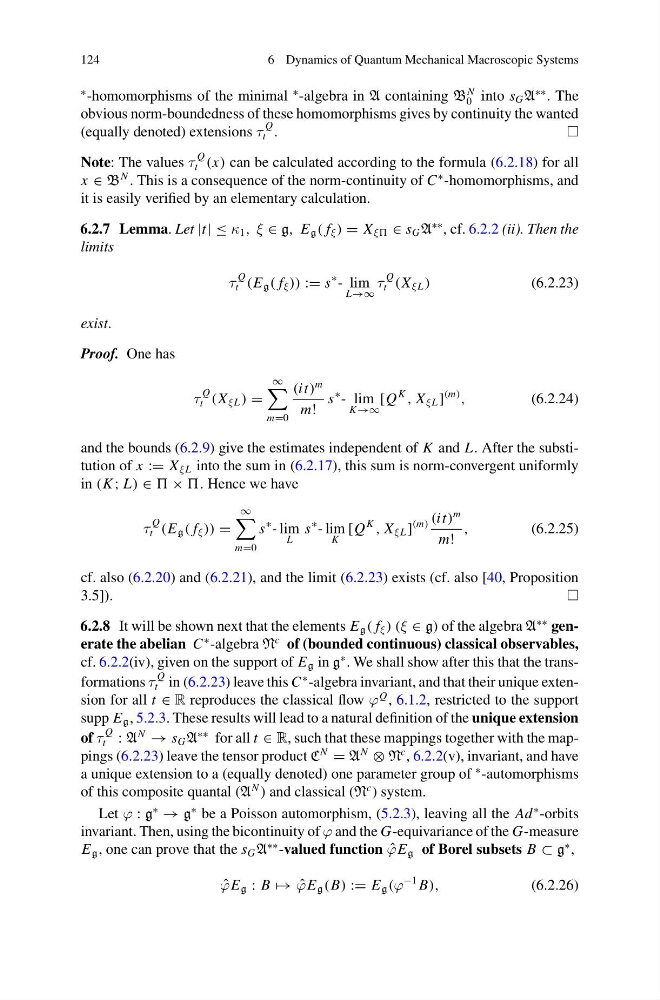
6.2.7 Lemma. Let |t| ≤ κ 1 , ξ ∈ g, E g ( f ξ ) = X ξ ∈ s G A
∗∗ , cf. 6.2.2 (ii). Then the
limits
τ
Q
t (E g ( f ξ )) := s
∗ - lim
L→∞
τ
Q
t (X ξ L )
(6.2.23)
exist.
Proof. One has
τ
Q
t (X ξ L ) =
∞
m=0
(it)
m
m!
s
∗ - lim
K →∞
[Q
K
, X ξ L ]
(m)
,
(6.2.24)
and the bounds (6.2.9) give the estimates independent of K and L. After the substitution of x := X ξ L into the sum in (6.2.17), this sum is norm-convergent uniformly
in (K ; L) ∈ × . Hence we have
τ
Q
t (E g ( f ξ )) =
∞
m=0
s
∗ - lim
L
s
∗ - lim
K
[Q
K
, X ξ L ]
(m) (it)
m
m!
,
(6.2.25)
cf. also (6.2.20) and (6.2.21), and the limit (6.2.23) exists (cf. also [40, Proposition
3.5]).
6.2.8 It will be shown next that the elements E g ( f ξ ) (ξ ∈ g) of the algebra A
∗∗ generate the abelian C
∗ -algebra N
c of (bounded continuous) classical observables,
cf. 6.2.2(iv), given on the support of E g in g
∗ . We shall show after this that the transformations τ
Q
t in (6.2.23) leave this C
∗ -algebra invariant, and that their unique extension for all t ∈ R reproduces the classical flow ϕ
Q , 6.1.2, restricted to the support
supp E g , 5.2.3. These results will lead to a natural definition of the unique extension
of τ
Q
t : A
N
→ s G A
∗∗ for all t ∈ R, such that these mappings together with the mappings (6.2.23) leave the tensor product C
N
= A
N
⊗ N
c , 6.2.2(v), invariant, and have
a unique extension to a (equally denoted) one parameter group of
∗ -automorphisms
of this composite quantal (A
N ) and classical (N
c ) system.
Let ϕ : g
∗
→ g
∗ be a Poisson automorphism, (5.2.3), leaving all the Ad
∗ -orbits
invariant. Then, using the bicontinuity of ϕ and the G-equivariance of the G-measure
E g , one can prove that the s G A
∗∗ -valued function ˆ
ϕE g of Borel subsets B ⊂ g
∗ ,
ˆ
ϕE g : B → ˆ
ϕE g (B) := E g (ϕ
−1 B),
(6.2.26)
6 Dynamics of Quantum Mechanical Macroscopic Systems
∗ -homomorphisms of the minimal
∗ -algebra in A containing B
N
0 into s G A
∗∗ . The
obvious norm-boundedness of these homomorphisms gives by continuity the wanted
(equally denoted) extensions τ
Q
t .
Note: The values τ
Q
t (x) can be calculated according to the formula (6.2.18) for all
x ∈ B
N . This is a consequence of the norm-continuity of C
∗ -homomorphisms, and
it is easily verified by an elementary calculation.
6.2.7 Lemma. Let |t| ≤ κ 1 , ξ ∈ g, E g ( f ξ ) = X ξ ∈ s G A
∗∗ , cf. 6.2.2 (ii). Then the
limits
τ
Q
t (E g ( f ξ )) := s
∗ - lim
L→∞
τ
Q
t (X ξ L )
(6.2.23)
exist.
Proof. One has
τ
Q
t (X ξ L ) =
∞
m=0
(it)
m
m!
s
∗ - lim
K →∞
[Q
K
, X ξ L ]
(m)
,
(6.2.24)
and the bounds (6.2.9) give the estimates independent of K and L. After the substitution of x := X ξ L into the sum in (6.2.17), this sum is norm-convergent uniformly
in (K ; L) ∈ × . Hence we have
τ
Q
t (E g ( f ξ )) =
∞
m=0
s
∗ - lim
L
s
∗ - lim
K
[Q
K
, X ξ L ]
(m) (it)
m
m!
,
(6.2.25)
cf. also (6.2.20) and (6.2.21), and the limit (6.2.23) exists (cf. also [40, Proposition
3.5]).
6.2.8 It will be shown next that the elements E g ( f ξ ) (ξ ∈ g) of the algebra A
∗∗ generate the abelian C
∗ -algebra N
c of (bounded continuous) classical observables,
cf. 6.2.2(iv), given on the support of E g in g
∗ . We shall show after this that the transformations τ
Q
t in (6.2.23) leave this C
∗ -algebra invariant, and that their unique extension for all t ∈ R reproduces the classical flow ϕ
Q , 6.1.2, restricted to the support
supp E g , 5.2.3. These results will lead to a natural definition of the unique extension
of τ
Q
t : A
N
→ s G A
∗∗ for all t ∈ R, such that these mappings together with the mappings (6.2.23) leave the tensor product C
N
= A
N
⊗ N
c , 6.2.2(v), invariant, and have
a unique extension to a (equally denoted) one parameter group of
∗ -automorphisms
of this composite quantal (A
N ) and classical (N
c ) system.
Let ϕ : g
∗
→ g
∗ be a Poisson automorphism, (5.2.3), leaving all the Ad
∗ -orbits
invariant. Then, using the bicontinuity of ϕ and the G-equivariance of the G-measure
E g , one can prove that the s G A
∗∗ -valued function ˆ
ϕE g of Borel subsets B ⊂ g
∗ ,
ˆ
ϕE g : B → ˆ
ϕE g (B) := E g (ϕ
−1 B),
(6.2.26)