

6.1 General Considerations
119
of states on A (and their canonical normal extensions to A
∗∗ ), so called ‘classical
states’. The reason why we cannot use the set of all states S(A) for the definition of
τ
Q can be seen from the thermodynamic limits of polynomial interactions described
in Sect. 6.2: In the representations of A containing the GNS-representations of states
{ω : ω( p G ) = 1} as their subrepresentations the thermodynamic limits of the local
evolutions τ
N do not exist for a general Q. This fact can be seen from the definition
of the projector p G in (5.1.120) as well as from considerations in Sect. 6.2. Although
the resulting (algebraic) concept of τ
Q can be used in certain cases to a definition of
time evolution of all states on A, such a definition scarcely can be considered as a
physically correct consequence of the given interaction Q. This interaction does not
lead to any reasonable (from the point of view of physics) time evolution of states ω of
the infinite system, the central supports s ω of which are orthogonal to p G : s ω p G = 0,
i.e. ω( p G ) = 0. Since the set S g = p G S(A) is τ
Q -invariant (as will be clear later),
the time evolution of states ω ∈ (I − p G )S(A), where I is the identity of A
∗∗ , can
be determined arbitrarily with a help of some group τ R ⊂
∗ - Aut (I − p G )A
∗∗ . The
group τ R has nothing to do, in a general case, with the evolution τ
Q . For special
choices of the function Q, however, the evolution τ
Q can be defined on a larger
subalgebra of A
∗∗ than p G A
∗∗ , hence also an evolution of a set of states larger than
S g can be defined in a natural way, cf. also [40, Sect. II.C]. This can be seen on the
following (seemingly trivial) example.
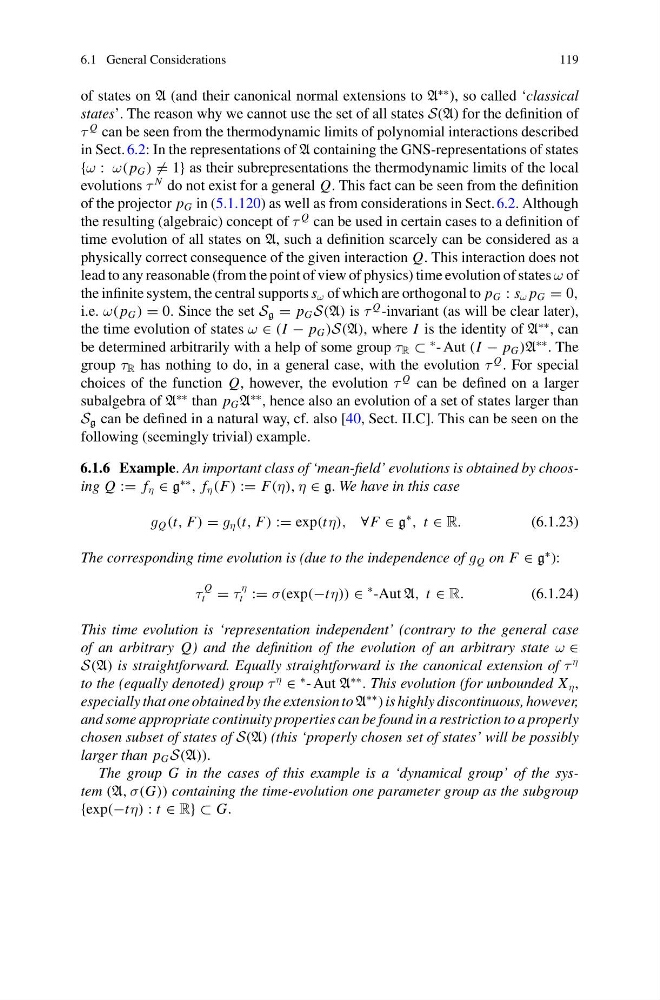
6.1.6 Example. An important class of ‘mean-field’ evolutions is obtained by choosing Q := f η ∈ g
∗∗
, f η (F) := F(η), η ∈ g. We have in this case
g Q (t, F) = g η (t, F) := exp(tη), ∀F ∈ g
∗
, t ∈ R.
(6.1.23)
The corresponding time evolution is (due to the independence of g Q on F ∈ g
∗ ):
τ
Q
t = τ
η
t := σ(exp(−tη)) ∈
∗ -Aut A, t ∈ R.
(6.1.24)
This time evolution is ‘representation independent’ (contrary to the general case
of an arbitrary Q) and the definition of the evolution of an arbitrary state ω ∈
S(A) is straightforward. Equally straightforward is the canonical extension of τ
η
to the (equally denoted) group τ
η
∈
∗ - Aut A
∗∗
. This evolution (for unbounded X η ,
especially that one obtained by the extension to A
∗∗ ) is highly discontinuous, however,
and some appropriate continuity properties can be found in a restriction to a properly
chosen subset of states of S(A) (this ‘properly chosen set of states’ will be possibly
larger than p G S(A)).
The group G in the cases of this example is a ‘dynamical group’ of the system (A, σ(G)) containing the time-evolution one parameter group as the subgroup
{exp(−tη) : t ∈ R} ⊂ G.
119
of states on A (and their canonical normal extensions to A
∗∗ ), so called ‘classical
states’. The reason why we cannot use the set of all states S(A) for the definition of
τ
Q can be seen from the thermodynamic limits of polynomial interactions described
in Sect. 6.2: In the representations of A containing the GNS-representations of states
{ω : ω( p G ) = 1} as their subrepresentations the thermodynamic limits of the local
evolutions τ
N do not exist for a general Q. This fact can be seen from the definition
of the projector p G in (5.1.120) as well as from considerations in Sect. 6.2. Although
the resulting (algebraic) concept of τ
Q can be used in certain cases to a definition of
time evolution of all states on A, such a definition scarcely can be considered as a
physically correct consequence of the given interaction Q. This interaction does not
lead to any reasonable (from the point of view of physics) time evolution of states ω of
the infinite system, the central supports s ω of which are orthogonal to p G : s ω p G = 0,
i.e. ω( p G ) = 0. Since the set S g = p G S(A) is τ
Q -invariant (as will be clear later),
the time evolution of states ω ∈ (I − p G )S(A), where I is the identity of A
∗∗ , can
be determined arbitrarily with a help of some group τ R ⊂
∗ - Aut (I − p G )A
∗∗ . The
group τ R has nothing to do, in a general case, with the evolution τ
Q . For special
choices of the function Q, however, the evolution τ
Q can be defined on a larger
subalgebra of A
∗∗ than p G A
∗∗ , hence also an evolution of a set of states larger than
S g can be defined in a natural way, cf. also [40, Sect. II.C]. This can be seen on the
following (seemingly trivial) example.
6.1.6 Example. An important class of ‘mean-field’ evolutions is obtained by choosing Q := f η ∈ g
∗∗
, f η (F) := F(η), η ∈ g. We have in this case
g Q (t, F) = g η (t, F) := exp(tη), ∀F ∈ g
∗
, t ∈ R.
(6.1.23)
The corresponding time evolution is (due to the independence of g Q on F ∈ g
∗ ):
τ
Q
t = τ
η
t := σ(exp(−tη)) ∈
∗ -Aut A, t ∈ R.
(6.1.24)
This time evolution is ‘representation independent’ (contrary to the general case
of an arbitrary Q) and the definition of the evolution of an arbitrary state ω ∈
S(A) is straightforward. Equally straightforward is the canonical extension of τ
η
to the (equally denoted) group τ
η
∈
∗ - Aut A
∗∗
. This evolution (for unbounded X η ,
especially that one obtained by the extension to A
∗∗ ) is highly discontinuous, however,
and some appropriate continuity properties can be found in a restriction to a properly
chosen subset of states of S(A) (this ‘properly chosen set of states’ will be possibly
larger than p G S(A)).
The group G in the cases of this example is a ‘dynamical group’ of the system (A, σ(G)) containing the time-evolution one parameter group as the subgroup
{exp(−tη) : t ∈ R} ⊂ G.