

108
5 Macroscopic Limits
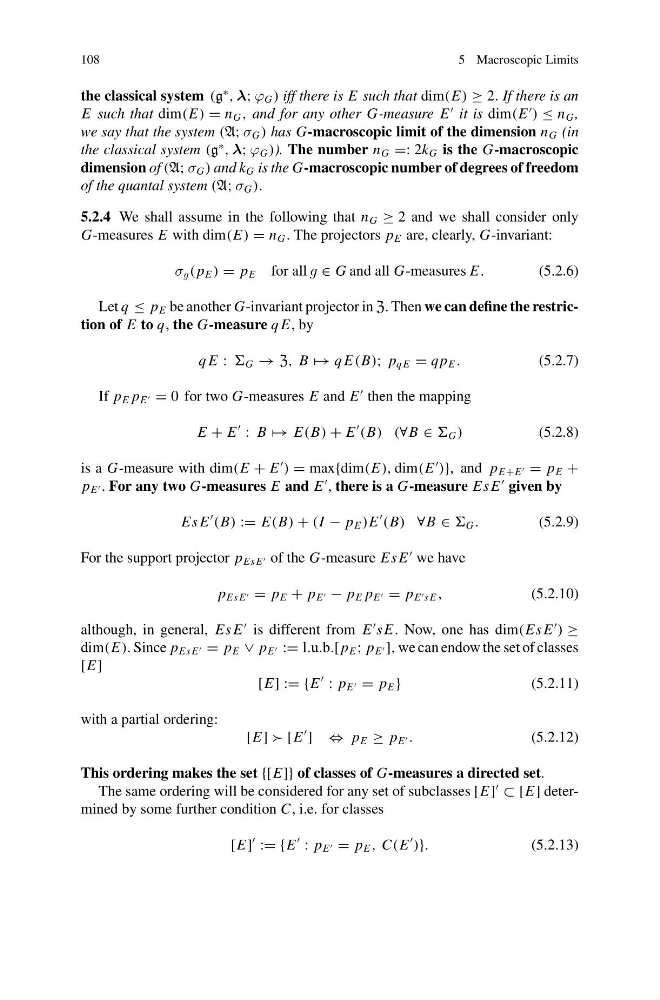
the classical system (g
∗
, λ; ϕ G ) iff there is E such that dim(E) ≥ 2. If there is an
E such that dim(E) = n G , and for any other G-measure E
it is dim(E
) ≤ n G ,
we say that the system (A; σ G ) has G-macroscopic limit of the dimension n G (in
the classical system (g
∗
, λ; ϕ G )). The number n G =: 2k G is the G-macroscopic
dimension of (A; σ G ) and k G is the G-macroscopic number of degrees of freedom
of the quantal system (A; σ G ).
5.2.4 We shall assume in the following that n G ≥ 2 and we shall consider only
G-measures E with dim(E) = n G . The projectors p E are, clearly, G-invariant:
σ g ( p E ) = p E for all g ∈ G and all G-measures E.
(5.2.6)
Let q ≤ p E be another G-invariant projector in Z. Then we can define the restriction of E to q, the G-measure q E, by
q E : G → Z, B → q E(B); p q E = qp E .
(5.2.7)
If p E p E = 0 for two G-measures E and E
then the mapping
E + E
: B → E(B) + E
(B) (∀B ∈ G )
(5.2.8)
is a G-measure with dim(E + E
) = max{dim(E), dim(E
)}, and p E+E = p E +
p E . For any two G-measures E and E
, there is a G-measure Es E
given by
Es E
(B) := E(B) + (I − p E )E
(B) ∀B ∈ G .
(5.2.9)
For the support projector p Es E of the G-measure Es E
we have
p Es E = p E + p E − p E p E = p E s E ,
(5.2.10)
although, in general, Es E
is different from E
s E. Now, one has dim(Es E
) ≥
dim(E). Since p Es E = p E ∨ p E := l.u.b.[ p E ; p E ], we can endow the set of classes
[E]
[E] := {E
: p E = p E }
(5.2.11)
with a partial ordering:
[E] ] [E
] ⇔ p E ≥ p E .
(5.2.12)
This ordering makes the set {[E]} of classes of G-measures a directed set.
The same ordering will be considered for any set of subclasses [E]
⊂ [E] determined by some further condition C, i.e. for classes
[E]
:= {E
: p E = p E , C(E
)}.
(5.2.13)
5 Macroscopic Limits
the classical system (g
∗
, λ; ϕ G ) iff there is E such that dim(E) ≥ 2. If there is an
E such that dim(E) = n G , and for any other G-measure E
it is dim(E
) ≤ n G ,
we say that the system (A; σ G ) has G-macroscopic limit of the dimension n G (in
the classical system (g
∗
, λ; ϕ G )). The number n G =: 2k G is the G-macroscopic
dimension of (A; σ G ) and k G is the G-macroscopic number of degrees of freedom
of the quantal system (A; σ G ).
5.2.4 We shall assume in the following that n G ≥ 2 and we shall consider only
G-measures E with dim(E) = n G . The projectors p E are, clearly, G-invariant:
σ g ( p E ) = p E for all g ∈ G and all G-measures E.
(5.2.6)
Let q ≤ p E be another G-invariant projector in Z. Then we can define the restriction of E to q, the G-measure q E, by
q E : G → Z, B → q E(B); p q E = qp E .
(5.2.7)
If p E p E = 0 for two G-measures E and E
then the mapping
E + E
: B → E(B) + E
(B) (∀B ∈ G )
(5.2.8)
is a G-measure with dim(E + E
) = max{dim(E), dim(E
)}, and p E+E = p E +
p E . For any two G-measures E and E
, there is a G-measure Es E
given by
Es E
(B) := E(B) + (I − p E )E
(B) ∀B ∈ G .
(5.2.9)
For the support projector p Es E of the G-measure Es E
we have
p Es E = p E + p E − p E p E = p E s E ,
(5.2.10)
although, in general, Es E
is different from E
s E. Now, one has dim(Es E
) ≥
dim(E). Since p Es E = p E ∨ p E := l.u.b.[ p E ; p E ], we can endow the set of classes
[E]
[E] := {E
: p E = p E }
(5.2.11)
with a partial ordering:
[E] ] [E
] ⇔ p E ≥ p E .
(5.2.12)
This ordering makes the set {[E]} of classes of G-measures a directed set.
The same ordering will be considered for any set of subclasses [E]
⊂ [E] determined by some further condition C, i.e. for classes
[E]
:= {E
: p E = p E , C(E
)}.
(5.2.13)