

106
5 Macroscopic Limits
term ‘macroscopic limit’ can be here understood in an analogy with the preceding
section.
The notion of the macroscopic limit introduced in this section is nonunique.
A certain arbitrariness is contained, however, also in the corresponding notion of
Sect. 5.1: The generators X
N
ξ of the restriction of σ G to A
N
:= ⊗
N
j=1 A j ⊂ A
are
determined up to additive constants a N (ξ), a N ∈ g
∗
, ξ ∈ g,
6 hence also the choice of
p G ∈ Z was arbitrary in a certain sense. We shall avoid partly this kind of ambiguity
in this section: we are dealing here just with the action of σ G , and not with generators.
5.2.2 Let G be a connected Lie group, g its Lie algebra, and g
∗ the dual of g. Let A be
an arbitrary C
∗ -algebra, A
∗∗ its double dual W
∗ -algebra, and Z is the center of A
∗∗ .
The algebra A is naturally contained in A
∗∗ as a σ(A
∗∗
, A
∗
)-dense C
∗ -subalgebra.
Any state ω ∈ S(A):= the state space of A, has a natural extension
e ∗ ω ∈ S ∗ (A
∗∗
) := the normal states of A
∗∗
.
If M is a C
∗ -subalgebra of A
∗∗ , then r M : S(A
∗∗
) → S(M) is the restriction
mapping; r M is σ(A
∗∗∗
, A
∗∗
) − σ(M
∗
, M) continuous and maps normal states onto
normal states.
Let σ : G →
∗ - Aut A, g → σ g be a given action of G; by the same symbol
σ G is denoted the canonical extension of σ G ⊂
∗ - Aut A to the action on A
∗∗ —the
double transpose of σ G . This system will be denoted by (A; σ G ). Z will denote the
spectrum space of Z = C(Z).
Let g
∗ be endowed with the structure of a Poisson manifold, 5.1.37, given by a
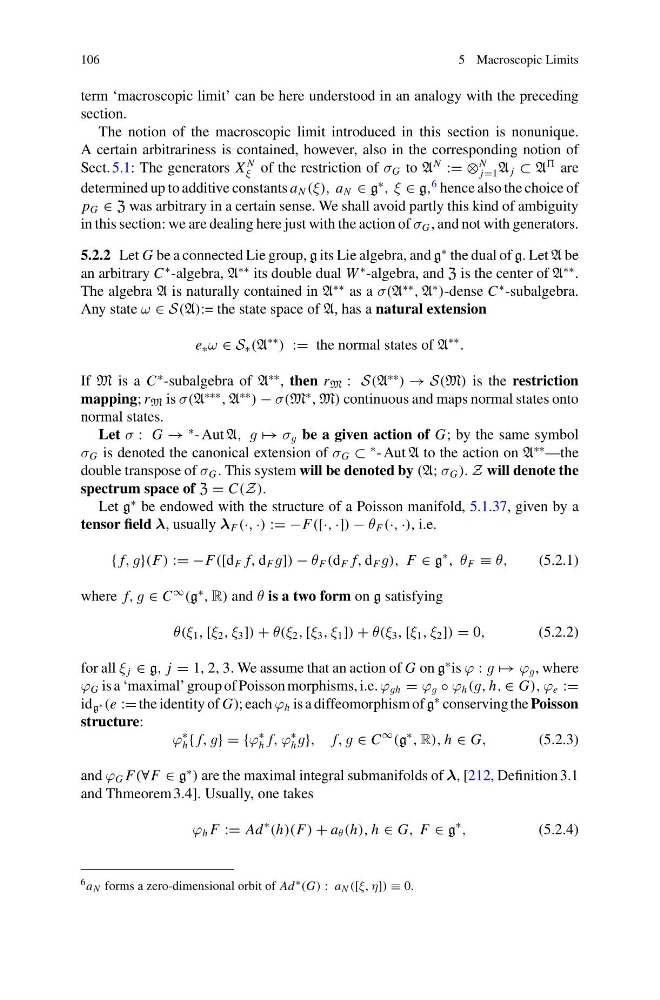
tensor field λ, usually λ F (·, ·) := −F([·, ·]) − θ F (·, ·), i.e.
{ f, g}(F) := −F([d F f, d F g]) − θ F (d F f, d F g), F ∈ g
∗
, θ F ≡ θ,
(5.2.1)
where f, g ∈ C
∞
(g
∗
, R) and θ is a two form on g satisfying
θ(ξ 1 , [ξ 2 , ξ 3 ]) + θ(ξ 2 , [ξ 3 , ξ 1 ]) + θ(ξ 3 , [ξ 1 , ξ 2 ]) = 0,
(5.2.2)
for all ξ j ∈ g, j = 1, 2, 3. We assume that an action of G on g
∗ is ϕ : g → ϕ g , where
ϕ G is a ‘maximal’ group of Poisson morphisms, i.e. ϕ gh = ϕ g ◦ ϕ h (g, h, ∈ G), ϕ e :=
id g ∗ (e := the identity of G); each ϕ h is a diffeomorphism of g
∗ conserving the Poisson
structure:
ϕ
∗
h { f, g} = {ϕ
∗
h f, ϕ
∗
h g}, f, g ∈ C
∞
(g
∗
, R), h ∈ G,
(5.2.3)
and ϕ G F(∀F ∈ g
∗
) are the maximal integral submanifolds of λ, [212, Definition 3.1
and Thmeorem 3.4]. Usually, one takes
ϕ h F := Ad
∗
(h)(F) + a θ (h), h ∈ G, F ∈ g
∗
,
(5.2.4)
6 a N forms a zero-dimensional orbit of Ad ∗ (G) : a N ([ξ, η]) ≡ 0.
5 Macroscopic Limits
term ‘macroscopic limit’ can be here understood in an analogy with the preceding
section.
The notion of the macroscopic limit introduced in this section is nonunique.
A certain arbitrariness is contained, however, also in the corresponding notion of
Sect. 5.1: The generators X
N
ξ of the restriction of σ G to A
N
:= ⊗
N
j=1 A j ⊂ A
are
determined up to additive constants a N (ξ), a N ∈ g
∗
, ξ ∈ g,
6 hence also the choice of
p G ∈ Z was arbitrary in a certain sense. We shall avoid partly this kind of ambiguity
in this section: we are dealing here just with the action of σ G , and not with generators.
5.2.2 Let G be a connected Lie group, g its Lie algebra, and g
∗ the dual of g. Let A be
an arbitrary C
∗ -algebra, A
∗∗ its double dual W
∗ -algebra, and Z is the center of A
∗∗ .
The algebra A is naturally contained in A
∗∗ as a σ(A
∗∗
, A
∗
)-dense C
∗ -subalgebra.
Any state ω ∈ S(A):= the state space of A, has a natural extension
e ∗ ω ∈ S ∗ (A
∗∗
) := the normal states of A
∗∗
.
If M is a C
∗ -subalgebra of A
∗∗ , then r M : S(A
∗∗
) → S(M) is the restriction
mapping; r M is σ(A
∗∗∗
, A
∗∗
) − σ(M
∗
, M) continuous and maps normal states onto
normal states.
Let σ : G →
∗ - Aut A, g → σ g be a given action of G; by the same symbol
σ G is denoted the canonical extension of σ G ⊂
∗ - Aut A to the action on A
∗∗ —the
double transpose of σ G . This system will be denoted by (A; σ G ). Z will denote the
spectrum space of Z = C(Z).
Let g
∗ be endowed with the structure of a Poisson manifold, 5.1.37, given by a
tensor field λ, usually λ F (·, ·) := −F([·, ·]) − θ F (·, ·), i.e.
{ f, g}(F) := −F([d F f, d F g]) − θ F (d F f, d F g), F ∈ g
∗
, θ F ≡ θ,
(5.2.1)
where f, g ∈ C
∞
(g
∗
, R) and θ is a two form on g satisfying
θ(ξ 1 , [ξ 2 , ξ 3 ]) + θ(ξ 2 , [ξ 3 , ξ 1 ]) + θ(ξ 3 , [ξ 1 , ξ 2 ]) = 0,
(5.2.2)
for all ξ j ∈ g, j = 1, 2, 3. We assume that an action of G on g
∗ is ϕ : g → ϕ g , where
ϕ G is a ‘maximal’ group of Poisson morphisms, i.e. ϕ gh = ϕ g ◦ ϕ h (g, h, ∈ G), ϕ e :=
id g ∗ (e := the identity of G); each ϕ h is a diffeomorphism of g
∗ conserving the Poisson
structure:
ϕ
∗
h { f, g} = {ϕ
∗
h f, ϕ
∗
h g}, f, g ∈ C
∞
(g
∗
, R), h ∈ G,
(5.2.3)
and ϕ G F(∀F ∈ g
∗
) are the maximal integral submanifolds of λ, [212, Definition 3.1
and Thmeorem 3.4]. Usually, one takes
ϕ h F := Ad
∗
(h)(F) + a θ (h), h ∈ G, F ∈ g
∗
,
(5.2.4)
6 a N forms a zero-dimensional orbit of Ad ∗ (G) : a N ([ξ, η]) ≡ 0.