

102
5 Macroscopic Limits
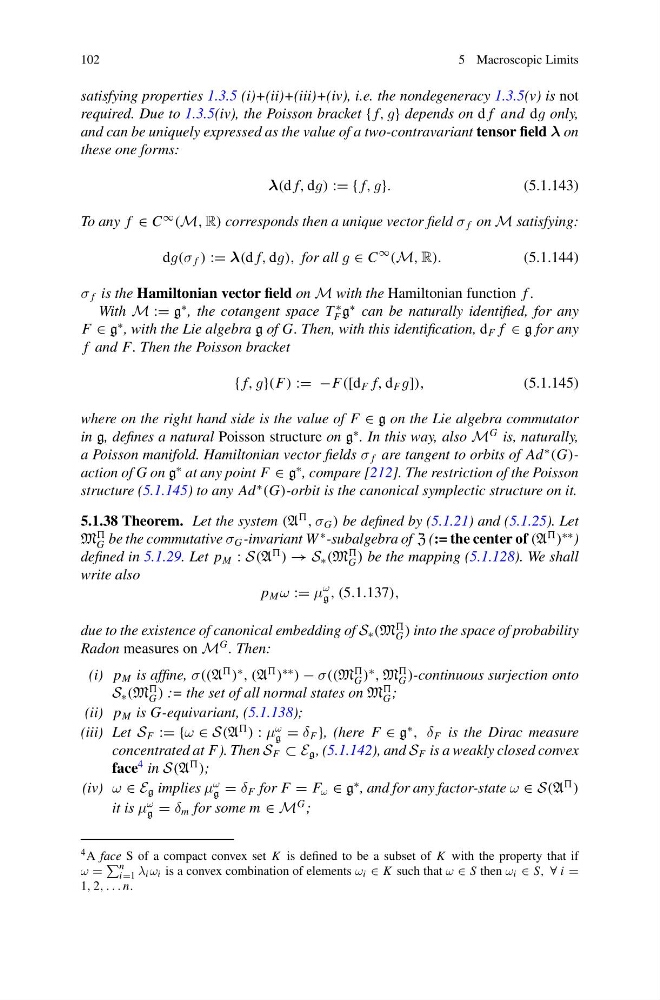
satisfying properties 1.3.5 (i)+(ii)+(iii)+(iv), i.e. the nondegeneracy 1.3.5(v) is not
required. Due to 1.3.5(iv), the Poisson bracket { f, g} depends on d f and dg only,
and can be uniquely expressed as the value of a two-contravariant tensor field λ on
these one forms:
λ(d f, dg) := { f, g}.
(5.1.143)
To any f ∈ C
∞
(M, R) corresponds then a unique vector field σ f on M satisfying:
dg(σ f ) := λ(d f, dg), for all g ∈ C
∞
(M, R).
(5.1.144)
σ f is the Hamiltonian vector field on M with the Hamiltonian function f .
With M := g
∗ , the cotangent space T
∗
F g
∗ can be naturally identified, for any
F ∈ g
∗ , with the Lie algebra g of G. Then, with this identification, d F f ∈ g for any
f and F. Then the Poisson bracket
{ f, g}(F) := −F([d F f, d F g]),
(5.1.145)
where on the right hand side is the value of F ∈ g on the Lie algebra commutator
in g, defines a natural Poisson structure on g
∗ . In this way, also M
G is, naturally,
a Poisson manifold. Hamiltonian vector fields σ f are tangent to orbits of Ad
∗
(G)action of G on g
∗ at any point F ∈ g
∗ , compare [212]. The restriction of the Poisson
structure (5.1.145) to any Ad
∗
(G)-orbit is the canonical symplectic structure on it.
5.1.38 Theorem. Let the system (A
, σ G ) be defined by (5.1.21) and (5.1.25). Let
M
G be the commutative σ G -invariant W
∗ -subalgebra of Z (:= the center of (A
)
∗∗ )
defined in 5.1.29. Let p M : S(A
) → S ∗ (M
G ) be the mapping (5.1.128). We shall
write also
p M ω := μ
ω
g , (5.1.137),
due to the existence of canonical embedding of S ∗ (M
G ) into the space of probability
Radon measures on M
G . Then:
(i) p M is affine, σ((A
)
∗
, (A
)
∗∗
) − σ((M
G )
∗
, M
G )-continuous surjection onto
S ∗ (M
G ) := the set of all normal states on M
G ;
(ii) p M is G-equivariant, (5.1.138);
(iii) Let S F := {ω ∈ S(A
) : μ
ω
g = δ F }, (here F ∈ g
∗
, δ F is the Dirac measure
concentrated at F). Then S F ⊂ E g , (5.1.142), and S F is a weakly closed convex
face
4 in S(A
);
(iv) ω ∈ E g implies μ
ω
g = δ F for F = F ω ∈ g
∗ , and for any factor-state ω ∈ S(A
)
it is μ
ω
g = δ m for some m ∈ M
G ;
4 A face S of a compact convex set K is defined to be a subset of K with the property that if
ω =
n
i=1 λ i ω i is a convex combination of elements ω i ∈ K such that ω ∈ S then ω i ∈ S, ∀ i =
1, 2, . . . n.
5 Macroscopic Limits
satisfying properties 1.3.5 (i)+(ii)+(iii)+(iv), i.e. the nondegeneracy 1.3.5(v) is not
required. Due to 1.3.5(iv), the Poisson bracket { f, g} depends on d f and dg only,
and can be uniquely expressed as the value of a two-contravariant tensor field λ on
these one forms:
λ(d f, dg) := { f, g}.
(5.1.143)
To any f ∈ C
∞
(M, R) corresponds then a unique vector field σ f on M satisfying:
dg(σ f ) := λ(d f, dg), for all g ∈ C
∞
(M, R).
(5.1.144)
σ f is the Hamiltonian vector field on M with the Hamiltonian function f .
With M := g
∗ , the cotangent space T
∗
F g
∗ can be naturally identified, for any
F ∈ g
∗ , with the Lie algebra g of G. Then, with this identification, d F f ∈ g for any
f and F. Then the Poisson bracket
{ f, g}(F) := −F([d F f, d F g]),
(5.1.145)
where on the right hand side is the value of F ∈ g on the Lie algebra commutator
in g, defines a natural Poisson structure on g
∗ . In this way, also M
G is, naturally,
a Poisson manifold. Hamiltonian vector fields σ f are tangent to orbits of Ad
∗
(G)action of G on g
∗ at any point F ∈ g
∗ , compare [212]. The restriction of the Poisson
structure (5.1.145) to any Ad
∗
(G)-orbit is the canonical symplectic structure on it.
5.1.38 Theorem. Let the system (A
, σ G ) be defined by (5.1.21) and (5.1.25). Let
M
G be the commutative σ G -invariant W
∗ -subalgebra of Z (:= the center of (A
)
∗∗ )
defined in 5.1.29. Let p M : S(A
) → S ∗ (M
G ) be the mapping (5.1.128). We shall
write also
p M ω := μ
ω
g , (5.1.137),
due to the existence of canonical embedding of S ∗ (M
G ) into the space of probability
Radon measures on M
G . Then:
(i) p M is affine, σ((A
)
∗
, (A
)
∗∗
) − σ((M
G )
∗
, M
G )-continuous surjection onto
S ∗ (M
G ) := the set of all normal states on M
G ;
(ii) p M is G-equivariant, (5.1.138);
(iii) Let S F := {ω ∈ S(A
) : μ
ω
g = δ F }, (here F ∈ g
∗
, δ F is the Dirac measure
concentrated at F). Then S F ⊂ E g , (5.1.142), and S F is a weakly closed convex
face
4 in S(A
);
(iv) ω ∈ E g implies μ
ω
g = δ F for F = F ω ∈ g
∗ , and for any factor-state ω ∈ S(A
)
it is μ
ω
g = δ m for some m ∈ M
G ;
4 A face S of a compact convex set K is defined to be a subset of K with the property that if
ω =
n
i=1 λ i ω i is a convex combination of elements ω i ∈ K such that ω ∈ S then ω i ∈ S, ∀ i =
1, 2, . . . n.