

74
3 Experimental Techniques
3.6.3 Wind Tunnel Process
Once the heated aluminum head form was prepared, the testing was conducted.
Many different helmet testing procedures were experimented with by varying the
test conditions until the optimum and final procedure was selected for comparing the
effectiveness of helmet ventilation. In the selected test method, the aluminum head
form was heated by circulating water for each test until the average thermocouple
temperature was 10 °C or 20 °C above the temperature of the air in the tunnel. Then
the heating and pumping of water was stopped and a helmet together with textile liner
was placed on the aluminum head form. The velocity of the wind in the tunnel was
then gradually increased until the required speed was achieved. After the required
speed was reached, cooling began and the thermocouple temperatures were recorded.
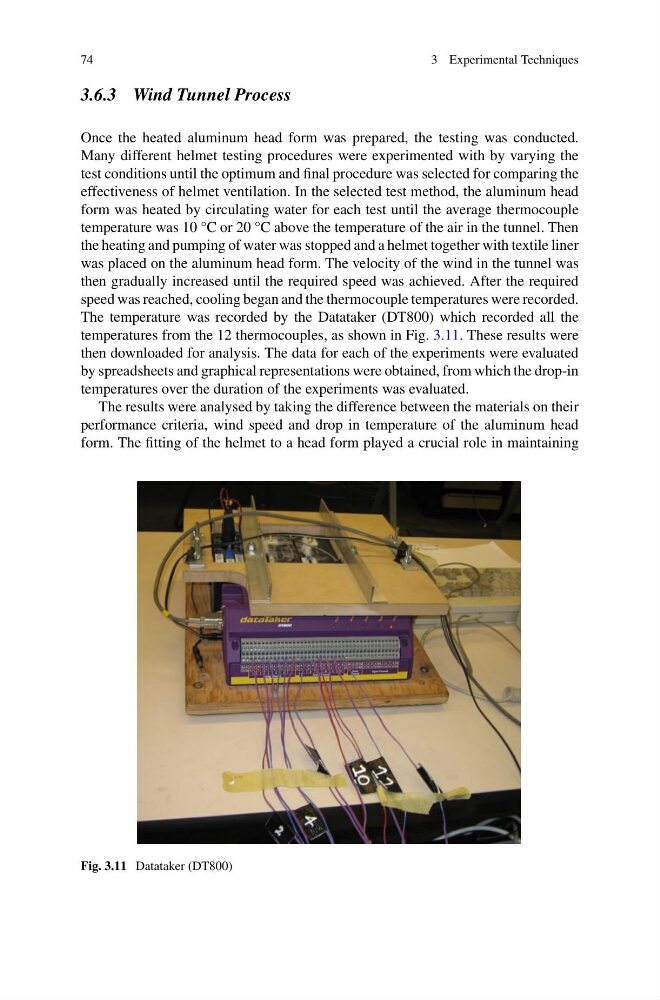
The temperature was recorded by the Datataker (DT800) which recorded all the
temperatures from the 12 thermocouples, as shown in Fig. 3.11. These results were
then downloaded for analysis. The data for each of the experiments were evaluated
by spreadsheets and graphical representations were obtained, from which the drop-in
temperatures over the duration of the experiments was evaluated.
The results were analysed by taking the difference between the materials on their
performance criteria, wind speed and drop in temperature of the aluminum head
form. The fitting of the helmet to a head form played a crucial role in maintaining
Fig. 3.11 Datataker (DT800)
3 Experimental Techniques
3.6.3 Wind Tunnel Process
Once the heated aluminum head form was prepared, the testing was conducted.
Many different helmet testing procedures were experimented with by varying the
test conditions until the optimum and final procedure was selected for comparing the
effectiveness of helmet ventilation. In the selected test method, the aluminum head
form was heated by circulating water for each test until the average thermocouple
temperature was 10 °C or 20 °C above the temperature of the air in the tunnel. Then
the heating and pumping of water was stopped and a helmet together with textile liner
was placed on the aluminum head form. The velocity of the wind in the tunnel was
then gradually increased until the required speed was achieved. After the required
speed was reached, cooling began and the thermocouple temperatures were recorded.
The temperature was recorded by the Datataker (DT800) which recorded all the
temperatures from the 12 thermocouples, as shown in Fig. 3.11. These results were
then downloaded for analysis. The data for each of the experiments were evaluated
by spreadsheets and graphical representations were obtained, from which the drop-in
temperatures over the duration of the experiments was evaluated.
The results were analysed by taking the difference between the materials on their
performance criteria, wind speed and drop in temperature of the aluminum head
form. The fitting of the helmet to a head form played a crucial role in maintaining
Fig. 3.11 Datataker (DT800)