

64
3 Experimental Techniques
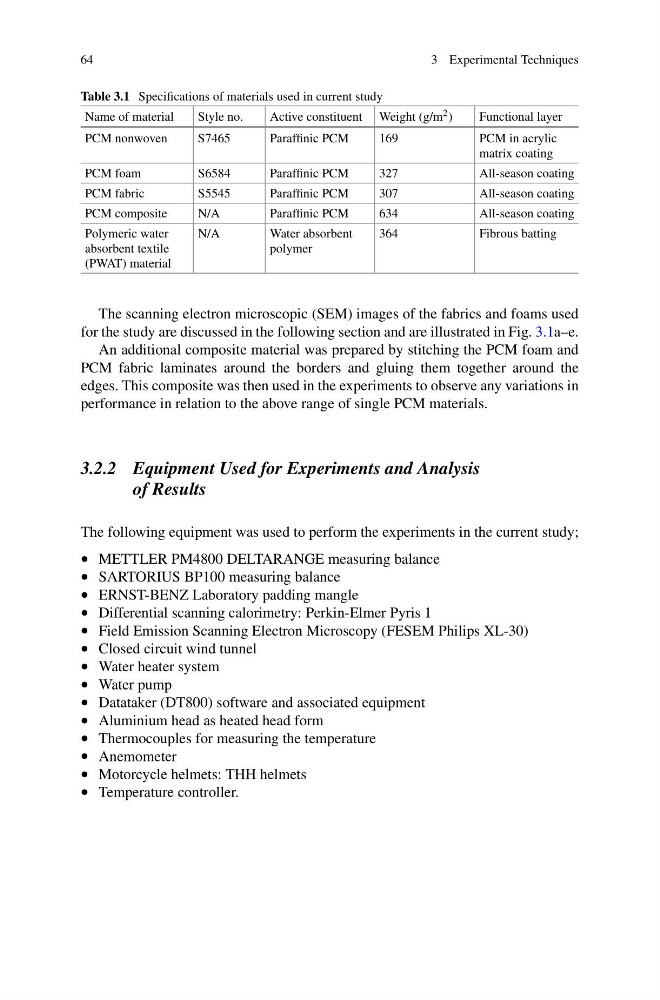
Table 3.1 Specifications of materials used in current study
Name of material
Style no.
Active constituent Weight (g/m 2 )
Functional layer
PCM nonwoven
S7465
Paraffinic PCM
169
PCM in acrylic
matrix coating
PCM foam
S6584
Paraffinic PCM
327
All-season coating
PCM fabric
S5545
Paraffinic PCM
307
All-season coating
PCM composite
N/A
Paraffinic PCM
634
All-season coating
Polymeric water
absorbent textile
(PWAT) material
N/A
Water absorbent
polymer
364
Fibrous batting
The scanning electron microscopic (SEM) images of the fabrics and foams used
for the study are discussed in the following section and are illustrated in Fig. 3.1a–e.
An additional composite material was prepared by stitching the PCM foam and
PCM fabric laminates around the borders and gluing them together around the
edges. This composite was then used in the experiments to observe any variations in
performance in relation to the above range of single PCM materials.
3.2.2 Equipment Used for Experiments and Analysis
of Results
The following equipment was used to perform the experiments in the current study;
• METTLER PM4800 DELTARANGE measuring balance
• SARTORIUS BP100 measuring balance
• ERNST-BENZ Laboratory padding mangle
• Differential scanning calorimetry: Perkin-Elmer Pyris 1
• Field Emission Scanning Electron Microscopy (FESEM Philips XL-30)
• Closed circuit wind tunnel
• Water heater system
• Water pump
• Datataker (DT800) software and associated equipment
• Aluminium head as heated head form
• Thermocouples for measuring the temperature
• Anemometer
• Motorcycle helmets: THH helmets
• Temperature controller.
3 Experimental Techniques
Table 3.1 Specifications of materials used in current study
Name of material
Style no.
Active constituent Weight (g/m 2 )
Functional layer
PCM nonwoven
S7465
Paraffinic PCM
169
PCM in acrylic
matrix coating
PCM foam
S6584
Paraffinic PCM
327
All-season coating
PCM fabric
S5545
Paraffinic PCM
307
All-season coating
PCM composite
N/A
Paraffinic PCM
634
All-season coating
Polymeric water
absorbent textile
(PWAT) material
N/A
Water absorbent
polymer
364
Fibrous batting
The scanning electron microscopic (SEM) images of the fabrics and foams used
for the study are discussed in the following section and are illustrated in Fig. 3.1a–e.
An additional composite material was prepared by stitching the PCM foam and
PCM fabric laminates around the borders and gluing them together around the
edges. This composite was then used in the experiments to observe any variations in
performance in relation to the above range of single PCM materials.
3.2.2 Equipment Used for Experiments and Analysis
of Results
The following equipment was used to perform the experiments in the current study;
• METTLER PM4800 DELTARANGE measuring balance
• SARTORIUS BP100 measuring balance
• ERNST-BENZ Laboratory padding mangle
• Differential scanning calorimetry: Perkin-Elmer Pyris 1
• Field Emission Scanning Electron Microscopy (FESEM Philips XL-30)
• Closed circuit wind tunnel
• Water heater system
• Water pump
• Datataker (DT800) software and associated equipment
• Aluminium head as heated head form
• Thermocouples for measuring the temperature
• Anemometer
• Motorcycle helmets: THH helmets
• Temperature controller.