

38
2 Review of Literature: Motorcycle helmet
When the ambient temperature increases above 32.1 °C (the melting point of nonadecane), the nonadecane melts, and latent heat is absorbed, thereby interrupting the
increase in temperature of a garment. Once the ambient temperature falls, the PCM
solidifies, and the latent heat is released, providing a heating effect. Thus, PCM can
be used to provide a cooling or heating effect on the garment microclimate depending
on the ambient temperature. The various applications of PCM are discussed in the
following section.
2.13.3.1 Textile Applications
In the field of textiles, there are many applications of PCM such as casual clothing,
sportswear, technical textiles (bulletproof vests, spacesuits and air suits), medical
uses, automotive textiles and shoe linings. For textile applications, PCM can be
applied to textile substrates by four methods, namely: spinning of fibres containing
PCM; impregnation of the fibres with PCM; coating the fibres with micro-PCM and
direct incorporation of PCM into polymer film [126].
In the first method, PCM are added to the liquid polymer (solution or melt)
followed by fibre spinning by various conventional methods such as dry or wet spinning. The protection of micro-PCM is enhanced in this process as there are two walls
covering the PCM. The first wall is the wall of the microcapsule, and the second wall
is the fibre itself [179]. Also, composite fibre-spinning (such as polytetramtehylene
glycol (PTMG) used as core and PET used as sheath) can be employed. Gateway
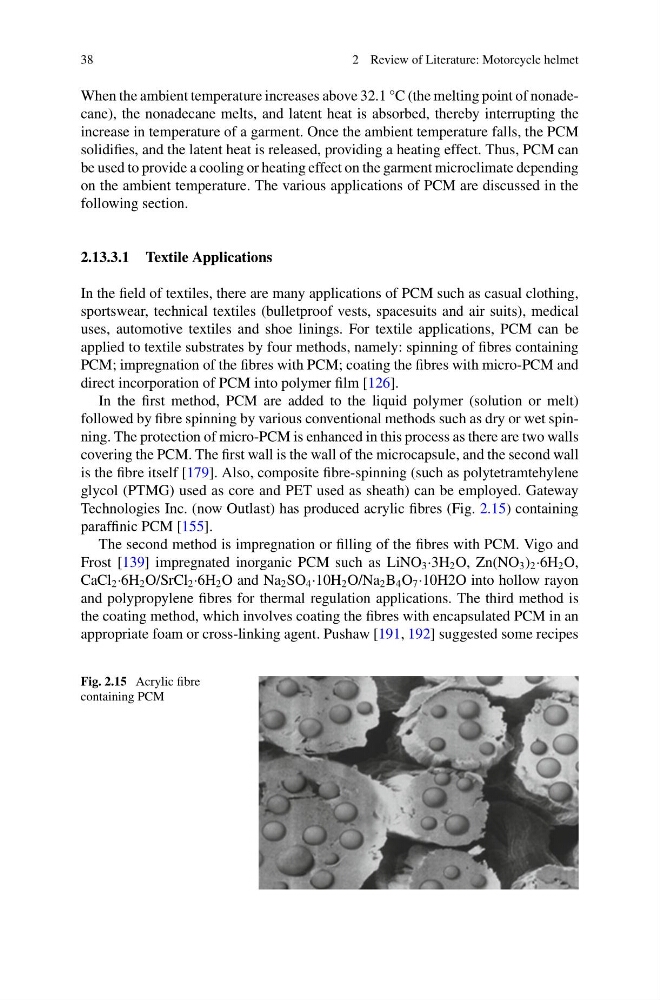
Technologies Inc. (now Outlast) has produced acrylic fibres (Fig. 2.15) containing
paraffinic PCM [155].
The second method is impregnation or filling of the fibres with PCM. Vigo and
Frost [139] impregnated inorganic PCM such as LiNO 3 ·3H 2 O, Zn(NO 3 ) 2 ·6H 2 O,
CaCl 2 ·6H 2 O/SrCl 2 ·6H 2 O and Na 2 SO 4 ·10H 2 O/Na 2 B 4 O 7 ·10H2O into hollow rayon
and polypropylene fibres for thermal regulation applications. The third method is
the coating method, which involves coating the fibres with encapsulated PCM in an
appropriate foam or cross-linking agent. Pushaw [191, 192] suggested some recipes
Fig. 2.15 Acrylic fibre
containing PCM
2 Review of Literature: Motorcycle helmet
When the ambient temperature increases above 32.1 °C (the melting point of nonadecane), the nonadecane melts, and latent heat is absorbed, thereby interrupting the
increase in temperature of a garment. Once the ambient temperature falls, the PCM
solidifies, and the latent heat is released, providing a heating effect. Thus, PCM can
be used to provide a cooling or heating effect on the garment microclimate depending
on the ambient temperature. The various applications of PCM are discussed in the
following section.
2.13.3.1 Textile Applications
In the field of textiles, there are many applications of PCM such as casual clothing,
sportswear, technical textiles (bulletproof vests, spacesuits and air suits), medical
uses, automotive textiles and shoe linings. For textile applications, PCM can be
applied to textile substrates by four methods, namely: spinning of fibres containing
PCM; impregnation of the fibres with PCM; coating the fibres with micro-PCM and
direct incorporation of PCM into polymer film [126].
In the first method, PCM are added to the liquid polymer (solution or melt)
followed by fibre spinning by various conventional methods such as dry or wet spinning. The protection of micro-PCM is enhanced in this process as there are two walls
covering the PCM. The first wall is the wall of the microcapsule, and the second wall
is the fibre itself [179]. Also, composite fibre-spinning (such as polytetramtehylene
glycol (PTMG) used as core and PET used as sheath) can be employed. Gateway
Technologies Inc. (now Outlast) has produced acrylic fibres (Fig. 2.15) containing
paraffinic PCM [155].
The second method is impregnation or filling of the fibres with PCM. Vigo and
Frost [139] impregnated inorganic PCM such as LiNO 3 ·3H 2 O, Zn(NO 3 ) 2 ·6H 2 O,
CaCl 2 ·6H 2 O/SrCl 2 ·6H 2 O and Na 2 SO 4 ·10H 2 O/Na 2 B 4 O 7 ·10H2O into hollow rayon
and polypropylene fibres for thermal regulation applications. The third method is
the coating method, which involves coating the fibres with encapsulated PCM in an
appropriate foam or cross-linking agent. Pushaw [191, 192] suggested some recipes
Fig. 2.15 Acrylic fibre
containing PCM