

36
2 Review of Literature: Motorcycle helmet
2.13.2 Micro-PCM
The use of the special thermo-physical properties of PCM to improve the thermal
insulation of textile materials only became possible by enclosing them in microcapsules. The diameter of the capsules varies between 1 and 60 µm. The PCM can be
encapsulated by a polymeric cover to produce a capsule of micrometre range [165].
The PCM contained in the microcapsule is referred to as a micro-PCM. The microPCM can be incorporated into the fibres by a wet-spinning process, or it can be coated
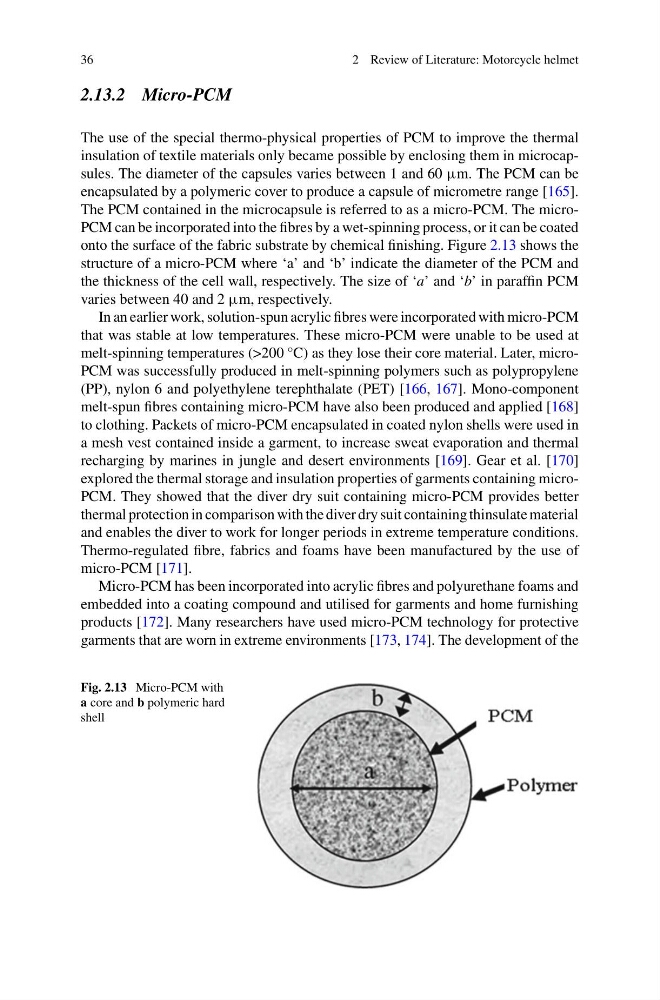
onto the surface of the fabric substrate by chemical finishing. Figure 2.13 shows the
structure of a micro-PCM where ‘a’ and ‘b’ indicate the diameter of the PCM and
the thickness of the cell wall, respectively. The size of ‘a’ and ‘b’ in paraffin PCM
varies between 40 and 2 µm, respectively.
In an earlier work, solution-spun acrylic fibres were incorporated with micro-PCM
that was stable at low temperatures. These micro-PCM were unable to be used at
melt-spinning temperatures (>200 °C) as they lose their core material. Later, microPCM was successfully produced in melt-spinning polymers such as polypropylene
(PP), nylon 6 and polyethylene terephthalate (PET) [166, 167]. Mono-component
melt-spun fibres containing micro-PCM have also been produced and applied [168]
to clothing. Packets of micro-PCM encapsulated in coated nylon shells were used in
a mesh vest contained inside a garment, to increase sweat evaporation and thermal
recharging by marines in jungle and desert environments [169]. Gear et al. [170]
explored the thermal storage and insulation properties of garments containing microPCM. They showed that the diver dry suit containing micro-PCM provides better
thermal protection in comparison with the diver dry suit containing thinsulate material
and enables the diver to work for longer periods in extreme temperature conditions.
Thermo-regulated fibre, fabrics and foams have been manufactured by the use of
micro-PCM [171].
Micro-PCM has been incorporated into acrylic fibres and polyurethane foams and
embedded into a coating compound and utilised for garments and home furnishing
products [172]. Many researchers have used micro-PCM technology for protective
garments that are worn in extreme environments [173, 174]. The development of the
Fig. 2.13 Micro-PCM with
a core and b polymeric hard
shell
2 Review of Literature: Motorcycle helmet
2.13.2 Micro-PCM
The use of the special thermo-physical properties of PCM to improve the thermal
insulation of textile materials only became possible by enclosing them in microcapsules. The diameter of the capsules varies between 1 and 60 µm. The PCM can be
encapsulated by a polymeric cover to produce a capsule of micrometre range [165].
The PCM contained in the microcapsule is referred to as a micro-PCM. The microPCM can be incorporated into the fibres by a wet-spinning process, or it can be coated
onto the surface of the fabric substrate by chemical finishing. Figure 2.13 shows the
structure of a micro-PCM where ‘a’ and ‘b’ indicate the diameter of the PCM and
the thickness of the cell wall, respectively. The size of ‘a’ and ‘b’ in paraffin PCM
varies between 40 and 2 µm, respectively.
In an earlier work, solution-spun acrylic fibres were incorporated with micro-PCM
that was stable at low temperatures. These micro-PCM were unable to be used at
melt-spinning temperatures (>200 °C) as they lose their core material. Later, microPCM was successfully produced in melt-spinning polymers such as polypropylene
(PP), nylon 6 and polyethylene terephthalate (PET) [166, 167]. Mono-component
melt-spun fibres containing micro-PCM have also been produced and applied [168]
to clothing. Packets of micro-PCM encapsulated in coated nylon shells were used in
a mesh vest contained inside a garment, to increase sweat evaporation and thermal
recharging by marines in jungle and desert environments [169]. Gear et al. [170]
explored the thermal storage and insulation properties of garments containing microPCM. They showed that the diver dry suit containing micro-PCM provides better
thermal protection in comparison with the diver dry suit containing thinsulate material
and enables the diver to work for longer periods in extreme temperature conditions.
Thermo-regulated fibre, fabrics and foams have been manufactured by the use of
micro-PCM [171].
Micro-PCM has been incorporated into acrylic fibres and polyurethane foams and
embedded into a coating compound and utilised for garments and home furnishing
products [172]. Many researchers have used micro-PCM technology for protective
garments that are worn in extreme environments [173, 174]. The development of the
Fig. 2.13 Micro-PCM with
a core and b polymeric hard
shell