

34
2 Review of Literature: Motorcycle helmet
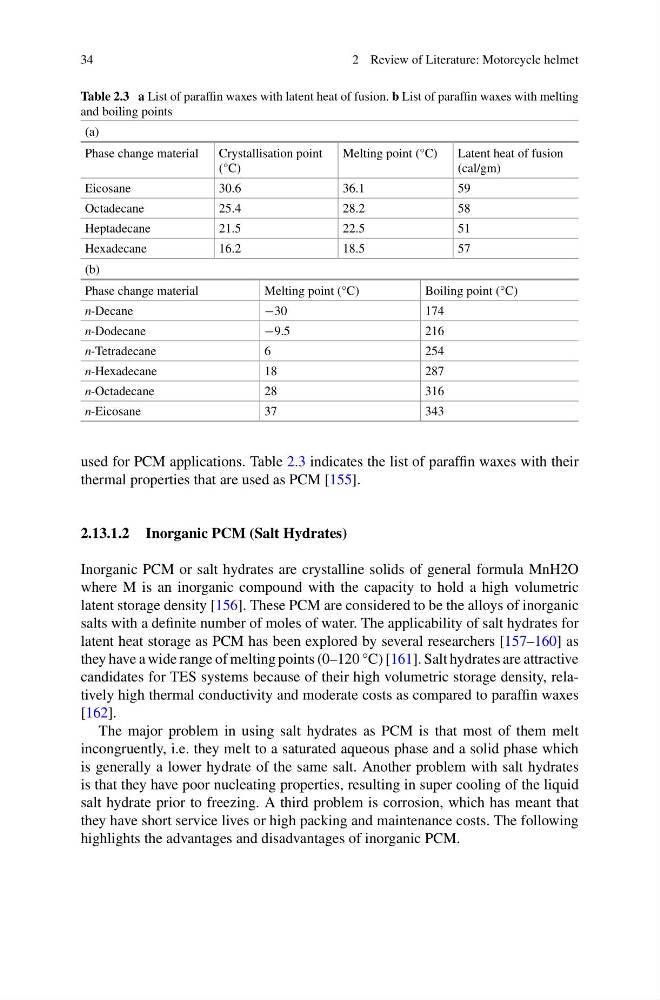
Table 2.3 a List of paraffin waxes with latent heat of fusion. b List of paraffin waxes with melting
and boiling points
(a)
Phase change material
Crystallisation point
(°C)
Melting point (°C)
Latent heat of fusion
(cal/gm)
Eicosane
30.6
36.1
59
Octadecane
25.4
28.2
58
Heptadecane
21.5
22.5
51
Hexadecane
16.2
18.5
57
(b)
Phase change material
Melting point (°C)
Boiling point (°C)
n-Decane
−30
174
n-Dodecane
−9.5
216
n-Tetradecane
6
254
n-Hexadecane
18
287
n-Octadecane
28
316
n-Eicosane
37
343
used for PCM applications. Table 2.3 indicates the list of paraffin waxes with their
thermal properties that are used as PCM [155].
2.13.1.2 Inorganic PCM (Salt Hydrates)
Inorganic PCM or salt hydrates are crystalline solids of general formula MnH2O
where M is an inorganic compound with the capacity to hold a high volumetric
latent storage density [156]. These PCM are considered to be the alloys of inorganic
salts with a definite number of moles of water. The applicability of salt hydrates for
latent heat storage as PCM has been explored by several researchers [157–160] as
they have a wide range of melting points (0–120 °C) [161]. Salt hydrates are attractive
candidates for TES systems because of their high volumetric storage density, relatively high thermal conductivity and moderate costs as compared to paraffin waxes
[162].
The major problem in using salt hydrates as PCM is that most of them melt
incongruently, i.e. they melt to a saturated aqueous phase and a solid phase which
is generally a lower hydrate of the same salt. Another problem with salt hydrates
is that they have poor nucleating properties, resulting in super cooling of the liquid
salt hydrate prior to freezing. A third problem is corrosion, which has meant that
they have short service lives or high packing and maintenance costs. The following
highlights the advantages and disadvantages of inorganic PCM.
2 Review of Literature: Motorcycle helmet
Table 2.3 a List of paraffin waxes with latent heat of fusion. b List of paraffin waxes with melting
and boiling points
(a)
Phase change material
Crystallisation point
(°C)
Melting point (°C)
Latent heat of fusion
(cal/gm)
Eicosane
30.6
36.1
59
Octadecane
25.4
28.2
58
Heptadecane
21.5
22.5
51
Hexadecane
16.2
18.5
57
(b)
Phase change material
Melting point (°C)
Boiling point (°C)
n-Decane
−30
174
n-Dodecane
−9.5
216
n-Tetradecane
6
254
n-Hexadecane
18
287
n-Octadecane
28
316
n-Eicosane
37
343
used for PCM applications. Table 2.3 indicates the list of paraffin waxes with their
thermal properties that are used as PCM [155].
2.13.1.2 Inorganic PCM (Salt Hydrates)
Inorganic PCM or salt hydrates are crystalline solids of general formula MnH2O
where M is an inorganic compound with the capacity to hold a high volumetric
latent storage density [156]. These PCM are considered to be the alloys of inorganic
salts with a definite number of moles of water. The applicability of salt hydrates for
latent heat storage as PCM has been explored by several researchers [157–160] as
they have a wide range of melting points (0–120 °C) [161]. Salt hydrates are attractive
candidates for TES systems because of their high volumetric storage density, relatively high thermal conductivity and moderate costs as compared to paraffin waxes
[162].
The major problem in using salt hydrates as PCM is that most of them melt
incongruently, i.e. they melt to a saturated aqueous phase and a solid phase which
is generally a lower hydrate of the same salt. Another problem with salt hydrates
is that they have poor nucleating properties, resulting in super cooling of the liquid
salt hydrate prior to freezing. A third problem is corrosion, which has meant that
they have short service lives or high packing and maintenance costs. The following
highlights the advantages and disadvantages of inorganic PCM.