

22
2 Review of Literature: Motorcycle helmet
Evaporation
By change of moisture into vapour
Relative Humidity
Wetted area of body (perspiration)
Velocity of surrounding air
Convection
By motion of air
Skin and surrounding air
temperature difference
Area of body exposed to moving
air
Velocity of surrounding air
Human Body
Heat Loss
Radiation
By electromagnetic waves
Mean radiant temperature
Radiation area of body
Conduction
By physical contact
Skin and contacting surface
temperature difference
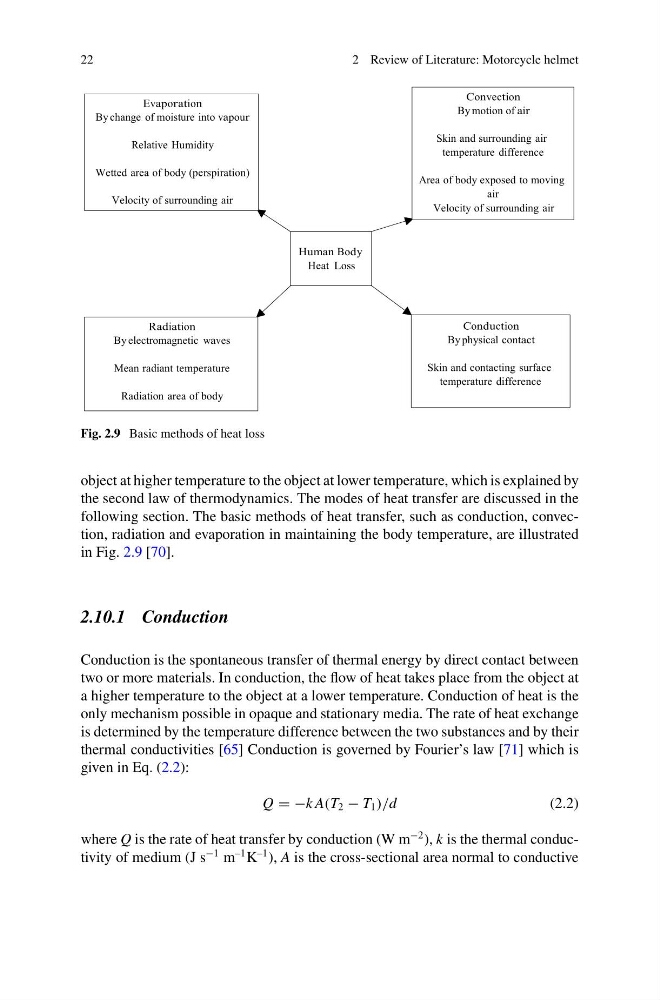
Fig. 2.9 Basic methods of heat loss
object at higher temperature to the object at lower temperature, which is explained by
the second law of thermodynamics. The modes of heat transfer are discussed in the
following section. The basic methods of heat transfer, such as conduction, convection, radiation and evaporation in maintaining the body temperature, are illustrated
in Fig. 2.9 [70].
2.10.1 Conduction
Conduction is the spontaneous transfer of thermal energy by direct contact between
two or more materials. In conduction, the flow of heat takes place from the object at
a higher temperature to the object at a lower temperature. Conduction of heat is the
only mechanism possible in opaque and stationary media. The rate of heat exchange
is determined by the temperature difference between the two substances and by their
thermal conductivities [65] Conduction is governed by Fourier’s law [71] which is
given in Eq. (2.2):
Q = −k A(T 2 − T 1 )/d
(2.2)
where Q is the rate of heat transfer by conduction (W m
−2 ), k is the thermal conductivity of medium (J s
−1 m
–1 K
–1 ), A is the cross-sectional area normal to conductive
2 Review of Literature: Motorcycle helmet
Evaporation
By change of moisture into vapour
Relative Humidity
Wetted area of body (perspiration)
Velocity of surrounding air
Convection
By motion of air
Skin and surrounding air
temperature difference
Area of body exposed to moving
air
Velocity of surrounding air
Human Body
Heat Loss
Radiation
By electromagnetic waves
Mean radiant temperature
Radiation area of body
Conduction
By physical contact
Skin and contacting surface
temperature difference
Fig. 2.9 Basic methods of heat loss
object at higher temperature to the object at lower temperature, which is explained by
the second law of thermodynamics. The modes of heat transfer are discussed in the
following section. The basic methods of heat transfer, such as conduction, convection, radiation and evaporation in maintaining the body temperature, are illustrated
in Fig. 2.9 [70].
2.10.1 Conduction
Conduction is the spontaneous transfer of thermal energy by direct contact between
two or more materials. In conduction, the flow of heat takes place from the object at
a higher temperature to the object at a lower temperature. Conduction of heat is the
only mechanism possible in opaque and stationary media. The rate of heat exchange
is determined by the temperature difference between the two substances and by their
thermal conductivities [65] Conduction is governed by Fourier’s law [71] which is
given in Eq. (2.2):
Q = −k A(T 2 − T 1 )/d
(2.2)
where Q is the rate of heat transfer by conduction (W m
−2 ), k is the thermal conductivity of medium (J s
−1 m
–1 K
–1 ), A is the cross-sectional area normal to conductive