

2.7 Bicycle Helmets
17
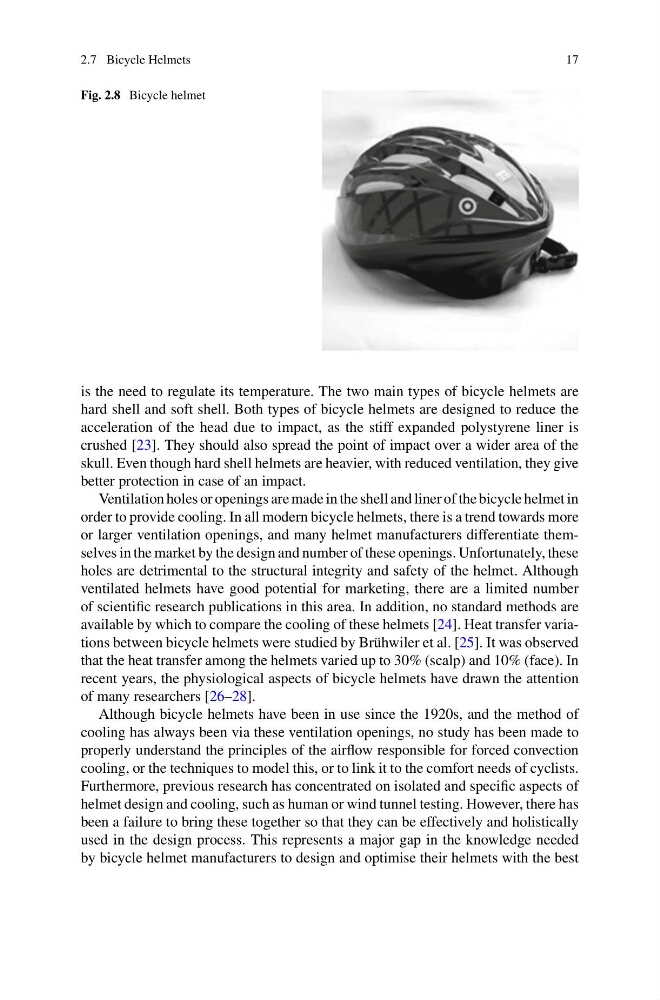
Fig. 2.8 Bicycle helmet
is the need to regulate its temperature. The two main types of bicycle helmets are
hard shell and soft shell. Both types of bicycle helmets are designed to reduce the
acceleration of the head due to impact, as the stiff expanded polystyrene liner is
crushed [23]. They should also spread the point of impact over a wider area of the
skull. Even though hard shell helmets are heavier, with reduced ventilation, they give
better protection in case of an impact.
Ventilation holes or openings are made in the shell and liner of the bicycle helmet in
order to provide cooling. In all modern bicycle helmets, there is a trend towards more
or larger ventilation openings, and many helmet manufacturers differentiate themselves in the market by the design and number of these openings. Unfortunately, these
holes are detrimental to the structural integrity and safety of the helmet. Although
ventilated helmets have good potential for marketing, there are a limited number
of scientific research publications in this area. In addition, no standard methods are
available by which to compare the cooling of these helmets [24]. Heat transfer variations between bicycle helmets were studied by Brühwiler et al. [25]. It was observed
that the heat transfer among the helmets varied up to 30% (scalp) and 10% (face). In
recent years, the physiological aspects of bicycle helmets have drawn the attention
of many researchers [26–28].
Although bicycle helmets have been in use since the 1920s, and the method of
cooling has always been via these ventilation openings, no study has been made to
properly understand the principles of the airflow responsible for forced convection
cooling, or the techniques to model this, or to link it to the comfort needs of cyclists.
Furthermore, previous research has concentrated on isolated and specific aspects of
helmet design and cooling, such as human or wind tunnel testing. However, there has
been a failure to bring these together so that they can be effectively and holistically
used in the design process. This represents a major gap in the knowledge needed
by bicycle helmet manufacturers to design and optimise their helmets with the best
17
Fig. 2.8 Bicycle helmet
is the need to regulate its temperature. The two main types of bicycle helmets are
hard shell and soft shell. Both types of bicycle helmets are designed to reduce the
acceleration of the head due to impact, as the stiff expanded polystyrene liner is
crushed [23]. They should also spread the point of impact over a wider area of the
skull. Even though hard shell helmets are heavier, with reduced ventilation, they give
better protection in case of an impact.
Ventilation holes or openings are made in the shell and liner of the bicycle helmet in
order to provide cooling. In all modern bicycle helmets, there is a trend towards more
or larger ventilation openings, and many helmet manufacturers differentiate themselves in the market by the design and number of these openings. Unfortunately, these
holes are detrimental to the structural integrity and safety of the helmet. Although
ventilated helmets have good potential for marketing, there are a limited number
of scientific research publications in this area. In addition, no standard methods are
available by which to compare the cooling of these helmets [24]. Heat transfer variations between bicycle helmets were studied by Brühwiler et al. [25]. It was observed
that the heat transfer among the helmets varied up to 30% (scalp) and 10% (face). In
recent years, the physiological aspects of bicycle helmets have drawn the attention
of many researchers [26–28].
Although bicycle helmets have been in use since the 1920s, and the method of
cooling has always been via these ventilation openings, no study has been made to
properly understand the principles of the airflow responsible for forced convection
cooling, or the techniques to model this, or to link it to the comfort needs of cyclists.
Furthermore, previous research has concentrated on isolated and specific aspects of
helmet design and cooling, such as human or wind tunnel testing. However, there has
been a failure to bring these together so that they can be effectively and holistically
used in the design process. This represents a major gap in the knowledge needed
by bicycle helmet manufacturers to design and optimise their helmets with the best