

and data of this application to another part of the memory. The same applies of
course for reloading a task.
To further analyze the SDD timing constraints, a certain assumption about the
task times must be made. In general, two cases must be distinguished: The task
completion times are known, or the task completion times are unknown. In a
time-sharing OS as well as real-time OS, the task time may not be known in
advance. An SDD process that ends in checking all hardware units is called a
diagnostic cycle and requires time Tc to complete.
We will further discuss the following three cases:
• Tc time and all task completion times are known.
• Tc time is known but the task completion times are not known.
• Tc time is unlimited and all task completion times are not known.
7.2.1 The System Model
The system model, diagnosis algorithms, and all analysis in this chapter are done on
the basis of a multiprocessor system with a set of U identical processors (units).
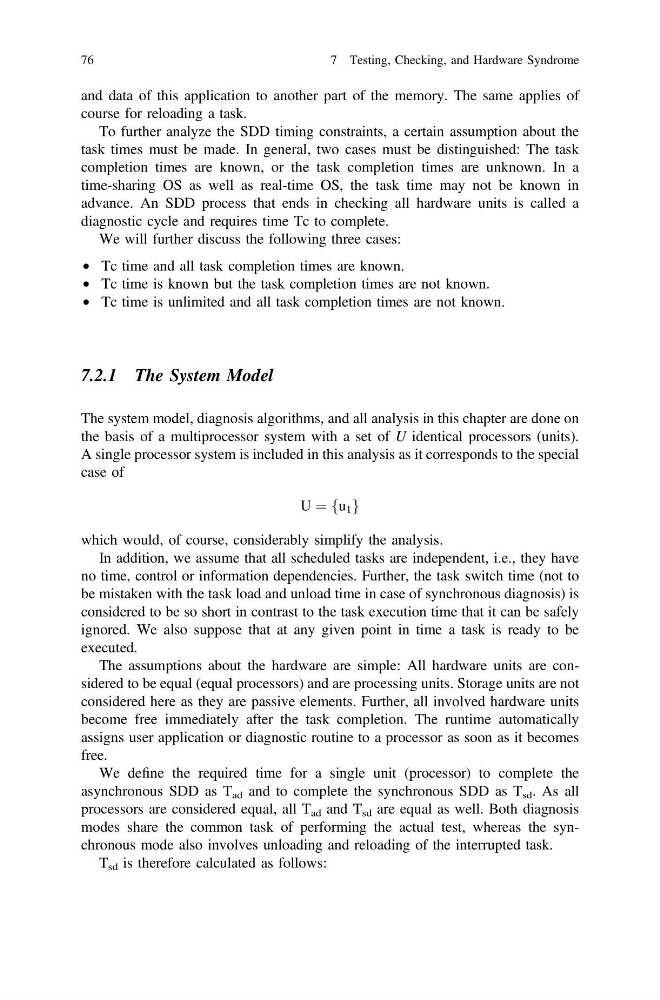
A single processor system is included in this analysis as it corresponds to the special
case of
U ¼ u 1
f g
which would, of course, considerably simplify the analysis.
In addition, we assume that all scheduled tasks are independent, i.e., they have
no time, control or information dependencies. Further, the task switch time (not to
be mistaken with the task load and unload time in case of synchronous diagnosis) is
considered to be so short in contrast to the task execution time that it can be safely
ignored. We also suppose that at any given point in time a task is ready to be
executed.
The assumptions about the hardware are simple: All hardware units are considered to be equal (equal processors) and are processing units. Storage units are not
considered here as they are passive elements. Further, all involved hardware units
become free immediately after the task completion. The runtime automatically
assigns user application or diagnostic routine to a processor as soon as it becomes
free.
We define the required time for a single unit (processor) to complete the
asynchronous SDD as T ad and to complete the synchronous SDD as T sd . As all
processors are considered equal, all T ad and T sd are equal as well. Both diagnosis
modes share the common task of performing the actual test, whereas the synchronous mode also involves unloading and reloading of the interrupted task.
T sd is therefore calculated as follows:
76
7 Testing, Checking, and Hardware Syndrome
course for reloading a task.
To further analyze the SDD timing constraints, a certain assumption about the
task times must be made. In general, two cases must be distinguished: The task
completion times are known, or the task completion times are unknown. In a
time-sharing OS as well as real-time OS, the task time may not be known in
advance. An SDD process that ends in checking all hardware units is called a
diagnostic cycle and requires time Tc to complete.
We will further discuss the following three cases:
• Tc time and all task completion times are known.
• Tc time is known but the task completion times are not known.
• Tc time is unlimited and all task completion times are not known.
7.2.1 The System Model
The system model, diagnosis algorithms, and all analysis in this chapter are done on
the basis of a multiprocessor system with a set of U identical processors (units).
A single processor system is included in this analysis as it corresponds to the special
case of
U ¼ u 1
f g
which would, of course, considerably simplify the analysis.
In addition, we assume that all scheduled tasks are independent, i.e., they have
no time, control or information dependencies. Further, the task switch time (not to
be mistaken with the task load and unload time in case of synchronous diagnosis) is
considered to be so short in contrast to the task execution time that it can be safely
ignored. We also suppose that at any given point in time a task is ready to be
executed.
The assumptions about the hardware are simple: All hardware units are considered to be equal (equal processors) and are processing units. Storage units are not
considered here as they are passive elements. Further, all involved hardware units
become free immediately after the task completion. The runtime automatically
assigns user application or diagnostic routine to a processor as soon as it becomes
free.
We define the required time for a single unit (processor) to complete the
asynchronous SDD as T ad and to complete the synchronous SDD as T sd . As all
processors are considered equal, all T ad and T sd are equal as well. Both diagnosis
modes share the common task of performing the actual test, whereas the synchronous mode also involves unloading and reloading of the interrupted task.
T sd is therefore calculated as follows:
76
7 Testing, Checking, and Hardware Syndrome