

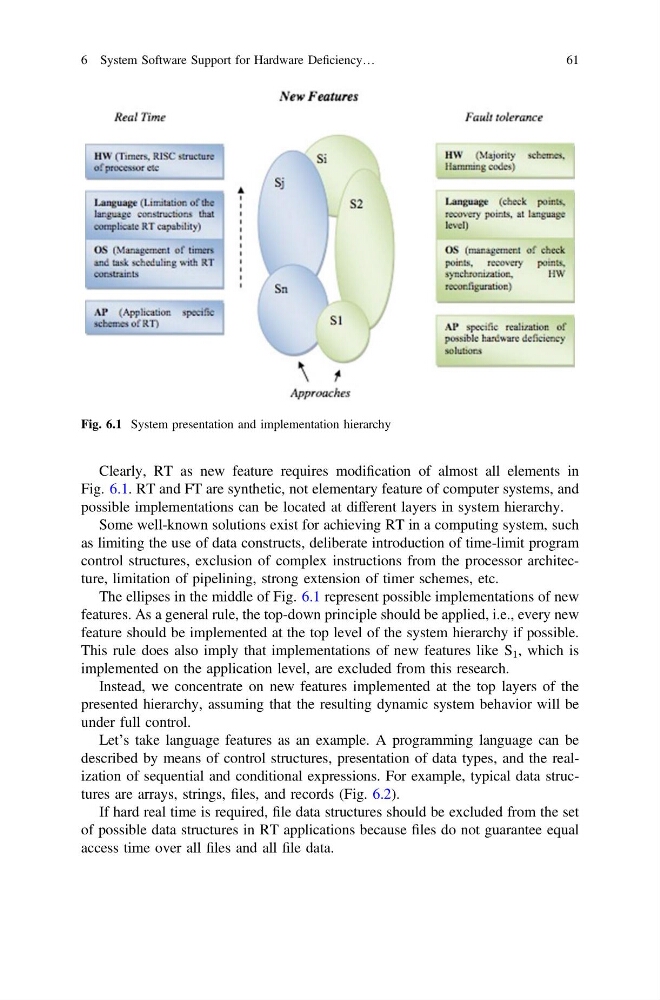
Clearly, RT as new feature requires modification of almost all elements in
Fig. 6.1. RT and FT are synthetic, not elementary feature of computer systems, and
possible implementations can be located at different layers in system hierarchy.
Some well-known solutions exist for achieving RT in a computing system, such
as limiting the use of data constructs, deliberate introduction of time-limit program
control structures, exclusion of complex instructions from the processor architecture, limitation of pipelining, strong extension of timer schemes, etc.
The ellipses in the middle of Fig. 6.1 represent possible implementations of new
features. As a general rule, the top-down principle should be applied, i.e., every new
feature should be implemented at the top level of the system hierarchy if possible.
This rule does also imply that implementations of new features like S 1 , which is
implemented on the application level, are excluded from this research.
Instead, we concentrate on new features implemented at the top layers of the
presented hierarchy, assuming that the resulting dynamic system behavior will be
under full control.
Let’s take language features as an example. A programming language can be
described by means of control structures, presentation of data types, and the realization of sequential and conditional expressions. For example, typical data structures are arrays, strings, files, and records (Fig. 6.2).
If hard real time is required, file data structures should be excluded from the set
of possible data structures in RT applications because files do not guarantee equal
access time over all files and all file data.
Fig. 6.1 System presentation and implementation hierarchy
6 System Software Support for Hardware Deficiency…
61
Fig. 6.1. RT and FT are synthetic, not elementary feature of computer systems, and
possible implementations can be located at different layers in system hierarchy.
Some well-known solutions exist for achieving RT in a computing system, such
as limiting the use of data constructs, deliberate introduction of time-limit program
control structures, exclusion of complex instructions from the processor architecture, limitation of pipelining, strong extension of timer schemes, etc.
The ellipses in the middle of Fig. 6.1 represent possible implementations of new
features. As a general rule, the top-down principle should be applied, i.e., every new
feature should be implemented at the top level of the system hierarchy if possible.
This rule does also imply that implementations of new features like S 1 , which is
implemented on the application level, are excluded from this research.
Instead, we concentrate on new features implemented at the top layers of the
presented hierarchy, assuming that the resulting dynamic system behavior will be
under full control.
Let’s take language features as an example. A programming language can be
described by means of control structures, presentation of data types, and the realization of sequential and conditional expressions. For example, typical data structures are arrays, strings, files, and records (Fig. 6.2).
If hard real time is required, file data structures should be excluded from the set
of possible data structures in RT applications because files do not guarantee equal
access time over all files and all file data.
Fig. 6.1 System presentation and implementation hierarchy
6 System Software Support for Hardware Deficiency…
61