

5.5.2 Backward Tracing Algorithm
The backward tracing algorithm is used to determine which elements originally
might have caused a fault in the suspected element s. This is required for two
reasons: at first, not all elements might have good quality of sensors or precise
models and a fault of an element might not be manifested as a data corruption or
corrupted behavior at another node.
Second, recovery, if possible, should be started not from manifested element but
from the faulty element—i.e., the reason, treating the reason not just the symptoms.
Reverse tracing of dependency matrix allows finding the elements, which are likely
to be the cause of the faults manifested by the suspected element.
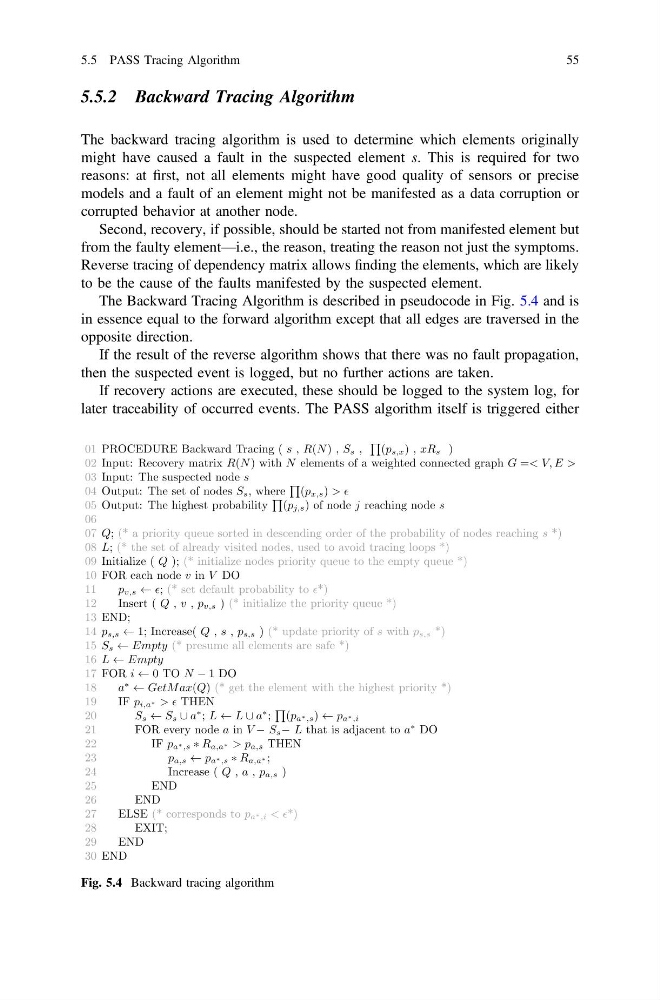
The Backward Tracing Algorithm is described in pseudocode in Fig. 5.4 and is
in essence equal to the forward algorithm except that all edges are traversed in the
opposite direction.
If the result of the reverse algorithm shows that there was no fault propagation,
then the suspected event is logged, but no further actions are taken.
If recovery actions are executed, these should be logged to the system log, for
later traceability of occurred events. The PASS algorithm itself is triggered either
Fig. 5.4 Backward tracing algorithm
5.5 PASS Tracing Algorithm
55
The backward tracing algorithm is used to determine which elements originally
might have caused a fault in the suspected element s. This is required for two
reasons: at first, not all elements might have good quality of sensors or precise
models and a fault of an element might not be manifested as a data corruption or
corrupted behavior at another node.
Second, recovery, if possible, should be started not from manifested element but
from the faulty element—i.e., the reason, treating the reason not just the symptoms.
Reverse tracing of dependency matrix allows finding the elements, which are likely
to be the cause of the faults manifested by the suspected element.
The Backward Tracing Algorithm is described in pseudocode in Fig. 5.4 and is
in essence equal to the forward algorithm except that all edges are traversed in the
opposite direction.
If the result of the reverse algorithm shows that there was no fault propagation,
then the suspected event is logged, but no further actions are taken.
If recovery actions are executed, these should be logged to the system log, for
later traceability of occurred events. The PASS algorithm itself is triggered either
Fig. 5.4 Backward tracing algorithm
5.5 PASS Tracing Algorithm
55