

by periodic activation of hardware checking schemes and SW input validation. It is,
therefore, possible that these devices introduce faults in software, which must be
handled solely by SW without hardware support.
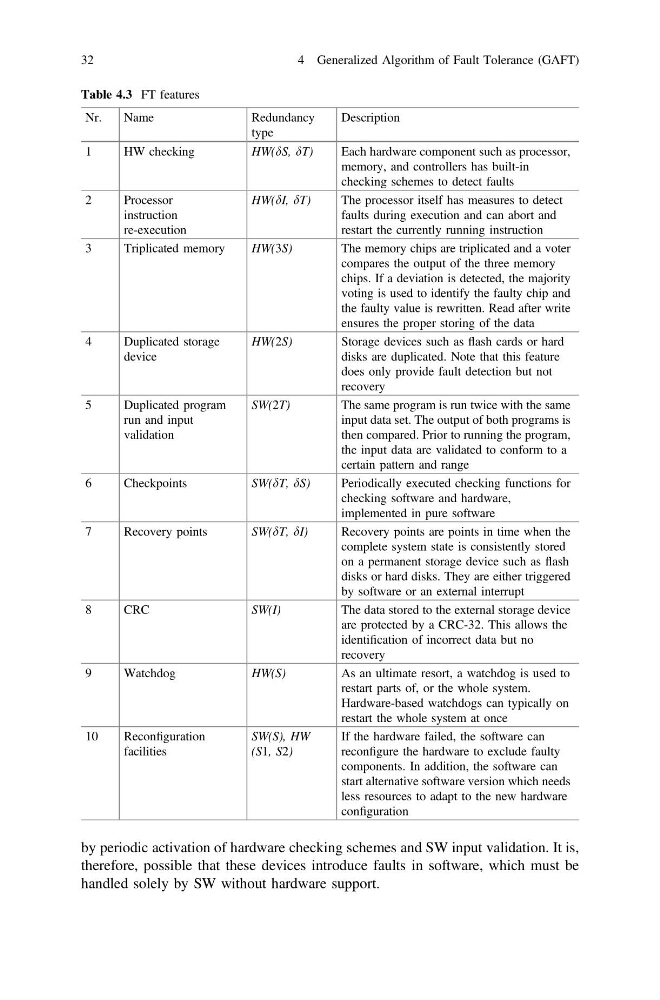
Table 4.3 FT features
Nr.
Name
Redundancy
type
Description
1
HW checking
HW(dS, dT)
Each hardware component such as processor,
memory, and controllers has built-in
checking schemes to detect faults
2
Processor
instruction
re-execution
HW(dI, dT)
The processor itself has measures to detect
faults during execution and can abort and
restart the currently running instruction
3
Triplicated memory
HW(3S)
The memory chips are triplicated and a voter
compares the output of the three memory
chips. If a deviation is detected, the majority
voting is used to identify the faulty chip and
the faulty value is rewritten. Read after write
ensures the proper storing of the data
4
Duplicated storage
device
HW(2S)
Storage devices such as flash cards or hard
disks are duplicated. Note that this feature
does only provide fault detection but not
recovery
5
Duplicated program
run and input
validation
SW(2T)
The same program is run twice with the same
input data set. The output of both programs is
then compared. Prior to running the program,
the input data are validated to conform to a
certain pattern and range
6
Checkpoints
SW(dT, dS)
Periodically executed checking functions for
checking software and hardware,
implemented in pure software
7
Recovery points
SW(dT, dI)
Recovery points are points in time when the
complete system state is consistently stored
on a permanent storage device such as flash
disks or hard disks. They are either triggered
by software or an external interrupt
8
CRC
SW(I)
The data stored to the external storage device
are protected by a CRC-32. This allows the
identification of incorrect data but no
recovery
9
Watchdog
HW(S)
As an ultimate resort, a watchdog is used to
restart parts of, or the whole system.
Hardware-based watchdogs can typically on
restart the whole system at once
10
Reconfiguration
facilities
SW(S), HW
(S1, S2)
If the hardware failed, the software can
reconfigure the hardware to exclude faulty
components. In addition, the software can
start alternative software version which needs
less resources to adapt to the new hardware
configuration
32
4 Generalized Algorithm of Fault Tolerance (GAFT)
therefore, possible that these devices introduce faults in software, which must be
handled solely by SW without hardware support.
Table 4.3 FT features
Nr.
Name
Redundancy
type
Description
1
HW checking
HW(dS, dT)
Each hardware component such as processor,
memory, and controllers has built-in
checking schemes to detect faults
2
Processor
instruction
re-execution
HW(dI, dT)
The processor itself has measures to detect
faults during execution and can abort and
restart the currently running instruction
3
Triplicated memory
HW(3S)
The memory chips are triplicated and a voter
compares the output of the three memory
chips. If a deviation is detected, the majority
voting is used to identify the faulty chip and
the faulty value is rewritten. Read after write
ensures the proper storing of the data
4
Duplicated storage
device
HW(2S)
Storage devices such as flash cards or hard
disks are duplicated. Note that this feature
does only provide fault detection but not
recovery
5
Duplicated program
run and input
validation
SW(2T)
The same program is run twice with the same
input data set. The output of both programs is
then compared. Prior to running the program,
the input data are validated to conform to a
certain pattern and range
6
Checkpoints
SW(dT, dS)
Periodically executed checking functions for
checking software and hardware,
implemented in pure software
7
Recovery points
SW(dT, dI)
Recovery points are points in time when the
complete system state is consistently stored
on a permanent storage device such as flash
disks or hard disks. They are either triggered
by software or an external interrupt
8
CRC
SW(I)
The data stored to the external storage device
are protected by a CRC-32. This allows the
identification of incorrect data but no
recovery
9
Watchdog
HW(S)
As an ultimate resort, a watchdog is used to
restart parts of, or the whole system.
Hardware-based watchdogs can typically on
restart the whole system at once
10
Reconfiguration
facilities
SW(S), HW
(S1, S2)
If the hardware failed, the software can
reconfigure the hardware to exclude faulty
components. In addition, the software can
start alternative software version which needs
less resources to adapt to the new hardware
configuration
32
4 Generalized Algorithm of Fault Tolerance (GAFT)