

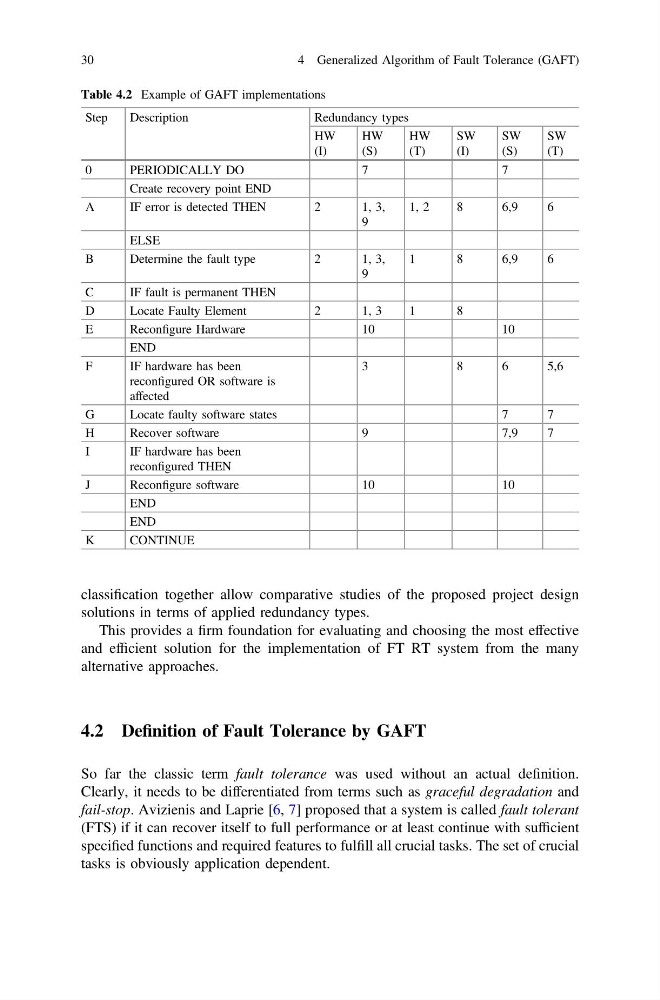
classification together allow comparative studies of the proposed project design
solutions in terms of applied redundancy types.
This provides a firm foundation for evaluating and choosing the most effective
and efficient solution for the implementation of FT RT system from the many
alternative approaches.
4.2 Definition of Fault Tolerance by GAFT
So far the classic term fault tolerance was used without an actual definition.
Clearly, it needs to be differentiated from terms such as graceful degradation and
fail-stop. Avizienis and Laprie [6, 7] proposed that a system is called fault tolerant
(FTS) if it can recover itself to full performance or at least continue with sufficient
specified functions and required features to fulfill all crucial tasks. The set of crucial
tasks is obviously application dependent.
Table 4.2 Example of GAFT implementations
Step
Description
Redundancy types
HW
(I)
HW
(S)
HW
(T)
SW
(I)
SW
(S)
SW
(T)
0
PERIODICALLY DO
7
7
Create recovery point END
A
IF error is detected THEN
2
1, 3,
9
1, 2
8
6,9
6
ELSE
B
Determine the fault type
2
1, 3,
9
1
8
6,9
6
C
IF fault is permanent THEN
D
Locate Faulty Element
2
1, 3
1
8
E
Reconfigure Hardware
10
10
END
F
IF hardware has been
reconfigured OR software is
affected
3
8
6
5,6
G
Locate faulty software states
7
7
H
Recover software
9
7,9
7
I
IF hardware has been
reconfigured THEN
J
Reconfigure software
10
10
END
END
K
CONTINUE
30
4 Generalized Algorithm of Fault Tolerance (GAFT)
solutions in terms of applied redundancy types.
This provides a firm foundation for evaluating and choosing the most effective
and efficient solution for the implementation of FT RT system from the many
alternative approaches.
4.2 Definition of Fault Tolerance by GAFT
So far the classic term fault tolerance was used without an actual definition.
Clearly, it needs to be differentiated from terms such as graceful degradation and
fail-stop. Avizienis and Laprie [6, 7] proposed that a system is called fault tolerant
(FTS) if it can recover itself to full performance or at least continue with sufficient
specified functions and required features to fulfill all crucial tasks. The set of crucial
tasks is obviously application dependent.
Table 4.2 Example of GAFT implementations
Step
Description
Redundancy types
HW
(I)
HW
(S)
HW
(T)
SW
(I)
SW
(S)
SW
(T)
0
PERIODICALLY DO
7
7
Create recovery point END
A
IF error is detected THEN
2
1, 3,
9
1, 2
8
6,9
6
ELSE
B
Determine the fault type
2
1, 3,
9
1
8
6,9
6
C
IF fault is permanent THEN
D
Locate Faulty Element
2
1, 3
1
8
E
Reconfigure Hardware
10
10
END
F
IF hardware has been
reconfigured OR software is
affected
3
8
6
5,6
G
Locate faulty software states
7
7
H
Recover software
9
7,9
7
I
IF hardware has been
reconfigured THEN
J
Reconfigure software
10
10
END
END
K
CONTINUE
30
4 Generalized Algorithm of Fault Tolerance (GAFT)