

The latency of faults thus becomes crucial in determining the reliability of the
system. Consequently, different faults require different actions and mechanisms to
tolerate them.
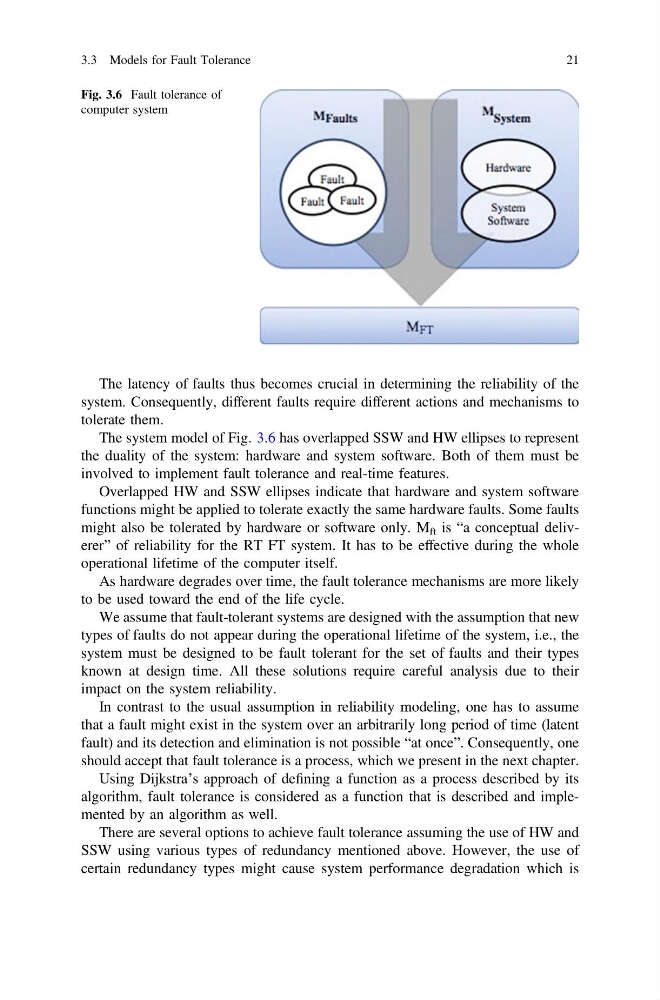
The system model of Fig. 3.6 has overlapped SSW and HW ellipses to represent
the duality of the system: hardware and system software. Both of them must be
involved to implement fault tolerance and real-time features.
Overlapped HW and SSW ellipses indicate that hardware and system software
functions might be applied to tolerate exactly the same hardware faults. Some faults
might also be tolerated by hardware or software only. M ft is “a conceptual deliverer” of reliability for the RT FT system. It has to be effective during the whole
operational lifetime of the computer itself.
As hardware degrades over time, the fault tolerance mechanisms are more likely
to be used toward the end of the life cycle.
We assume that fault-tolerant systems are designed with the assumption that new
types of faults do not appear during the operational lifetime of the system, i.e., the
system must be designed to be fault tolerant for the set of faults and their types
known at design time. All these solutions require careful analysis due to their
impact on the system reliability.
In contrast to the usual assumption in reliability modeling, one has to assume
that a fault might exist in the system over an arbitrarily long period of time (latent
fault) and its detection and elimination is not possible “at once”. Consequently, one
should accept that fault tolerance is a process, which we present in the next chapter.
Using Dijkstra’s approach of defining a function as a process described by its
algorithm, fault tolerance is considered as a function that is described and implemented by an algorithm as well.
There are several options to achieve fault tolerance assuming the use of HW and
SSW using various types of redundancy mentioned above. However, the use of
certain redundancy types might cause system performance degradation which is
Fig. 3.6 Fault tolerance of
computer system
3.3 Models for Fault Tolerance
21
system. Consequently, different faults require different actions and mechanisms to
tolerate them.
The system model of Fig. 3.6 has overlapped SSW and HW ellipses to represent
the duality of the system: hardware and system software. Both of them must be
involved to implement fault tolerance and real-time features.
Overlapped HW and SSW ellipses indicate that hardware and system software
functions might be applied to tolerate exactly the same hardware faults. Some faults
might also be tolerated by hardware or software only. M ft is “a conceptual deliverer” of reliability for the RT FT system. It has to be effective during the whole
operational lifetime of the computer itself.
As hardware degrades over time, the fault tolerance mechanisms are more likely
to be used toward the end of the life cycle.
We assume that fault-tolerant systems are designed with the assumption that new
types of faults do not appear during the operational lifetime of the system, i.e., the
system must be designed to be fault tolerant for the set of faults and their types
known at design time. All these solutions require careful analysis due to their
impact on the system reliability.
In contrast to the usual assumption in reliability modeling, one has to assume
that a fault might exist in the system over an arbitrarily long period of time (latent
fault) and its detection and elimination is not possible “at once”. Consequently, one
should accept that fault tolerance is a process, which we present in the next chapter.
Using Dijkstra’s approach of defining a function as a process described by its
algorithm, fault tolerance is considered as a function that is described and implemented by an algorithm as well.
There are several options to achieve fault tolerance assuming the use of HW and
SSW using various types of redundancy mentioned above. However, the use of
certain redundancy types might cause system performance degradation which is
Fig. 3.6 Fault tolerance of
computer system
3.3 Models for Fault Tolerance
21