

here is a refinement of many previous results from [4–10] and is, in fact, a further
development of [9, 10].
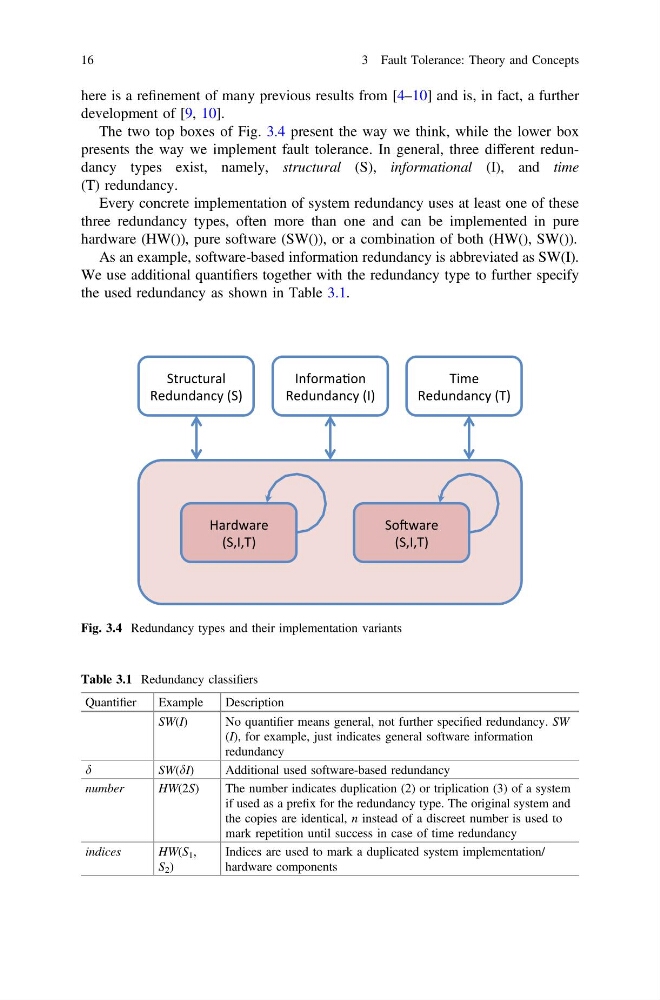
The two top boxes of Fig. 3.4 present the way we think, while the lower box
presents the way we implement fault tolerance. In general, three different redundancy types exist, namely, structural (S), informational (I), and time
(T) redundancy.
Every concrete implementation of system redundancy uses at least one of these
three redundancy types, often more than one and can be implemented in pure
hardware (HW()), pure software (SW()), or a combination of both (HW(), SW()).
As an example, software-based information redundancy is abbreviated as SW(I).
We use additional quantifiers together with the redundancy type to further specify
the used redundancy as shown in Table 3.1.
Fig. 3.4 Redundancy types and their implementation variants
Table 3.1 Redundancy classifiers
Quantifier
Example
Description
SW(I)
No quantifier means general, not further specified redundancy. SW
(I), for example, just indicates general software information
redundancy
d
SW(dI)
Additional used software-based redundancy
number
HW(2S)
The number indicates duplication (2) or triplication (3) of a system
if used as a prefix for the redundancy type. The original system and
the copies are identical, n instead of a discreet number is used to
mark repetition until success in case of time redundancy
indices
HW(S 1 ,
S 2 )
Indices are used to mark a duplicated system implementation/
hardware components
16
3 Fault Tolerance: Theory and Concepts
development of [9, 10].
The two top boxes of Fig. 3.4 present the way we think, while the lower box
presents the way we implement fault tolerance. In general, three different redundancy types exist, namely, structural (S), informational (I), and time
(T) redundancy.
Every concrete implementation of system redundancy uses at least one of these
three redundancy types, often more than one and can be implemented in pure
hardware (HW()), pure software (SW()), or a combination of both (HW(), SW()).
As an example, software-based information redundancy is abbreviated as SW(I).
We use additional quantifiers together with the redundancy type to further specify
the used redundancy as shown in Table 3.1.
Fig. 3.4 Redundancy types and their implementation variants
Table 3.1 Redundancy classifiers
Quantifier
Example
Description
SW(I)
No quantifier means general, not further specified redundancy. SW
(I), for example, just indicates general software information
redundancy
d
SW(dI)
Additional used software-based redundancy
number
HW(2S)
The number indicates duplication (2) or triplication (3) of a system
if used as a prefix for the redundancy type. The original system and
the copies are identical, n instead of a discreet number is used to
mark repetition until success in case of time redundancy
indices
HW(S 1 ,
S 2 )
Indices are used to mark a duplicated system implementation/
hardware components
16
3 Fault Tolerance: Theory and Concepts