

When desperation property is introduced in DCS or any other system actually, other
very interesting questions remain and still unanswered:
– Are we desperate at the starting point?
– Is it enough to known only shortest distances and total time constraint
introduced?
– Is it good to know inside the package the time constraint and how to deal with it?
– How desperate we are when a package time inequality—below—stands?
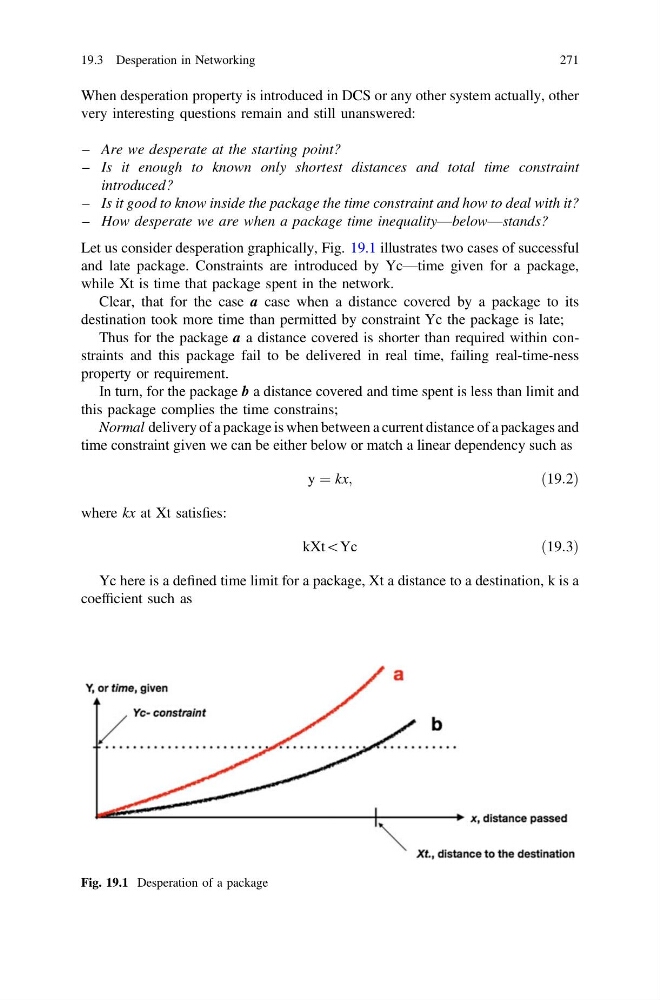
Let us consider desperation graphically, Fig. 19.1 illustrates two cases of successful
and late package. Constraints are introduced by Yc—time given for a package,
while Xt is time that package spent in the network.
Clear, that for the case a case when a distance covered by a package to its
destination took more time than permitted by constraint Yc the package is late;
Thus for the package a a distance covered is shorter than required within constraints and this package fail to be delivered in real time, failing real-time-ness
property or requirement.
In turn, for the package b a distance covered and time spent is less than limit and
this package complies the time constrains;
Normal delivery of a package is when between a current distance of a packages and
time constraint given we can be either below or match a linear dependency such as
y ¼ kx;
ð19:2Þ
where kx at Xt satisfies:
kXt\Yc
ð19:3Þ
Yc here is a defined time limit for a package, Xt a distance to a destination, k is a
coefficient such as
Fig. 19.1 Desperation of a package
19.3 Desperation in Networking
271
very interesting questions remain and still unanswered:
– Are we desperate at the starting point?
– Is it enough to known only shortest distances and total time constraint
introduced?
– Is it good to know inside the package the time constraint and how to deal with it?
– How desperate we are when a package time inequality—below—stands?
Let us consider desperation graphically, Fig. 19.1 illustrates two cases of successful
and late package. Constraints are introduced by Yc—time given for a package,
while Xt is time that package spent in the network.
Clear, that for the case a case when a distance covered by a package to its
destination took more time than permitted by constraint Yc the package is late;
Thus for the package a a distance covered is shorter than required within constraints and this package fail to be delivered in real time, failing real-time-ness
property or requirement.
In turn, for the package b a distance covered and time spent is less than limit and
this package complies the time constrains;
Normal delivery of a package is when between a current distance of a packages and
time constraint given we can be either below or match a linear dependency such as
y ¼ kx;
ð19:2Þ
where kx at Xt satisfies:
kXt\Yc
ð19:3Þ
Yc here is a defined time limit for a package, Xt a distance to a destination, k is a
coefficient such as
Fig. 19.1 Desperation of a package
19.3 Desperation in Networking
271