

Then, from informal discussion of desperation as a word from the literature and
art domain we will be able to define and apply it formally for analysis of complex
technological objects like computers, distributed systems and Internet, to name a
few.
In theory of redundancy mentioned and developed in [1–7] for the purpose of
system improvement we also were considering an efficiency of system using three
categories mentioned above: time, structure and information. The aim was as
mentioned above is making systems smarter in terms of performance, reliability
and energy (or cost), using available time, structure and information. This framework let us see and enables to making evolvable systems.
This was called PRE-smart [5, 7] system, and further thought through as
evolvable systems [6, 7]. References presented indicate just starting point in this
direction of research.
In principle, networking is nothing new in terms of computer science, because a
foundation of distributed computing and distributed computer systems (DCS) were
developed over 60 years ago [8–10]. Differences or advances in performance of
links and nodes did not change logic and concepts of synchronization,
a-synchronization and ordering of messaging in the network [9–12].
Queuing theory and works of Kleinrock were dealing with this since 20th
mid-century [11]. At the same time, a desperation concept was not addressed as it
should. The main reason for this, we guess, was an absence of real-time-ness
requirements for packages and/or sequence of packages.
19.3 Desperation in Networking
In networking, when we deal with real time-ness of messaging we suggest to move
from generic definitions above or using formulas with all three independent variables (s, i, t) down to addressing “time” as a prime parameter. The idea here is about
seeking what information we can have or use to see measurable gain. Thus, for real
time-ness of networking in terms of probabilities we might say:
Desperation is a probability of non-reaching a destination within scheduled time
(D2)
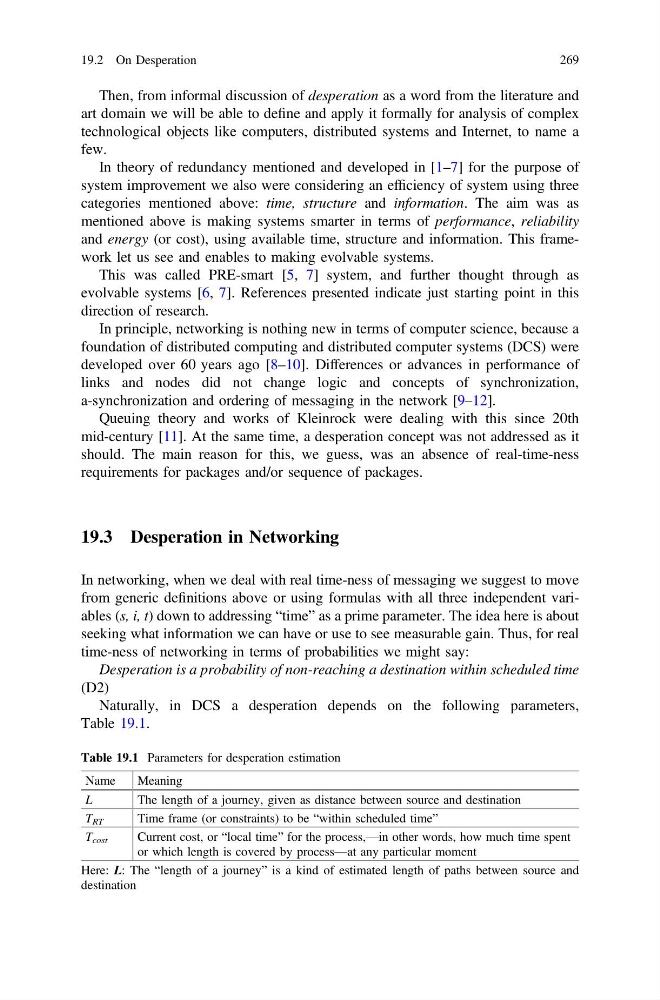
Naturally, in DCS a desperation depends on the following parameters,
Table 19.1.
Table 19.1 Parameters for desperation estimation
Name
Meaning
L
The length of a journey, given as distance between source and destination
T RT
Time frame (or constraints) to be “within scheduled time”
T cost
Current cost, or “local time” for the process,—in other words, how much time spent
or which length is covered by process—at any particular moment
Here: L: The “length of a journey” is a kind of estimated length of paths between source and
destination
19.2 On Desperation
269
art domain we will be able to define and apply it formally for analysis of complex
technological objects like computers, distributed systems and Internet, to name a
few.
In theory of redundancy mentioned and developed in [1–7] for the purpose of
system improvement we also were considering an efficiency of system using three
categories mentioned above: time, structure and information. The aim was as
mentioned above is making systems smarter in terms of performance, reliability
and energy (or cost), using available time, structure and information. This framework let us see and enables to making evolvable systems.
This was called PRE-smart [5, 7] system, and further thought through as
evolvable systems [6, 7]. References presented indicate just starting point in this
direction of research.
In principle, networking is nothing new in terms of computer science, because a
foundation of distributed computing and distributed computer systems (DCS) were
developed over 60 years ago [8–10]. Differences or advances in performance of
links and nodes did not change logic and concepts of synchronization,
a-synchronization and ordering of messaging in the network [9–12].
Queuing theory and works of Kleinrock were dealing with this since 20th
mid-century [11]. At the same time, a desperation concept was not addressed as it
should. The main reason for this, we guess, was an absence of real-time-ness
requirements for packages and/or sequence of packages.
19.3 Desperation in Networking
In networking, when we deal with real time-ness of messaging we suggest to move
from generic definitions above or using formulas with all three independent variables (s, i, t) down to addressing “time” as a prime parameter. The idea here is about
seeking what information we can have or use to see measurable gain. Thus, for real
time-ness of networking in terms of probabilities we might say:
Desperation is a probability of non-reaching a destination within scheduled time
(D2)
Naturally, in DCS a desperation depends on the following parameters,
Table 19.1.
Table 19.1 Parameters for desperation estimation
Name
Meaning
L
The length of a journey, given as distance between source and destination
T RT
Time frame (or constraints) to be “within scheduled time”
T cost
Current cost, or “local time” for the process,—in other words, how much time spent
or which length is covered by process—at any particular moment
Here: L: The “length of a journey” is a kind of estimated length of paths between source and
destination
19.2 On Desperation
269