

2.3 Conclusion
This short introduction is by no means comprehensive, but illustrates that not all
faults can be treated at the hardware level, especially the more complex fault types.
Examples of these faults are multiple bit upsets and intermittent faults.
Both of mentioned types of faults are expected to occur more often in the future
with decreasing hardware structure sizes and growing demand of higher frequencies
of operation.
It is, therefore, obvious that software must assist the hardware in the fault
detection and recovery process.
References
1. Baumann R (2005) Soft errors in advanced computer systems. IEEE Des Test Comput 22
(3):258–266
2. Constantinescu C (2008) Intermittent faults and effects on reliability of integrated circuits. In:
RAMS 2008. Annual, pp 370–374, Jan 2008
3. Wells P, Chakraborty K, Sohi GS (2007) Adapting to intermittent faults in future multicore
systems. In: 16th international conference on parallel architecture and compilation techniques,
PACT, p 431, Sept 2007
4. Hamming R (1950) Error detection and error correction codes. Bell Syst Tech J XXVI(9):147–
160
5. Reed I, Solomon G (1960) Polynomial codes over certain finite fields. J Soc Ind Appl Math 8
(2):300–304
6. Takaesu K, Yoshida T (2004) Construction of a fault-tolerant voter for n-modular redundancy.
Electron Commun Jpn (Part II: Electron) 87(12):62–71
7. Birolini A (2004) Reliability engineering theory and practice, 8th edn. Springer
8. Schagaev I, Castano V (2015) Resilient computer system design. Springer. ISBN
978-3-319-15069-7
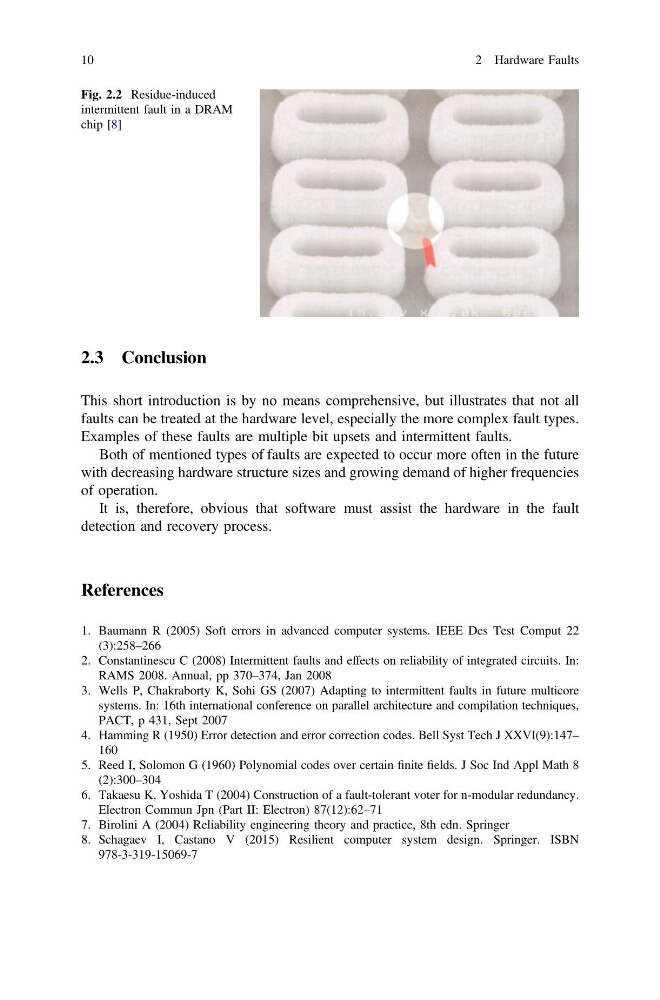
Fig. 2.2 Residue-induced
intermittent fault in a DRAM
chip [8]
10
2 Hardware Faults
This short introduction is by no means comprehensive, but illustrates that not all
faults can be treated at the hardware level, especially the more complex fault types.
Examples of these faults are multiple bit upsets and intermittent faults.
Both of mentioned types of faults are expected to occur more often in the future
with decreasing hardware structure sizes and growing demand of higher frequencies
of operation.
It is, therefore, obvious that software must assist the hardware in the fault
detection and recovery process.
References
1. Baumann R (2005) Soft errors in advanced computer systems. IEEE Des Test Comput 22
(3):258–266
2. Constantinescu C (2008) Intermittent faults and effects on reliability of integrated circuits. In:
RAMS 2008. Annual, pp 370–374, Jan 2008
3. Wells P, Chakraborty K, Sohi GS (2007) Adapting to intermittent faults in future multicore
systems. In: 16th international conference on parallel architecture and compilation techniques,
PACT, p 431, Sept 2007
4. Hamming R (1950) Error detection and error correction codes. Bell Syst Tech J XXVI(9):147–
160
5. Reed I, Solomon G (1960) Polynomial codes over certain finite fields. J Soc Ind Appl Math 8
(2):300–304
6. Takaesu K, Yoshida T (2004) Construction of a fault-tolerant voter for n-modular redundancy.
Electron Commun Jpn (Part II: Electron) 87(12):62–71
7. Birolini A (2004) Reliability engineering theory and practice, 8th edn. Springer
8. Schagaev I, Castano V (2015) Resilient computer system design. Springer. ISBN
978-3-319-15069-7
Fig. 2.2 Residue-induced
intermittent fault in a DRAM
chip [8]
10
2 Hardware Faults