

hierarchy, for any component—UW, SSW, HW, and business management.
Leaving efficiency of management discussion to business schools, we will consider
mostly SSW-HW model.
17.4 SSW-HW Performance Model
Task of user (userware tasks, further (UWT)) splits down at the level of HW as a
series of micro-tasks (instructions, microinstructions). Program tasks are surrounded by another group of micro-tasks that define the system software
(SSW) involvement on execution of the user program, secure a completion, and
system resource monitoring.
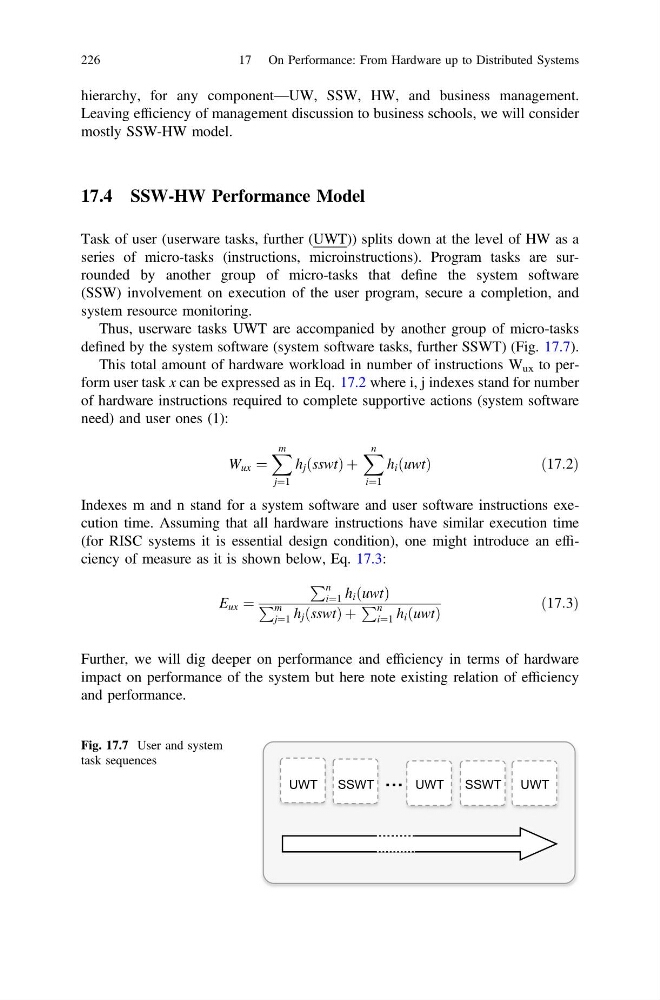
Thus, userware tasks UWT are accompanied by another group of micro-tasks
defined by the system software (system software tasks, further SSWT) (Fig. 17.7).
This total amount of hardware workload in number of instructions W ux to perform user task x can be expressed as in Eq. 17.2 where i, j indexes stand for number
of hardware instructions required to complete supportive actions (system software
need) and user ones (1):
W ux ¼
X m
j¼1
h j ðsswtÞ þ
X n
i¼1
h i ðuwtÞ
ð 17:2Þ
Indexes m and n stand for a system software and user software instructions execution time. Assuming that all hardware instructions have similar execution time
(for RISC systems it is essential design condition), one might introduce an efficiency of measure as it is shown below, Eq. 17.3:
E ux ¼
P n
i¼1 h i ðuwtÞ
P m
j¼1 h j ðsswtÞ þ
P n
i¼1 h i ðuwtÞ
ð17:3Þ
Further, we will dig deeper on performance and efficiency in terms of hardware
impact on performance of the system but here note existing relation of efficiency
and performance.
…
UWT
SSWT
UWT
SSWT
UWT
Fig. 17.7 User and system
task sequences
226
17 On Performance: From Hardware up to Distributed Systems
Leaving efficiency of management discussion to business schools, we will consider
mostly SSW-HW model.
17.4 SSW-HW Performance Model
Task of user (userware tasks, further (UWT)) splits down at the level of HW as a
series of micro-tasks (instructions, microinstructions). Program tasks are surrounded by another group of micro-tasks that define the system software
(SSW) involvement on execution of the user program, secure a completion, and
system resource monitoring.
Thus, userware tasks UWT are accompanied by another group of micro-tasks
defined by the system software (system software tasks, further SSWT) (Fig. 17.7).
This total amount of hardware workload in number of instructions W ux to perform user task x can be expressed as in Eq. 17.2 where i, j indexes stand for number
of hardware instructions required to complete supportive actions (system software
need) and user ones (1):
W ux ¼
X m
j¼1
h j ðsswtÞ þ
X n
i¼1
h i ðuwtÞ
ð 17:2Þ
Indexes m and n stand for a system software and user software instructions execution time. Assuming that all hardware instructions have similar execution time
(for RISC systems it is essential design condition), one might introduce an efficiency of measure as it is shown below, Eq. 17.3:
E ux ¼
P n
i¼1 h i ðuwtÞ
P m
j¼1 h j ðsswtÞ þ
P n
i¼1 h i ðuwtÞ
ð17:3Þ
Further, we will dig deeper on performance and efficiency in terms of hardware
impact on performance of the system but here note existing relation of efficiency
and performance.
…
UWT
SSWT
UWT
SSWT
UWT
Fig. 17.7 User and system
task sequences
226
17 On Performance: From Hardware up to Distributed Systems