

Then performance growth is defined as a function of number of elements and
EIZ:
Ps ¼ fðEIZ; nÞ
ð 17:1Þ
where EIZ stands for external interacting zone, n—number of “performers” considered only by performance, not the organization.
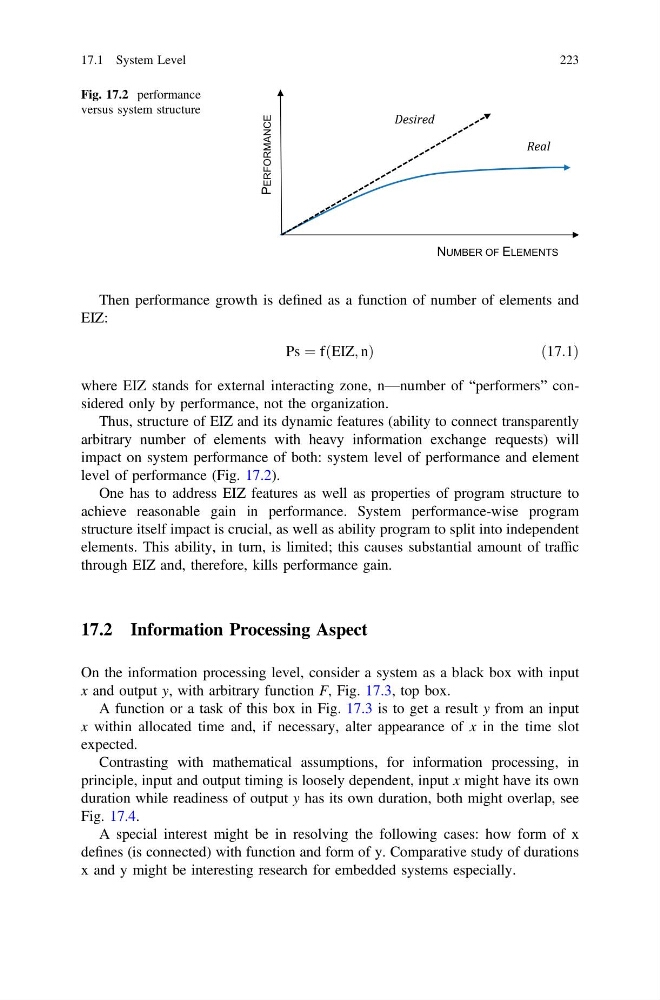
Thus, structure of EIZ and its dynamic features (ability to connect transparently
arbitrary number of elements with heavy information exchange requests) will
impact on system performance of both: system level of performance and element
level of performance (Fig. 17.2).
One has to address EIZ features as well as properties of program structure to
achieve reasonable gain in performance. System performance-wise program
structure itself impact is crucial, as well as ability program to split into independent
elements. This ability, in turn, is limited; this causes substantial amount of traffic
through EIZ and, therefore, kills performance gain.
17.2 Information Processing Aspect
On the information processing level, consider a system as a black box with input
x and output y, with arbitrary function F, Fig. 17.3, top box.
A function or a task of this box in Fig. 17.3 is to get a result y from an input
x within allocated time and, if necessary, alter appearance of x in the time slot
expected.
Contrasting with mathematical assumptions, for information processing, in
principle, input and output timing is loosely dependent, input x might have its own
duration while readiness of output y has its own duration, both might overlap, see
Fig. 17.4.
A special interest might be in resolving the following cases: how form of x
defines (is connected) with function and form of y. Comparative study of durations
x and y might be interesting research for embedded systems especially.
PERFORMANCE
NUMBER OF ELEMENTS
Fig. 17.2 performance
versus system structure
17.1 System Level
223
EIZ:
Ps ¼ fðEIZ; nÞ
ð 17:1Þ
where EIZ stands for external interacting zone, n—number of “performers” considered only by performance, not the organization.
Thus, structure of EIZ and its dynamic features (ability to connect transparently
arbitrary number of elements with heavy information exchange requests) will
impact on system performance of both: system level of performance and element
level of performance (Fig. 17.2).
One has to address EIZ features as well as properties of program structure to
achieve reasonable gain in performance. System performance-wise program
structure itself impact is crucial, as well as ability program to split into independent
elements. This ability, in turn, is limited; this causes substantial amount of traffic
through EIZ and, therefore, kills performance gain.
17.2 Information Processing Aspect
On the information processing level, consider a system as a black box with input
x and output y, with arbitrary function F, Fig. 17.3, top box.
A function or a task of this box in Fig. 17.3 is to get a result y from an input
x within allocated time and, if necessary, alter appearance of x in the time slot
expected.
Contrasting with mathematical assumptions, for information processing, in
principle, input and output timing is loosely dependent, input x might have its own
duration while readiness of output y has its own duration, both might overlap, see
Fig. 17.4.
A special interest might be in resolving the following cases: how form of x
defines (is connected) with function and form of y. Comparative study of durations
x and y might be interesting research for embedded systems especially.
PERFORMANCE
NUMBER OF ELEMENTS
Fig. 17.2 performance
versus system structure
17.1 System Level
223