

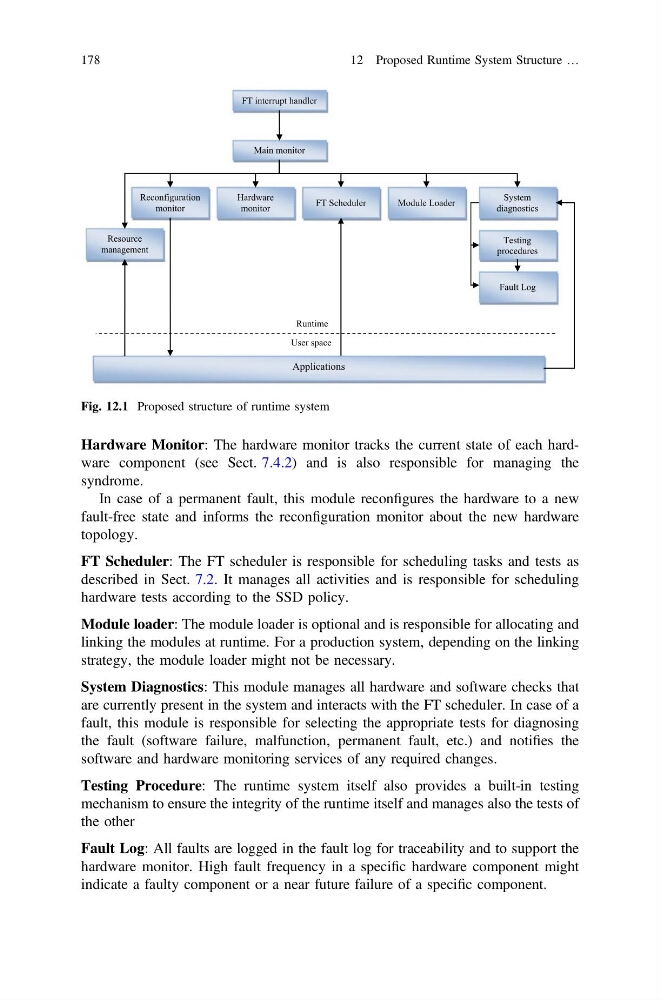
Hardware Monitor: The hardware monitor tracks the current state of each hardware component (see Sect. 7.4.2) and is also responsible for managing the
syndrome.
In case of a permanent fault, this module reconfigures the hardware to a new
fault-free state and informs the reconfiguration monitor about the new hardware
topology.
FT Scheduler: The FT scheduler is responsible for scheduling tasks and tests as
described in Sect. 7.2. It manages all activities and is responsible for scheduling
hardware tests according to the SSD policy.
Module loader: The module loader is optional and is responsible for allocating and
linking the modules at runtime. For a production system, depending on the linking
strategy, the module loader might not be necessary.
System Diagnostics: This module manages all hardware and software checks that
are currently present in the system and interacts with the FT scheduler. In case of a
fault, this module is responsible for selecting the appropriate tests for diagnosing
the fault (software failure, malfunction, permanent fault, etc.) and notifies the
software and hardware monitoring services of any required changes.
Testing Procedure: The runtime system itself also provides a built-in testing
mechanism to ensure the integrity of the runtime itself and manages also the tests of
the other
Fault Log: All faults are logged in the fault log for traceability and to support the
hardware monitor. High fault frequency in a specific hardware component might
indicate a faulty component or a near future failure of a specific component.
Fig. 12.1 Proposed structure of runtime system
178
12 Proposed Runtime System Structure …
syndrome.
In case of a permanent fault, this module reconfigures the hardware to a new
fault-free state and informs the reconfiguration monitor about the new hardware
topology.
FT Scheduler: The FT scheduler is responsible for scheduling tasks and tests as
described in Sect. 7.2. It manages all activities and is responsible for scheduling
hardware tests according to the SSD policy.
Module loader: The module loader is optional and is responsible for allocating and
linking the modules at runtime. For a production system, depending on the linking
strategy, the module loader might not be necessary.
System Diagnostics: This module manages all hardware and software checks that
are currently present in the system and interacts with the FT scheduler. In case of a
fault, this module is responsible for selecting the appropriate tests for diagnosing
the fault (software failure, malfunction, permanent fault, etc.) and notifies the
software and hardware monitoring services of any required changes.
Testing Procedure: The runtime system itself also provides a built-in testing
mechanism to ensure the integrity of the runtime itself and manages also the tests of
the other
Fault Log: All faults are logged in the fault log for traceability and to support the
hardware monitor. High fault frequency in a specific hardware component might
indicate a faulty component or a near future failure of a specific component.
Fig. 12.1 Proposed structure of runtime system
178
12 Proposed Runtime System Structure …