

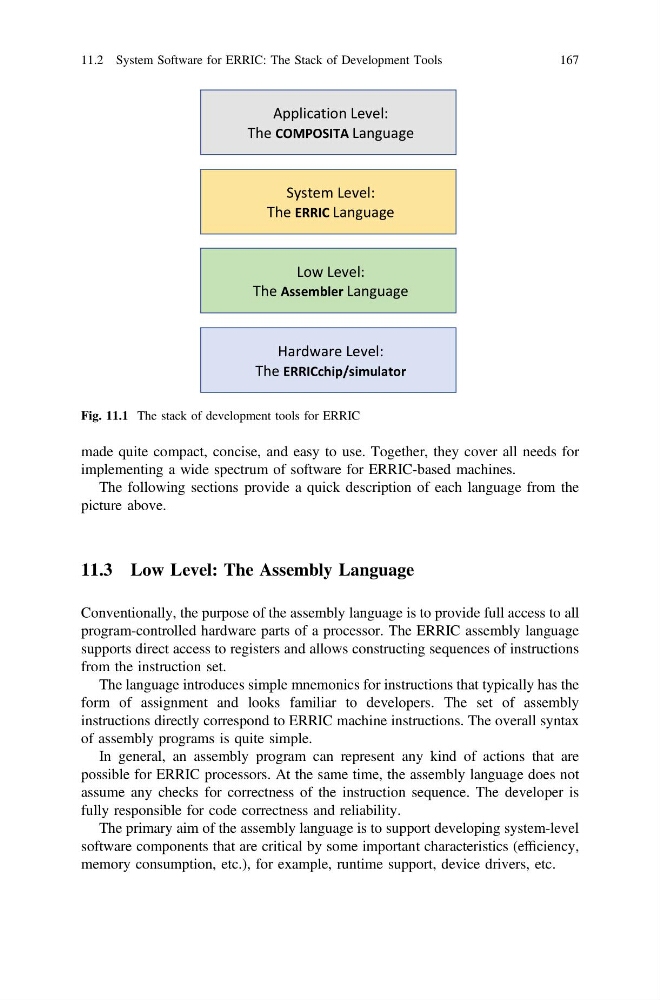
made quite compact, concise, and easy to use. Together, they cover all needs for
implementing a wide spectrum of software for ERRIC-based machines.
The following sections provide a quick description of each language from the
picture above.
11.3 Low Level: The Assembly Language
Conventionally, the purpose of the assembly language is to provide full access to all
program-controlled hardware parts of a processor. The ERRIC assembly language
supports direct access to registers and allows constructing sequences of instructions
from the instruction set.
The language introduces simple mnemonics for instructions that typically has the
form of assignment and looks familiar to developers. The set of assembly
instructions directly correspond to ERRIC machine instructions. The overall syntax
of assembly programs is quite simple.
In general, an assembly program can represent any kind of actions that are
possible for ERRIC processors. At the same time, the assembly language does not
assume any checks for correctness of the instruction sequence. The developer is
fully responsible for code correctness and reliability.
The primary aim of the assembly language is to support developing system-level
software components that are critical by some important characteristics (efficiency,
memory consumption, etc.), for example, runtime support, device drivers, etc.
Application Level:
The COMPOSITA Language
System Level:
The ERRIC Language
Low Level:
The Assembler Language
Hardware Level:
The ERRICchip/simulator
Fig. 11.1 The stack of development tools for ERRIC
11.2 System Software for ERRIC: The Stack of Development Tools
167
implementing a wide spectrum of software for ERRIC-based machines.
The following sections provide a quick description of each language from the
picture above.
11.3 Low Level: The Assembly Language
Conventionally, the purpose of the assembly language is to provide full access to all
program-controlled hardware parts of a processor. The ERRIC assembly language
supports direct access to registers and allows constructing sequences of instructions
from the instruction set.
The language introduces simple mnemonics for instructions that typically has the
form of assignment and looks familiar to developers. The set of assembly
instructions directly correspond to ERRIC machine instructions. The overall syntax
of assembly programs is quite simple.
In general, an assembly program can represent any kind of actions that are
possible for ERRIC processors. At the same time, the assembly language does not
assume any checks for correctness of the instruction sequence. The developer is
fully responsible for code correctness and reliability.
The primary aim of the assembly language is to support developing system-level
software components that are critical by some important characteristics (efficiency,
memory consumption, etc.), for example, runtime support, device drivers, etc.
Application Level:
The COMPOSITA Language
System Level:
The ERRIC Language
Low Level:
The Assembler Language
Hardware Level:
The ERRICchip/simulator
Fig. 11.1 The stack of development tools for ERRIC
11.2 System Software for ERRIC: The Stack of Development Tools
167