

system and use the BIST (Built-In Self-Test) procedures to thoroughly analyze the
system at boot up time.
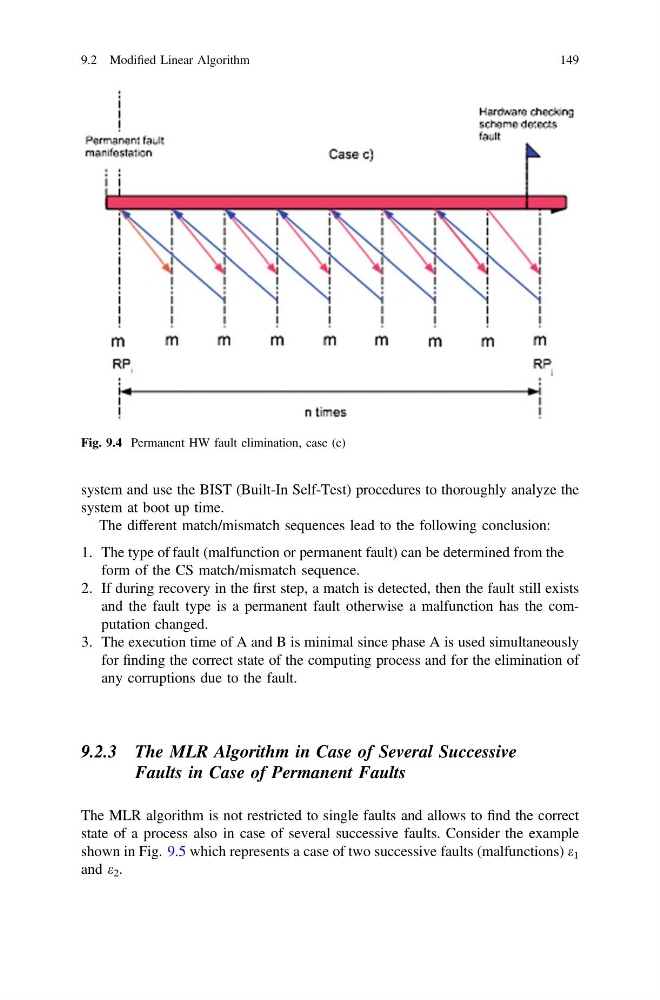
The different match/mismatch sequences lead to the following conclusion:
1. The type of fault (malfunction or permanent fault) can be determined from the
form of the CS match/mismatch sequence.
2. If during recovery in the first step, a match is detected, then the fault still exists
and the fault type is a permanent fault otherwise a malfunction has the computation changed.
3. The execution time of A and B is minimal since phase A is used simultaneously
for finding the correct state of the computing process and for the elimination of
any corruptions due to the fault.
9.2.3 The MLR Algorithm in Case of Several Successive
Faults in Case of Permanent Faults
The MLR algorithm is not restricted to single faults and allows to find the correct
state of a process also in case of several successive faults. Consider the example
shown in Fig. 9.5 which represents a case of two successive faults (malfunctions) e 1
and e 2 .
Fig. 9.4 Permanent HW fault elimination, case (c)
9.2 Modified Linear Algorithm
149
system at boot up time.
The different match/mismatch sequences lead to the following conclusion:
1. The type of fault (malfunction or permanent fault) can be determined from the
form of the CS match/mismatch sequence.
2. If during recovery in the first step, a match is detected, then the fault still exists
and the fault type is a permanent fault otherwise a malfunction has the computation changed.
3. The execution time of A and B is minimal since phase A is used simultaneously
for finding the correct state of the computing process and for the elimination of
any corruptions due to the fault.
9.2.3 The MLR Algorithm in Case of Several Successive
Faults in Case of Permanent Faults
The MLR algorithm is not restricted to single faults and allows to find the correct
state of a process also in case of several successive faults. Consider the example
shown in Fig. 9.5 which represents a case of two successive faults (malfunctions) e 1
and e 2 .
Fig. 9.4 Permanent HW fault elimination, case (c)
9.2 Modified Linear Algorithm
149