

• Is it possible to determine a correct recovery point when a permanent fault
(failure) has occurred?
• Does the MLR algorithm remain valid for the case of successively occurring
faults?
9.2.1 Characteristics of Modified Linear Recovery
Algorithm
The purpose of the modified linear recovery algorithm is the detection and elimination of hardware faults during operation, followed by a search for the last correct
program state to recover the system. The procedure for the search is explained
further down.
Concurrent to ongoing tasks, recovery points are generated together with their
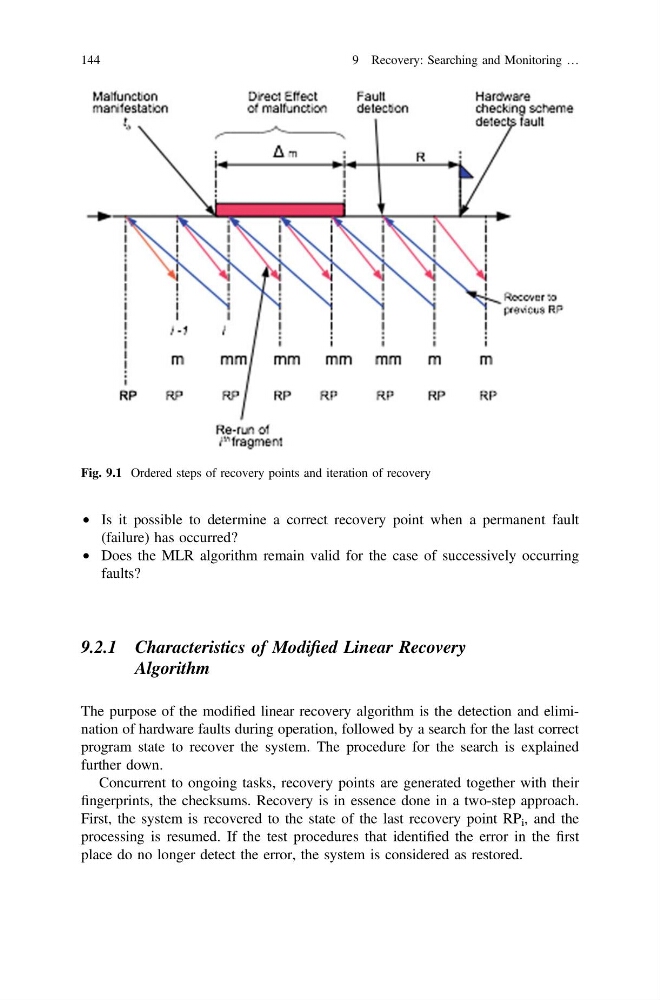
fingerprints, the checksums. Recovery is in essence done in a two-step approach.
First, the system is recovered to the state of the last recovery point RP i , and the
processing is resumed. If the test procedures that identified the error in the first
place do no longer detect the error, the system is considered as restored.
Fig. 9.1 Ordered steps of recovery points and iteration of recovery
144
9 Recovery: Searching and Monitoring …
(failure) has occurred?
• Does the MLR algorithm remain valid for the case of successively occurring
faults?
9.2.1 Characteristics of Modified Linear Recovery
Algorithm
The purpose of the modified linear recovery algorithm is the detection and elimination of hardware faults during operation, followed by a search for the last correct
program state to recover the system. The procedure for the search is explained
further down.
Concurrent to ongoing tasks, recovery points are generated together with their
fingerprints, the checksums. Recovery is in essence done in a two-step approach.
First, the system is recovered to the state of the last recovery point RP i , and the
processing is resumed. If the test procedures that identified the error in the first
place do no longer detect the error, the system is considered as restored.
Fig. 9.1 Ordered steps of recovery points and iteration of recovery
144
9 Recovery: Searching and Monitoring …