

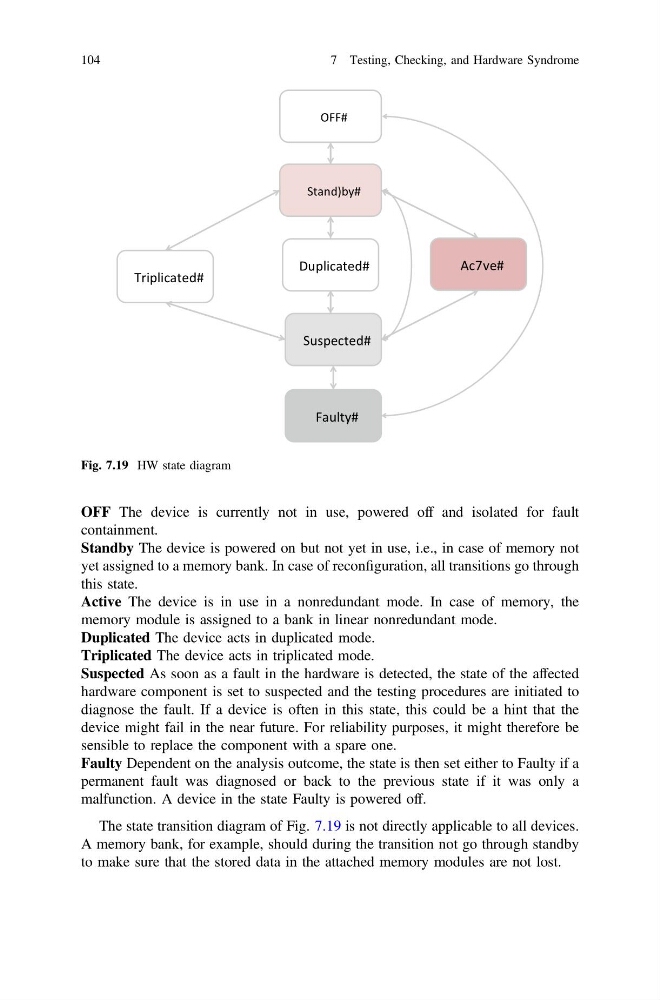
OFF The device is currently not in use, powered off and isolated for fault
containment.
Standby The device is powered on but not yet in use, i.e., in case of memory not
yet assigned to a memory bank. In case of reconfiguration, all transitions go through
this state.
Active The device is in use in a nonredundant mode. In case of memory, the
memory module is assigned to a bank in linear nonredundant mode.
Duplicated The device acts in duplicated mode.
Triplicated The device acts in triplicated mode.
Suspected As soon as a fault in the hardware is detected, the state of the affected
hardware component is set to suspected and the testing procedures are initiated to
diagnose the fault. If a device is often in this state, this could be a hint that the
device might fail in the near future. For reliability purposes, it might therefore be
sensible to replace the component with a spare one.
Faulty Dependent on the analysis outcome, the state is then set either to Faulty if a
permanent fault was diagnosed or back to the previous state if it was only a
malfunction. A device in the state Faulty is powered off.
The state transition diagram of Fig. 7.19 is not directly applicable to all devices.
A memory bank, for example, should during the transition not go through standby
to make sure that the stored data in the attached memory modules are not lost.
OFF#
Stand)by#
Triplicated#
Duplicated#
Suspected#
Faulty#
Ac7ve#
Fig. 7.19 HW state diagram
104
7 Testing, Checking, and Hardware Syndrome
containment.
Standby The device is powered on but not yet in use, i.e., in case of memory not
yet assigned to a memory bank. In case of reconfiguration, all transitions go through
this state.
Active The device is in use in a nonredundant mode. In case of memory, the
memory module is assigned to a bank in linear nonredundant mode.
Duplicated The device acts in duplicated mode.
Triplicated The device acts in triplicated mode.
Suspected As soon as a fault in the hardware is detected, the state of the affected
hardware component is set to suspected and the testing procedures are initiated to
diagnose the fault. If a device is often in this state, this could be a hint that the
device might fail in the near future. For reliability purposes, it might therefore be
sensible to replace the component with a spare one.
Faulty Dependent on the analysis outcome, the state is then set either to Faulty if a
permanent fault was diagnosed or back to the previous state if it was only a
malfunction. A device in the state Faulty is powered off.
The state transition diagram of Fig. 7.19 is not directly applicable to all devices.
A memory bank, for example, should during the transition not go through standby
to make sure that the stored data in the attached memory modules are not lost.
OFF#
Stand)by#
Triplicated#
Duplicated#
Suspected#
Faulty#
Ac7ve#
Fig. 7.19 HW state diagram
104
7 Testing, Checking, and Hardware Syndrome