

58
4 Life Evolves
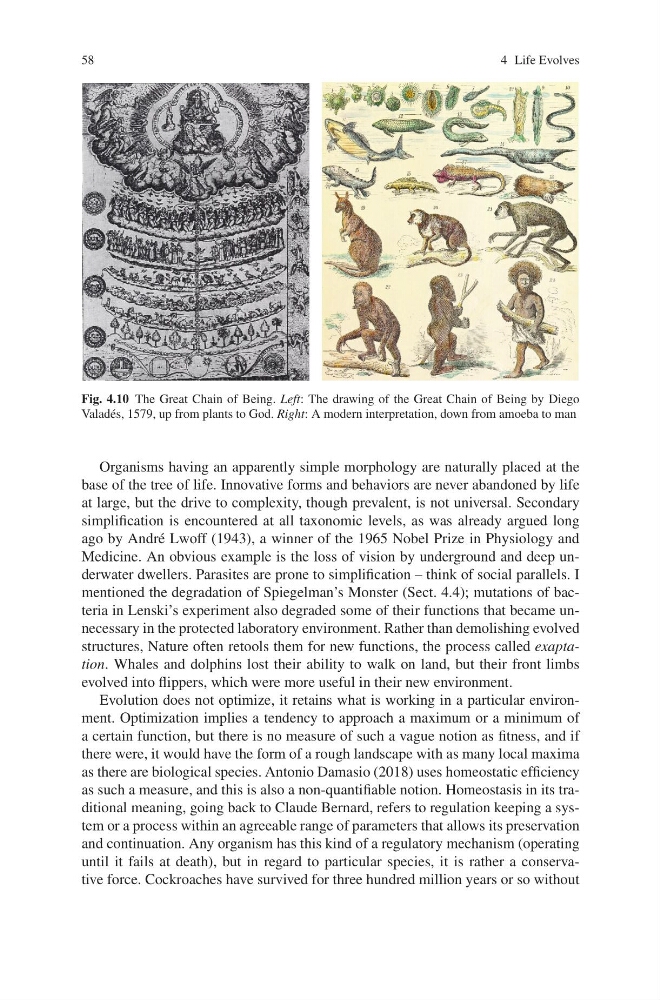
Fig. 4.10 The Great Chain of Being. Left: The drawing of the Great Chain of Being by Diego
Valad´ es, 1579, up from plants to God. Right: A modern interpretation, down from amoeba to man
Organisms having an apparently simple morphology are naturally placed at the
base of the tree of life. Innovative forms and behaviors are never abandoned by life
at large, but the drive to complexity, though prevalent, is not universal. Secondary
simplification is encountered at all taxonomic levels, as was already argued long
ago by Andr´ e Lwoff (1943), a winner of the 1965 Nobel Prize in Physiology and
Medicine. An obvious example is the loss of vision by underground and deep underwater dwellers. Parasites are prone to simplification – think of social parallels. I
mentioned the degradation of Spiegelman’s Monster (Sect. 4.4); mutations of bacteria in Lenski’s experiment also degraded some of their functions that became unnecessary in the protected laboratory environment. Rather than demolishing evolved
structures, Nature often retools them for new functions, the process called exaptation. Whales and dolphins lost their ability to walk on land, but their front limbs
evolved into flippers, which were more useful in their new environment.
Evolution does not optimize, it retains what is working in a particular environment. Optimization implies a tendency to approach a maximum or a minimum of
a certain function, but there is no measure of such a vague notion as fitness, and if
there were, it would have the form of a rough landscape with as many local maxima
as there are biological species. Antonio Damasio (2018) uses homeostatic efficiency
as such a measure, and this is also a non-quantifiable notion. Homeostasis in its traditional meaning, going back to Claude Bernard, refers to regulation keeping a system or a process within an agreeable range of parameters that allows its preservation
and continuation. Any organism has this kind of a regulatory mechanism (operating
until it fails at death), but in regard to particular species, it is rather a conservative force. Cockroaches have survived for three hundred million years or so without
4 Life Evolves
Fig. 4.10 The Great Chain of Being. Left: The drawing of the Great Chain of Being by Diego
Valad´ es, 1579, up from plants to God. Right: A modern interpretation, down from amoeba to man
Organisms having an apparently simple morphology are naturally placed at the
base of the tree of life. Innovative forms and behaviors are never abandoned by life
at large, but the drive to complexity, though prevalent, is not universal. Secondary
simplification is encountered at all taxonomic levels, as was already argued long
ago by Andr´ e Lwoff (1943), a winner of the 1965 Nobel Prize in Physiology and
Medicine. An obvious example is the loss of vision by underground and deep underwater dwellers. Parasites are prone to simplification – think of social parallels. I
mentioned the degradation of Spiegelman’s Monster (Sect. 4.4); mutations of bacteria in Lenski’s experiment also degraded some of their functions that became unnecessary in the protected laboratory environment. Rather than demolishing evolved
structures, Nature often retools them for new functions, the process called exaptation. Whales and dolphins lost their ability to walk on land, but their front limbs
evolved into flippers, which were more useful in their new environment.
Evolution does not optimize, it retains what is working in a particular environment. Optimization implies a tendency to approach a maximum or a minimum of
a certain function, but there is no measure of such a vague notion as fitness, and if
there were, it would have the form of a rough landscape with as many local maxima
as there are biological species. Antonio Damasio (2018) uses homeostatic efficiency
as such a measure, and this is also a non-quantifiable notion. Homeostasis in its traditional meaning, going back to Claude Bernard, refers to regulation keeping a system or a process within an agreeable range of parameters that allows its preservation
and continuation. Any organism has this kind of a regulatory mechanism (operating
until it fails at death), but in regard to particular species, it is rather a conservative force. Cockroaches have survived for three hundred million years or so without