

4.4 Cells Are Sine Qua Non
53
soap is a substance of this kind; we use it to catch fatty grime and wash it away
in running water. The proper name for these molecules is surfactants. They tend to
aggregate on the water surface, sticking their tails into the air, or to form micelles
(Fig. 4.6), exposing their hydrophilic heads to water and hiding their hydrophobic
tails inside.
A particular class of surfactants building up cell membranes are lipids. It would
be natural (meaning, thermodynamically advantageous, i.e., reducing the overall
free energy) for all kinds of organic admixtures in either a “soup” or an adsorbed
layer to concentrate within micelles; their shell would expand, turning a primitive
membrane into the bounding wall of the emerging chemical reactor, enclosing what
would eventually become a primitive cell. It has also been shown (Hanczyc, 2003)
that clay which catalyzes the synthesis of RNA also stimulates the formation of fatty
acid vesicles. This links the origin of cells to the hypothesis that life originated in
adsorbed layers (Sect. 4.2) rather than in a “warm pond”. Some trapped chemicals
may have possessed catalytic properties, and further honed them, turning them into
the first protein enzymes. Both the envelope and the reactor would gradually evolve,
the interior matter developing its metabolic network, and the membrane learning to
be discerning, recognizing those with entry and exit visas, like a watchful border
guard.
Oparin assumed that the hardware, cells and proteins, came first. He really had
little idea of genes. Cells could somehow survive and perhaps even multiply by
division, and only later acquire a more precise and efficient replicating apparatus.
Division of fatty acid vesicles modeling primitive cells has been reproduced in the
laboratory (Szostak and Zhu, 2009). The surface area of a vesicle can be increased
rapidly by addition of surfactant molecules, but its volume would grow only slowly,
as it is limited by the permeability of the membrane and may be counteracted osmotically, depending on the balance of solute concentrations within and outside the
micelle. As the surface to volume ratio increases, the vesicle elongates, becoming
mechanically unstable and breaking into smaller vesicles. Deformation to complicated shapes and division has been reproduced in the model of a vesicle bounded
by a penetrable elastic membrane (Ruiz-Herrero et al, 2019). Zwicker et al (2017)
came up with a model for multiplying droplets that did not even include a membrane
but was based on chemical activity. An active species within the droplet degrades
into “waste”, which then leaves the droplet and is recycled in its environment with
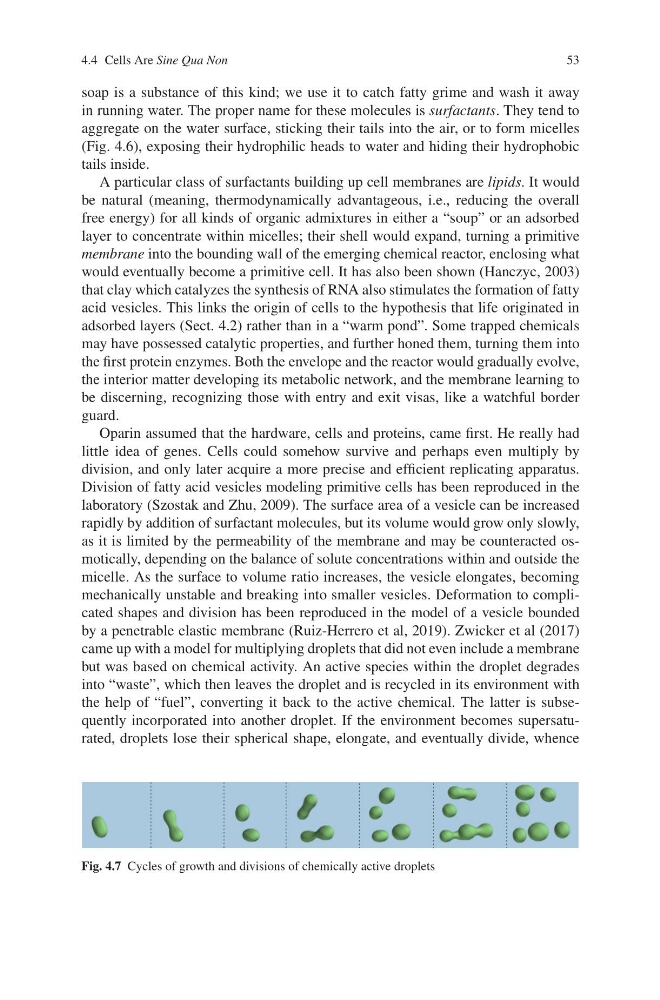
the help of “fuel”, converting it back to the active chemical. The latter is subsequently incorporated into another droplet. If the environment becomes supersaturated, droplets lose their spherical shape, elongate, and eventually divide, whence
Fig. 4.7 Cycles of growth and divisions of chemically active droplets
53
soap is a substance of this kind; we use it to catch fatty grime and wash it away
in running water. The proper name for these molecules is surfactants. They tend to
aggregate on the water surface, sticking their tails into the air, or to form micelles
(Fig. 4.6), exposing their hydrophilic heads to water and hiding their hydrophobic
tails inside.
A particular class of surfactants building up cell membranes are lipids. It would
be natural (meaning, thermodynamically advantageous, i.e., reducing the overall
free energy) for all kinds of organic admixtures in either a “soup” or an adsorbed
layer to concentrate within micelles; their shell would expand, turning a primitive
membrane into the bounding wall of the emerging chemical reactor, enclosing what
would eventually become a primitive cell. It has also been shown (Hanczyc, 2003)
that clay which catalyzes the synthesis of RNA also stimulates the formation of fatty
acid vesicles. This links the origin of cells to the hypothesis that life originated in
adsorbed layers (Sect. 4.2) rather than in a “warm pond”. Some trapped chemicals
may have possessed catalytic properties, and further honed them, turning them into
the first protein enzymes. Both the envelope and the reactor would gradually evolve,
the interior matter developing its metabolic network, and the membrane learning to
be discerning, recognizing those with entry and exit visas, like a watchful border
guard.
Oparin assumed that the hardware, cells and proteins, came first. He really had
little idea of genes. Cells could somehow survive and perhaps even multiply by
division, and only later acquire a more precise and efficient replicating apparatus.
Division of fatty acid vesicles modeling primitive cells has been reproduced in the
laboratory (Szostak and Zhu, 2009). The surface area of a vesicle can be increased
rapidly by addition of surfactant molecules, but its volume would grow only slowly,
as it is limited by the permeability of the membrane and may be counteracted osmotically, depending on the balance of solute concentrations within and outside the
micelle. As the surface to volume ratio increases, the vesicle elongates, becoming
mechanically unstable and breaking into smaller vesicles. Deformation to complicated shapes and division has been reproduced in the model of a vesicle bounded
by a penetrable elastic membrane (Ruiz-Herrero et al, 2019). Zwicker et al (2017)
came up with a model for multiplying droplets that did not even include a membrane
but was based on chemical activity. An active species within the droplet degrades
into “waste”, which then leaves the droplet and is recycled in its environment with
the help of “fuel”, converting it back to the active chemical. The latter is subsequently incorporated into another droplet. If the environment becomes supersaturated, droplets lose their spherical shape, elongate, and eventually divide, whence
Fig. 4.7 Cycles of growth and divisions of chemically active droplets